

Brazil’s horizontal condominium sector grew by more than 22% in lot launches between 2023 and 2025, with the vast majority of that growth occurring not in São Paulo or Rio de Janeiro, but in mid-sized interior cities with populations between 100,000 and 500,000 people [1]. That single statistic reframes the entire Brazilian real estate conversation. The story of master-planned communities and gated condominiums in Brazil’s interior: designing self-contained neighborhoods for the new middle class is no longer a niche subplot, it is the central chapter of the country’s residential development boom in 2026.
Families in cities like Piracicaba, Campo Grande, Ribeirão Preto, and Uberlândia are upgrading out of dense central neighborhoods and informal settlements into purpose-built, security-controlled communities that offer parks, sports clubs, and retail, all within a single perimeter fence. Developers who understand this shift are capturing extraordinary demand. Those who ignore it are watching inventory sit unsold in markets that no longer reflect where buyers actually want to live.
Key Takeaways
- Brazil’s interior cities are the primary engine of horizontal condominium growth in 2026, driven by a rising new middle class seeking security, amenity-rich living, and land ownership.
- Self-contained master-planned communities now routinely include clubhouses, sports courts, walking trails, and mixed-use commercial zones, moving far beyond simple lot subdivisions.
- Federal housing policy under the expanded Minha Casa Minha Vida program now explicitly targets the new middle class, unlocking mortgage credit for gated product in secondary cities [3].
- Phased development strategies allow developers to manage capital exposure while delivering amenities progressively, maintaining buyer confidence across multi-year buildouts.
- Shrinking lot inventory in established interior markets is creating price appreciation pressure, making early-phase entry a compelling strategy for investors and end-users alike [2].
Why Brazil’s Interior Is the New Frontier for Gated Living
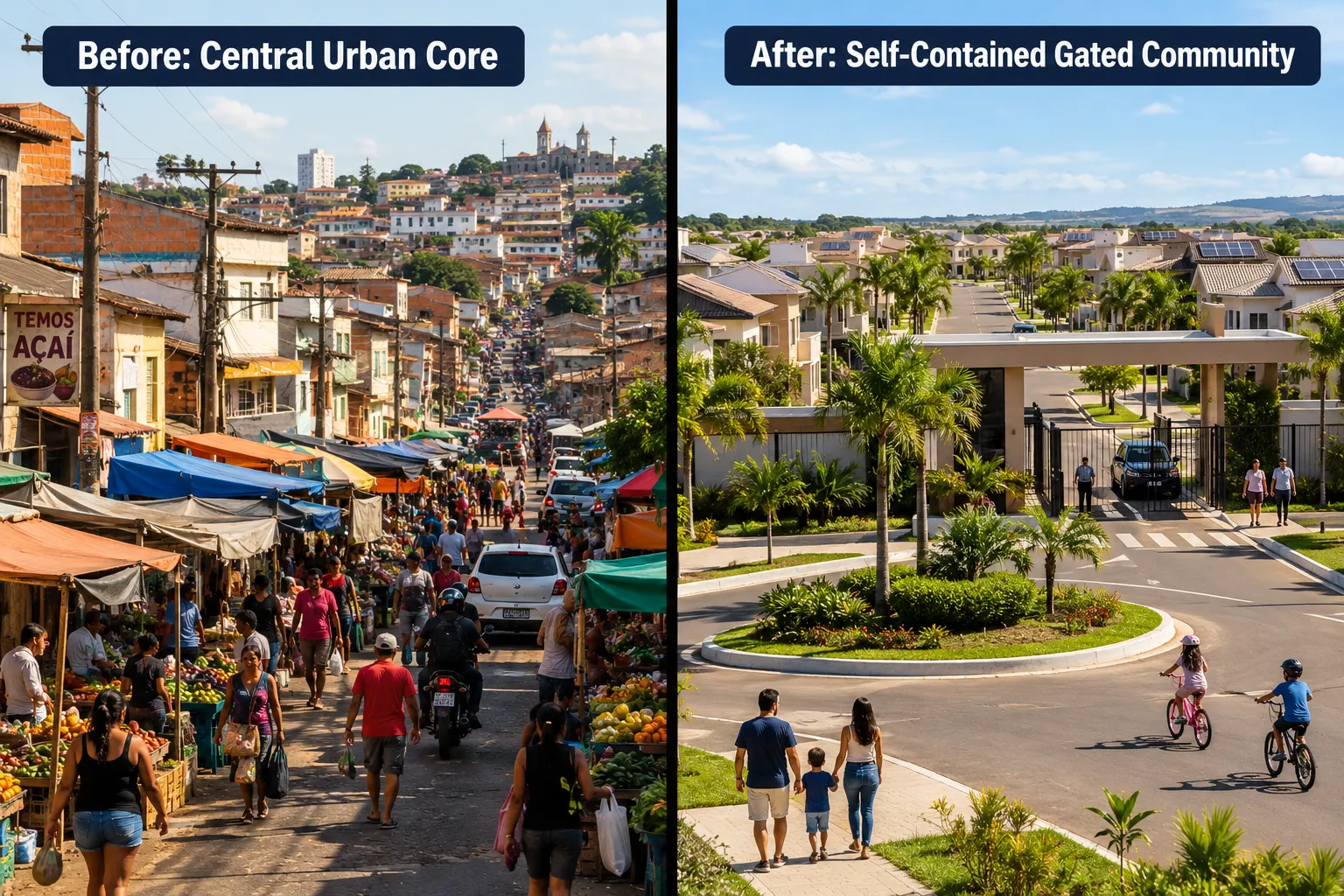
The interiorization of Brazil’s real estate market has been building for over a decade, but 2026 marks the point at which it has become structurally dominant. According to data tracked by the GRI Institute, loteamentos, Brazil’s legal framework for planned lot subdivisions, now account for the majority of new residential launches in cities outside the state capitals [2]. This is not a temporary trend driven by pandemic-era migration. It reflects a permanent reconfiguration of where Brazil’s expanding middle class chooses to live.
Several forces are converging at once. Land costs in interior cities remain a fraction of metropolitan equivalents, allowing developers to offer larger lots, often between 200 and 600 square meters, at prices that urban apartments cannot match. Infrastructure investment by state and federal governments in roads, sanitation, and broadband connectivity has made interior locations genuinely livable for families who previously felt anchored to capital cities for career reasons. The rise of remote work amenities in Brazilian urban properties has further loosened the geographic constraints on professional workers, allowing them to prioritize quality of life over proximity to a central business district.
The result is a buyer profile that developers must understand precisely. The new middle class in Brazil’s interior is not the traditional upper-middle segment that has historically purchased luxury condominiums. These are families with household incomes between R$6,000 and R$20,000 per month, salaried workers, small business owners, public servants, and agricultural sector professionals, who are making their first or second formal real estate purchase and prioritizing safety, green space, and community infrastructure over prestige addresses.
Key demand drivers in interior markets:
- Rising crime rates in dense urban cores pushing families toward perimeter-controlled environments
- Desire for land ownership as a wealth-building and lifestyle asset
- Access to leisure infrastructure (pools, sports courts, playgrounds) that apartments rarely provide at this price point
- School-age children as a primary motivation for neighborhood quality
- Availability of mortgage credit under expanded federal programs [3]
The Anatomy of a Self-Contained Gated Community in 2026
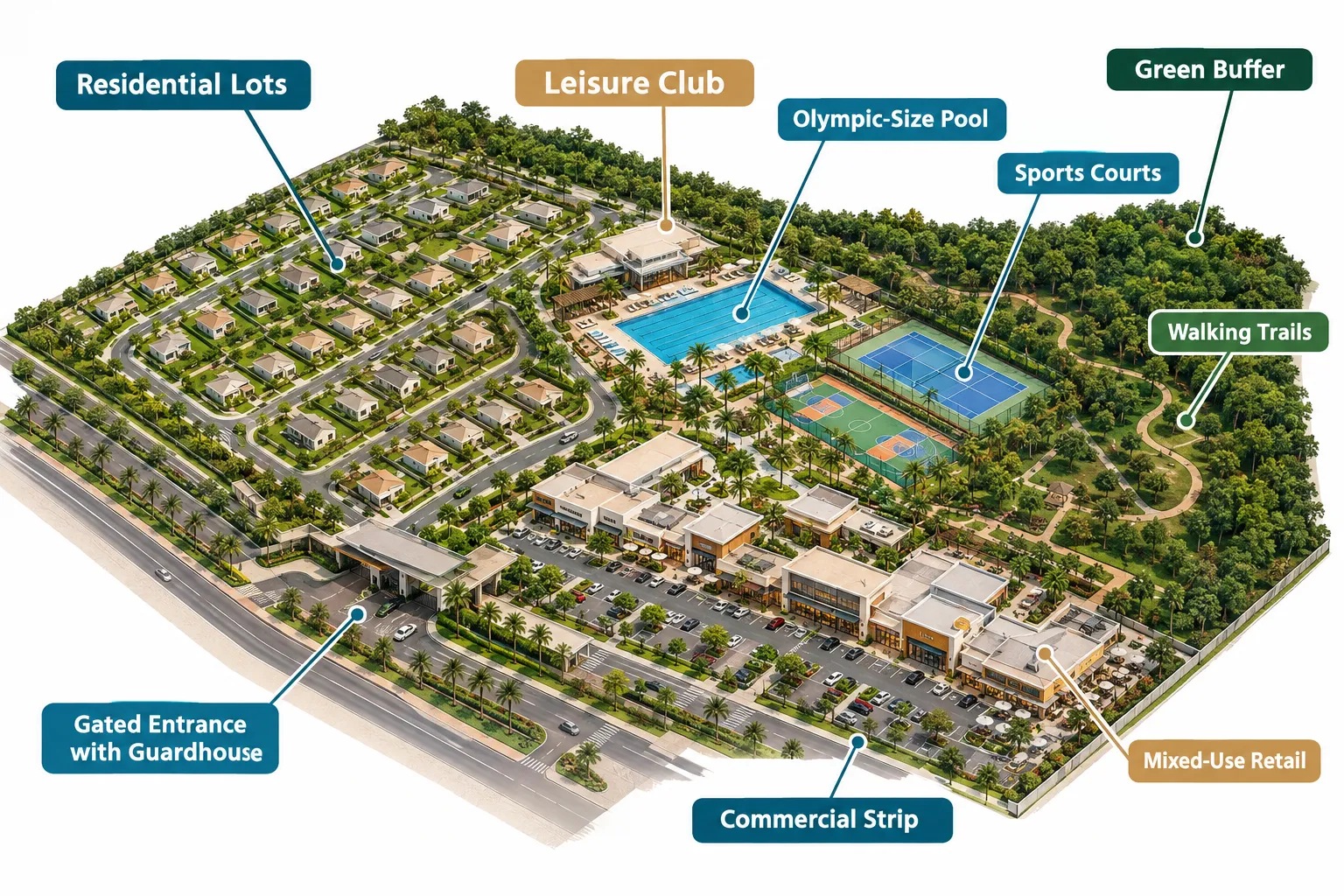
The term “gated condominium” covers a wide spectrum in Brazil’s interior market. At one end sits the simple loteamento fechado, a subdivided lot development enclosed by a perimeter wall with a single guardhouse. At the other end sits the fully realized master-planned community, a development that functions as a small town in its own right, with its own commercial zone, schools, medical facilities, and extensive leisure programming.
The most competitive products launching in 2026 sit firmly toward the master-planned end of that spectrum. A well-documented example is the TerraAmérica development in Piracicaba, São Paulo state, launched by THCM Loteadora. This project features a complete leisure program including sports courts, a clubhouse, walking and cycling trails, and landscaped common areas, all within a secured perimeter [9]. The Piracicaba market is representative of a broader pattern across interior São Paulo, where high-standard condominiums are advancing rapidly in cities surrounding the capital [5].
In Campo Grande, Mato Grosso do Sul, pre-launch offerings for the Artesano development are targeting lots between 455 and 599 square meters in the Jardim Veraneio district, with pricing and product specifications designed explicitly for families upgrading from central urban locations [8]. This pattern, mid-sized lots, complete leisure infrastructure, and a clear new-middle-class buyer profile, is being replicated across interior states from Minas Gerais to Goiás to Paraná.
Core Amenity Components That Drive Absorption
Developers who have studied absorption rates across interior markets consistently identify the following amenity categories as decisive purchase motivators:
| Amenity Category | Buyer Priority Rank | Notes |
|---|---|---|
| Perimeter security and access control | 1 | Guardhouse, cameras, controlled entry |
| Swimming pool and wet leisure | 2 | Family pools outperform lap pools |
| Sports courts (society football, tennis) | 3 | Society football courts are highest demand |
| Children’s play areas | 4 | Critical for families with school-age children |
| Walking and cycling trails | 5 | Increasingly standard in new launches |
| Clubhouse / social events space | 6 | Drives community cohesion and resale value |
| Commercial strip or convenience retail | 7 | Differentiates master-planned from simple loteamentos |
The commercial component deserves special attention. Projects that incorporate a small commercial zone, a pharmacy, a bakery, a convenience store, a medical clinic, within or immediately adjacent to the perimeter create a genuine self-sufficiency that resonates powerfully with buyers who are consciously moving away from urban dependency. The Costa Nova and Costa Mare formats, which blend residential lots with mixed-use amenity hubs, represent this model at scale [2].
“The buyer is not just purchasing a lot. They are purchasing a lifestyle system, security, leisure, community, and convenience bundled into a single monthly condominium fee.”
Phasing, Pricing, and the Capital Stack for Interior Masterplans
The financial architecture of a large-scale master-planned community in Brazil’s interior is fundamentally different from a standard vertical condominium launch. The land areas involved are substantial, projects with VGVs (Valor Geral de Vendas) running into the billions of reais are no longer exceptional in the interior market [7]. The Lore Development Group’s Brazilian portfolio, for instance, includes large-scale masterplan projects in interior locations with multi-phase delivery structures designed to manage capital exposure across development cycles [7].
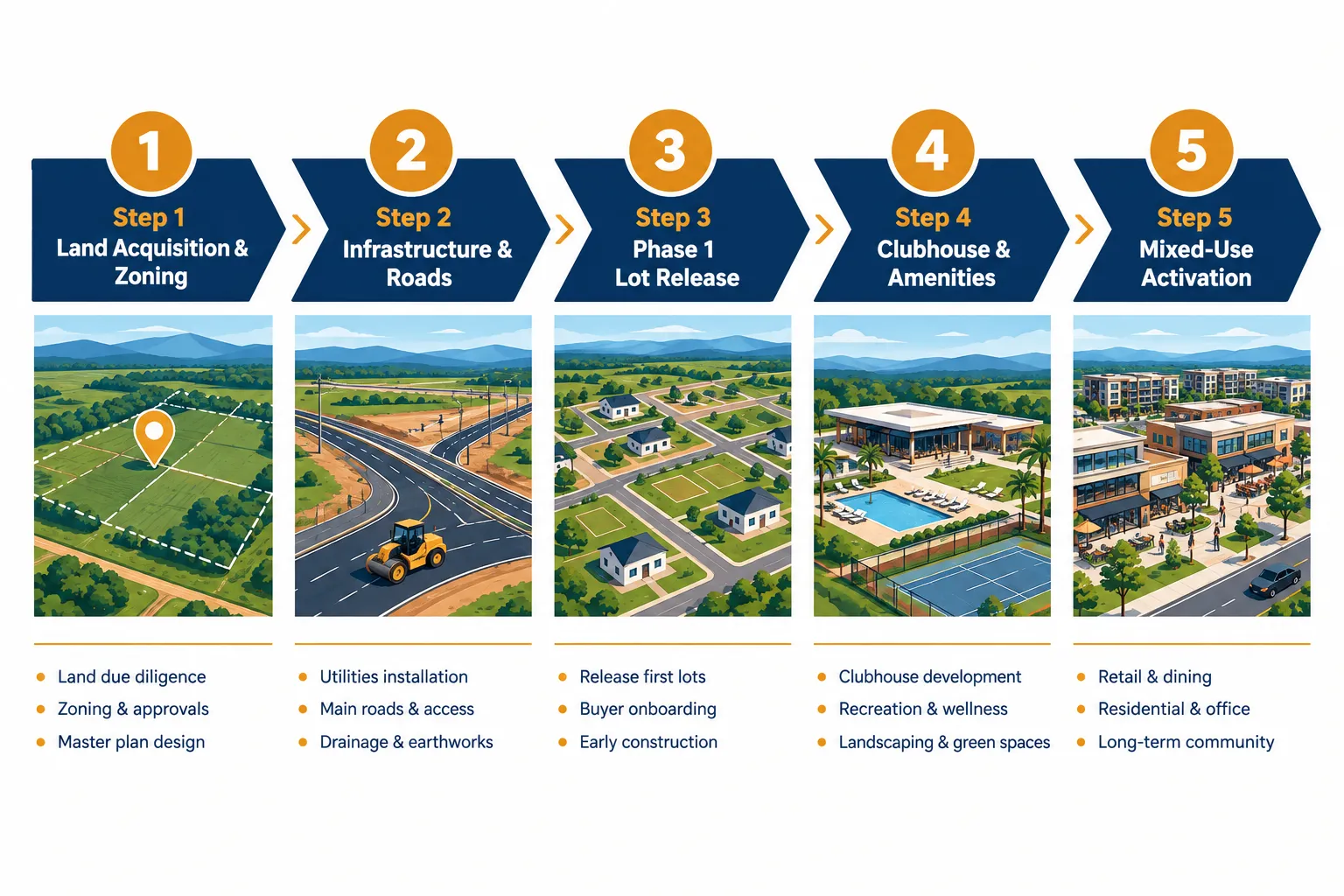
This scale requires a disciplined phasing strategy. The most successful developers in this segment follow a sequenced approach:
Phase 1, Infrastructure and first lot release: Roads, drainage, utilities, and the perimeter wall are installed. The first tranche of lots, typically the most affordable units positioned to generate rapid absorption and cash flow, is released. The guardhouse and basic access control are operational.
Phase 2, Clubhouse and primary leisure delivery: The swimming pool, sports courts, and clubhouse are completed. This phase is critical because it converts a construction site into a livable community and dramatically improves the perceived value of remaining inventory.
Phase 3, Remaining lot releases and commercial activation: Later phases release premium lots (larger, better-positioned, or with elevated views) at higher price points. Commercial zones are activated as resident population reaches critical mass.
Phase 4, Community maturation: Schools, medical facilities, or additional retail are added as the development reaches full occupancy. Condominium governance structures are transferred to resident associations.
This phased model serves multiple strategic purposes. It allows developers to use early-phase cash flows to fund later-phase construction, reducing dependence on construction finance. It creates a visible progress narrative that maintains buyer confidence. And it enables price escalation across phases, a practice well-documented in the interior market, where lot prices in established gated communities have appreciated significantly between 2020 and 2025 as available inventory has shrunk [2].
The Price Gap and Its Implications
One of the most important dynamics in the interior gated market is the pricing relationship between open loteamentos and closed condominiums. Historically, gated products commanded a 30-50% premium over equivalent open lots in the same city. Recent data suggests this gap has been narrowing as supply of gated product has increased, but the premium remains structurally justified by the security, amenity, and community governance components that closed products deliver [1].
For investors, this dynamic creates a clear entry logic: purchasing lots in the early phases of a well-designed master-planned community in an interior city with strong demographic fundamentals offers both rental income potential (from lot leasing to builders) and capital appreciation as the community matures and available inventory decreases. The secondary cities housing boom driven by MCMV development plays in inland Brazil is amplifying this dynamic by bringing mortgage-eligible buyers into markets that previously lacked formal credit infrastructure.
Federal Policy as a Demand Accelerator
The role of federal housing policy in enabling the new middle class to access gated condominium products cannot be overstated. The Minha Casa Minha Vida program’s expansion in April 2026, which raised the income ceiling and property value limits for subsidized and semi-subsidized mortgage credit, has directly expanded the pool of buyers who can finance lot purchases in interior gated communities [3]. This policy shift explicitly targets households that sit above the traditional social housing threshold but below the income levels historically served by private mortgage markets.
For developers, this means that a product designed for the R$8,000, R$15,000 monthly household income segment now has access to structured mortgage financing that was previously unavailable. The practical effect is a significant reduction in the sales cycle and an improvement in buyer qualification rates. Developers who have aligned their product specifications and pricing to the new MCMV parameters are reporting faster absorption and lower default rates on installment sales.
The housing credit expansion and policy changes reshaping Brazil’s regional mortgage market have made previously marginal projects in smaller interior cities financially viable for the first time. Cities with populations as low as 80,000 are now seeing formal gated lot launches where informal subdivisions previously dominated [6].
This policy tailwind intersects with a broader institutional capital trend. Institutional investors, FIIs (Fundos de Investimento Imobiliário) and private equity vehicles, are increasing their exposure to the loteamentos sector, attracted by the combination of strong absorption data, inflation-linked returns, and the structural undersupply of quality gated product in interior markets [4]. The entry of institutional capital is professionalizing the sector, raising design standards, and improving the governance structures of master-planned communities.
Design Principles That Define Competitive Products
Beyond amenity lists and pricing strategies, the master-planned communities gaining the strongest market positions in Brazil’s interior share a set of design principles that distinguish them from commodity loteamentos.
Security as architecture, not afterthought. The most successful projects integrate security into the spatial design from the master plan stage. Single-entry points with guardhouses, internal road layouts that discourage through-traffic, and camera coverage of all common areas create security that residents feel without it dominating the visual character of the community.
Green infrastructure as a selling asset. Interior Brazil’s climate, particularly in the cerrado and Atlantic Forest transition zones, supports lush landscaping that metropolitan developers struggle to replicate. Projects that preserve native trees, create riparian buffer zones along streams, and design walking trails through natural areas command measurable premiums and generate powerful marketing imagery. The eco-residences boom in Bahia’s interior demonstrates how sustainability-led design translates directly into price premiums.
Mobility within the perimeter. As lot sizes increase and communities grow larger, internal mobility becomes a genuine quality-of-life issue. Wide internal roads designed for pedestrian and cycling use, not just automotive traffic, signal a development philosophy that resonates with families. Some larger projects are incorporating internal electric shuttle routes for residents who cannot walk the full perimeter.
Wellness and health infrastructure. The integration of fitness facilities, outdoor exercise equipment, yoga spaces, and even small medical clinics into master-planned communities reflects a broader shift in buyer expectations. Buyers who consult the wellness-integrated real estate design guide for health-conscious buyers will recognize that this trend is not limited to luxury segments, it is now a standard expectation across the new middle class.
PropTech integration from launch. Developers using AI-driven site selection tools and VR tour platforms are achieving faster pre-sales in markets where buyers cannot physically visit a site under construction. The adoption of PropTech innovations including AI site selection and VR tours is becoming a competitive differentiator in interior markets where buyer bases are geographically dispersed.
Risks, Constraints, and What Developers Must Get Right
No market opportunity exists without execution risk. The interior gated condominium sector carries several specific challenges that developers must address directly.
Infrastructure dependency. Many interior cities lack the municipal infrastructure, water pressure, sewage capacity, road access, to support large-scale residential developments without significant developer-funded upgrades. Projects that underestimate this cost face budget overruns and delivery delays that damage buyer confidence and legal standing.
Governance and condominium management. A self-contained community is only as good as its governance. Poorly managed condominium associations, inadequate maintenance budgets, and weak enforcement of community rules can rapidly erode the premium that buyers paid for. Developers who invest in professional condominium management from handover, rather than leaving residents to organize themselves, protect their brand and their resale values.
Overbuilding in secondary markets. The rapid expansion of gated lot products across interior states carries concentration risk. Cities where multiple developers launch simultaneously can experience absorption slowdowns and price corrections. Rigorous demand analysis, population growth rates, income distribution, existing housing stock quality, and competitive supply pipeline, is essential before committing capital.
Political and fiscal risk. Brazil’s 2026 electoral cycle introduces policy uncertainty that developers with long-horizon projects must stress-test. The 2026 election year uncertainty and its implications for Brazil’s development pipeline is a relevant consideration for any project with a multi-year delivery horizon.
Conclusion
The boom in master-planned communities and gated condominiums in Brazil’s interior: designing self-contained neighborhoods for the new middle class represents one of the most durable structural opportunities in Brazilian real estate in 2026. It is grounded in genuine demographic demand, supported by federal policy, and amplified by the interiorization of economic activity and remote work flexibility.
For developers, the actionable priorities are clear:
- Target secondary cities with strong demographic fundamentals, population growth above 1.5% annually, rising formal employment, and existing demand for quality housing that the current stock does not satisfy.
- Design for the complete lifestyle system, not just the lot. Security, leisure, community, and convenience must be bundled into a coherent product that justifies the condominium fee.
- Phase delivery to match cash flow and buyer confidence. Release amenities progressively but deliver the clubhouse and pool before the final lot phases to protect premium pricing.
- Align product specifications with MCMV credit parameters to maximize the buyer pool and reduce sales cycle length.
- Invest in governance from day one. Professional condominium management is not an optional extra, it is a core component of the product and the brand.
The interior of Brazil is not a secondary market. For the new middle class and the developers who serve them, it is the primary one.
References
[1] Loteamentos Brasil Cidades Medias 2026 – https://nr1.lat/blog/loteamentos-brasil-cidades-medias-2026
[2] Report Loteamentos Comunidades Planejadas – https://news.griinstitute.org/pt/mercado-imobiliario/report-loteamentos-comunidades-planejadas
[3] Minha Casa Minha Vida New Rules 600k April 2026 – https://www.riotimesonline.com/minha-casa-minha-vida-new-rules-600k-april-2026/
[4] Edlp Mercado Loteamentos Brasil Absorcao Capital Institucional 2026 – https://news.griinstitute.org/pt/mercado-imobiliario/edlp-mercado-loteamentos-brasil-absorcao-capital-institucional-2026
[5] Condominios De Alto Padrao Avancam Em Cidades No Entorno De Sao Paulo – https://www1.folha.uol.com.br/mercado/2026/08/condominios-de-alto-padrao-avancam-em-cidades-no-entorno-de-sao-paulo.shtml
[6] Loteamentos Fechados – https://www.conectivaimoveis.com.br/site/loteamentos_fechados
[7] Portfolio Brasil – https://loredevelopmentgroup.com/portfolio-brasil/
[8] Pre Lancamento Artesano Campo Grande Lotes De 455 A 599 M No Jardim Veraneio – https://www.campograndenews.com.br/classificados/imoveis/pre-lancamento-artesano-campo-grande-lotes-de-455-a-599-m-no-jardim-veraneio
[9] Piracicaba Tem Um Novo Loteamento Fechado Da Loteadora Thcm Conheca O Terramerica – https://g1.globo.com/sp/piracicaba-regiao/especial-publicitario/thcm/noticia/2025/06/04/piracicaba-tem-um-novo-loteamento-fechado-da-loteadora-thcm-conheca-o-terramerica.ghtml
[10] New Housing Concept For Brazils Middle Class – https://www.vollert.de/en/media-center/press-center/detail/new-housing-concept-for-brazils-middle-class