
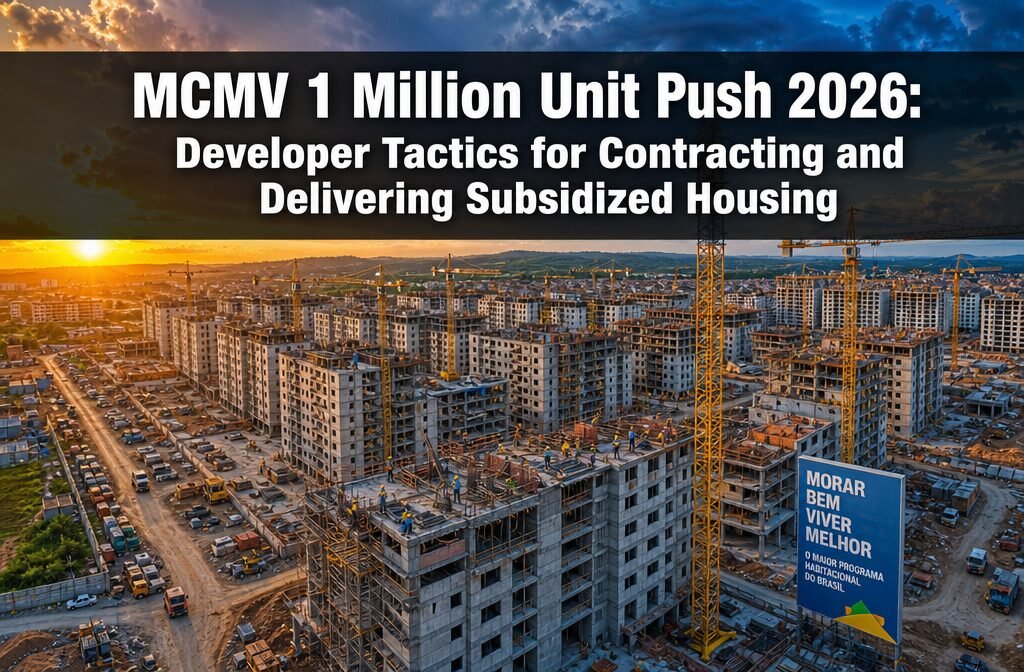
Brazil’s federal government has committed to contracting 1 million additional Minha Casa Minha Vida (MCMV) units in 2026 — a target so aggressive that it is already stress-testing the limits of construction supply chains, public financing pipelines, and developer capacity across the country. The MCMV 1 Million Unit Push 2026: Developer Tactics for Contracting and Delivering Subsidized Housing is not just a policy headline; it is a live operational challenge that separates developers who will capture government contracts from those who will be left behind. Understanding how to position, contract, and deliver at this scale — while managing Brazil’s persistently high Selic rate — is now a critical competency for every player in the subsidized housing market.
Key Takeaways 📌
- The 1-million-unit MCMV target for 2026 is heavily front-loaded, creating intense competition for contracts and severe pressure on supply chains in the first half of the year.
- Steel and aluminum sourcing strategies are a primary differentiator — developers with pre-negotiated bulk supply agreements are winning contracts faster and protecting margins.
- High Selic rates (still above 10% in 2026) require developers to use FGTS-backed financing structures and phased disbursement models to protect project economics.
- Pipeline stress-testing — modeling delayed disbursements, cost inflation, and permitting delays simultaneously — is now standard practice for serious MCMV developers [8].
- Bundled capital stacks that braid multiple subsidy programs together are emerging as the fastest path from contract to groundbreaking, mirroring tactics proven in other large housing markets [7].
The Scale of the Challenge: Why 1 Million Units Changes Everything

A million units sounds like an abstraction until you break it down into steel tonnage, concrete pours, and permitting queues. At average MCMV unit sizes, delivering one million homes requires roughly 4.5 to 5 million metric tons of concrete, hundreds of thousands of tons of structural steel, and millions of aluminum window and door frames — all sourced, transported, and installed within a compressed 12-to-24-month contracting window.
This is not hypothetical pressure. Analysis of large-scale 2026 housing programs shows that when governments front-load ambitious unit targets into a single calendar year, execution capacity becomes the binding constraint — not political will or even funding [8]. The same dynamic is visible globally: California’s affordable housing pipeline identified nearly 39,880 shovel-ready units stalled not by design or legal issues, but by incomplete capital stacks [5]. The lesson for MCMV developers is clear — being ready to build is not the same as being able to build.
What “Front-Loading” Means for Developers
When a government announces a million-unit target for a single year, contracts cluster in Q1 and Q2. This creates three simultaneous pressures:
| Pressure | Developer Impact | Tactical Response |
|---|---|---|
| Supply chain bottlenecks | Steel/aluminum prices spike 15–30% | Pre-negotiate bulk supply agreements in Q4 prior year |
| Permitting queue overload | Municipal offices slow approvals | Prioritize municipalities with faster processing records |
| Disbursement delays | Cash flow gaps emerge mid-project | Build 15–20% cost buffers into project budgets |
Developers who treat these pressures as surprises lose margin. Those who plan for them as known variables maintain profitability even in a high-Selic environment.
Supply Chain Strategies: Steel, Aluminum, and the Race to Lock In Materials
The MCMV 1 Million Unit Push 2026: Developer Tactics for Contracting and Delivering Subsidized Housing begins — operationally — at the materials procurement level. No other single factor has a greater impact on both delivery timelines and profit margins in a subsidized housing program of this scale.
Steel Sourcing: Bulk Agreements and Vertical Integration
Brazil’s domestic steel sector (led by producers like Gerdau and CSN) has historically offered volume discounts of 8–14% to developers who commit to annual purchase agreements before the contracting season opens. In 2026, with MCMV demand surging, those windows are closing faster. Smart developers are pursuing three approaches:
- Pre-season bulk purchase agreements — signed in October/November of the prior year, locking in tonnage at pre-surge pricing.
- Consortium purchasing — smaller developers pooling steel orders to hit volume thresholds that trigger industrial pricing tiers.
- Partial vertical integration — larger developers acquiring minority stakes in regional steel distributors to guarantee allocation priority.
💬 “The developer who controls their steel allocation in a million-unit year controls their delivery schedule. Everyone else is negotiating from weakness.” — Common position among MCMV project managers in 2026.
Aluminum and Finishing Materials
Aluminum is the second critical bottleneck. Window frames, door systems, and facade elements for MCMV units are heavily aluminum-dependent. Tactics that are gaining traction in 2026 include:
- Standardized unit designs that use identical aluminum specifications across all units in a development, enabling factory-scale production runs and lower per-unit costs.
- Direct manufacturer relationships with aluminum extruders, bypassing distributors entirely for projects above 500 units.
- Modular prefabrication of bathroom and kitchen pods — reducing on-site labor requirements and compressing construction timelines by 20–35%.
For developers exploring how broader real estate market trends are shaping investment strategies, the materials procurement dynamic in MCMV mirrors pressures seen across the Brazilian property sector — cost management is the defining skill of the decade.
Financing Structures and Profit Models in a High-Selic Environment

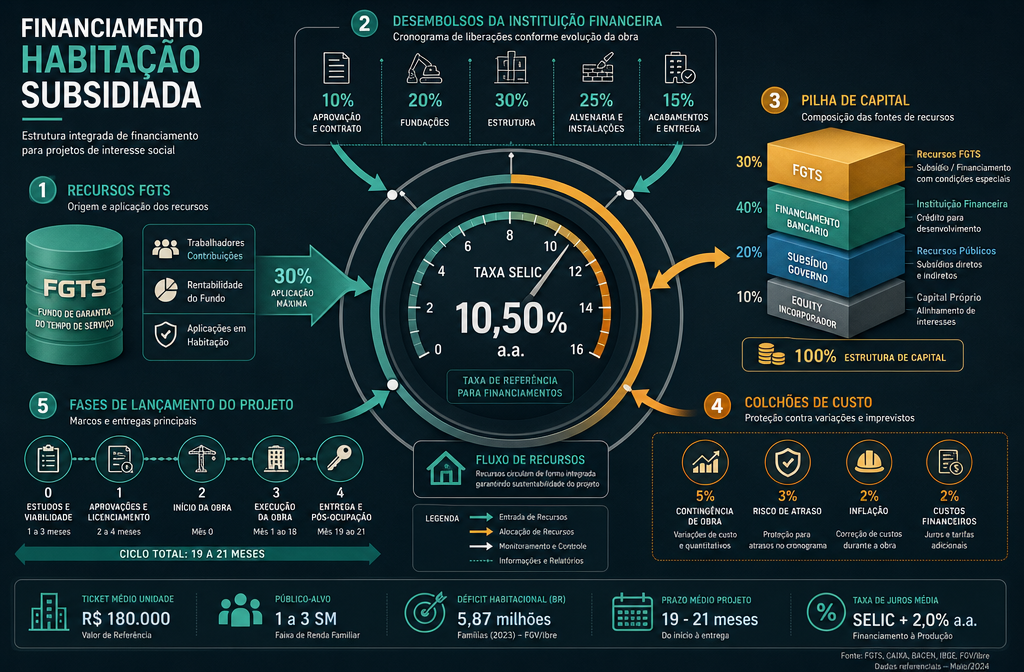
The MCMV 1 Million Unit Push 2026: Developer Tactics for Contracting and Delivering Subsidized Housing is fundamentally a financing challenge wearing a construction hat. Brazil’s Selic rate — which remained elevated well above 10% through the first half of 2026 — creates a hostile environment for any developer relying on conventional credit lines to bridge project costs.
Why FGTS-Backed Financing Is Non-Negotiable
The Fundo de Garantia do Tempo de Serviço (FGTS) is the backbone of MCMV financing, offering subsidized interest rates that are structurally insulated from Selic movements. For developers, this means:
- Buyer financing rates of 4–8.16% (depending on income bracket and region), far below market rates.
- Predictable demand — buyers who qualify for FGTS-backed mortgages are pre-qualified through a government process, reducing sales risk.
- Faster absorption — subsidized units in MCMV Faixas 1 and 2 typically sell out before construction completes, improving developer cash flow.
The critical tactical point: developers must structure their project economics around FGTS disbursement schedules, not around construction milestones. FGTS releases funds in tranches tied to verified construction progress. Developers who front-load costs (especially materials purchases) without modeling these tranches create dangerous cash flow gaps.
Stress-Testing: The New Standard Practice
Analysis of 2026 housing pipeline management confirms that leading developers are now stress-testing projects under at least three simultaneous adverse scenarios [8]:
- Budget disbursement delayed by 60–90 days beyond scheduled release dates.
- Construction cost inflation of 12–18% above baseline estimates.
- Permitting delays of 30–60 days in target municipalities.
Projects that survive all three scenarios simultaneously are considered viable for contracting. Those that fail under even one scenario are restructured before submission. This discipline — borrowed from infrastructure finance — is what separates developers who complete MCMV projects from those who abandon them mid-construction.
The Bundled Capital Stack Model
One of the most powerful tactics emerging from large subsidized housing programs globally is braiding multiple funding sources into a single, predictable capital stack. California’s 2025 streamlined finance program demonstrated this at scale, delivering over $414 million across 2,099 homes by mixing Multifamily Housing Program funds, tax credits, and local subsidies into coordinated awards [7]. Michigan’s housing board approved funding for 490 affordable housing units in a single 2026 action by similarly stacking state and federal resources [4].
For MCMV developers in Brazil, the equivalent approach involves combining:
- FGTS subsidies (primary buyer financing)
- FNHIS grants (infrastructure and land cost offsets)
- State-level housing funds (varies by state; São Paulo, Minas Gerais, and Bahia have the most active programs)
- Municipal land contributions (land swaps or discounted municipal land in exchange for unit allocation agreements)
Developers who master this multi-source approach reduce their effective cost of capital by 3–6 percentage points compared to those relying on a single program — a margin that is the difference between profit and loss in a Selic-elevated environment.
For a deeper look at how off-plan property investment can amplify returns in Brazil’s current market, the capital stack dynamics in MCMV share structural similarities with private-sector pre-sale strategies.
Contracting Tactics: Winning Government Agreements at Scale
Securing MCMV contracts in a million-unit year requires more than competitive pricing. Government procurement at this scale evaluates developers on execution credibility — the demonstrated ability to deliver what is promised, on time and on budget.
The Phased Launch Strategy
Rather than submitting proposals for maximum unit counts in a single submission, high-performing MCMV developers in 2026 are using phased launch strategies:
- Phase 1: Submit proposals for 200–400 units in a municipality with fast permitting history and confirmed land availability.
- Phase 2: Use Phase 1 contract award as proof of execution capacity to unlock larger contract opportunities in subsequent rounds.
- Phase 3: Scale to 1,000+ unit developments once supply chain relationships and municipal relationships are established.
This approach sacrifices short-term volume for long-term contract security — a rational trade-off in a program where execution failures result in contract cancellations and blacklisting from future rounds.
Permitting Prioritization
Not all Brazilian municipalities process MCMV permits at the same speed. Developers who maintain municipal permitting scorecards — tracking average approval times, common rejection reasons, and key contacts in planning departments — gain a measurable contracting advantage. Prioritizing municipalities where permits clear in 60–90 days rather than 180+ days can compress project timelines by 25–40%.
Maryland’s 2026 affordable housing plan similarly emphasizes that planning and permitting alignment between developers and government agencies is a primary driver of whether housing targets are met [1]. The principle translates directly to MCMV: developers who invest in municipal relationships before submitting proposals win more contracts and deliver faster.
Partner and Subcontractor Qualification
At million-unit scale, the quality of subcontractor networks is as important as the developer’s own capacity. Leading MCMV developers in 2026 are maintaining pre-qualified subcontractor pools — vetted for financial stability, equipment capacity, and labor force size — that can be activated within 30 days of contract award.
The lending environment in 2026 is also supporting this approach, with construction lenders increasingly offering performance-linked credit facilities that disburse based on verified subcontractor milestones rather than developer self-reporting [10]. This structure reduces lender risk and incentivizes developers to maintain high-quality subcontractor relationships.
For developers interested in how sales performance is transforming the real estate market, the discipline of partner qualification in MCMV mirrors the rigorous vendor management practices reshaping commercial real estate sales.
Delivery Execution: From Contract to Keys
Winning the contract is the beginning, not the end. Delivery execution in a million-unit program requires systems-level thinking — treating each development not as a standalone project but as a repeatable production unit within a larger portfolio.
Standardization as a Delivery Accelerator
The most efficient MCMV developers in 2026 are operating with standardized unit typologies — a limited menu of 2-bedroom and 3-bedroom designs that use identical structural systems, MEP layouts, and finishing specifications across all projects. Benefits include:
- Faster permitting (municipalities approve familiar designs more quickly)
- Bulk material purchasing (identical specifications across 10+ projects = industrial pricing)
- Labor efficiency (crews become faster with repetition; productivity improves 15–25% by the third identical project)
Technology Integration
Digital construction management tools — including BIM (Building Information Modeling), IoT-enabled site monitoring, and drone-based progress verification — are now standard in MCMV projects above 300 units. These tools serve a dual purpose: they improve delivery efficiency and they generate the verified progress documentation required for FGTS disbursement tranches.
Affordable housing development is pushing forward on technology adoption globally, with developers recognizing that digital tools pay for themselves through faster disbursement cycles and reduced rework costs [2].
Developers looking to understand how construction progress documentation affects investor confidence can explore recent project updates from active developments that demonstrate transparent progress reporting as a competitive advantage.
Conclusion: Turning the 1-Million-Unit Mandate Into a Business Opportunity
The MCMV 1 Million Unit Push 2026: Developer Tactics for Contracting and Delivering Subsidized Housing represents one of the largest single-year opportunities in Brazilian real estate history — and one of its most demanding execution challenges. The developers who will capture the most contracts and deliver the most units are not necessarily the largest; they are the most systematically prepared.
Actionable Next Steps for Developers 🎯
- Lock in steel and aluminum supply agreements immediately — pre-season bulk purchasing is the single highest-ROI preparation action available in 2026.
- Build a bundled capital stack — identify which state and municipal programs can be combined with FGTS to reduce effective financing costs by 3–6 points.
- Stress-test every project under three simultaneous adverse scenarios before submitting a contract proposal [8].
- Prioritize fast-permitting municipalities — build and maintain a permitting scorecard for every target market.
- Standardize unit designs across your portfolio to unlock bulk purchasing, faster permitting, and labor efficiency gains.
- Pre-qualify your subcontractor pool — have 3–5 vetted subcontractors per trade ready to mobilize within 30 days of contract award.
- Invest in digital progress documentation — BIM and drone verification tools pay for themselves through faster FGTS disbursements.
The million-unit target is ambitious. It will stress test every link in the subsidized housing supply chain. But for developers who prepare systematically, it is also a once-in-a-decade contracting opportunity that will define market positions for years to come.
For developers exploring where Brazil’s best property investment opportunities align with MCMV demand corridors, or those ready to discuss project partnership opportunities, connecting with experienced development teams is a logical first step toward positioning for the 2026 contracting wave.
References
[1] Draft 2026 Plan For Affordable Housing Development In Maryland Set To Guide More Than 300 Million Worth Of Critically Needed Housing – news.maryland.gov
[2] Affordable Housing Development Pushes On – multihousingnews.com
[4] Mshda Board Approves Funding For 490 Affordable Housing Units – michigan.gov
[5] California Has 40000 Affordable Housing Units Ready To Break Ground. One Setback Is Holding Them Up Calmatters 3.9.26 – selfhelpenterprises.org
[7] California Announces Funding To Create Thousands Of Affordable Homes For California Families – gov.ca.gov
[8] Election Year Fiscal Risks 2026 Stress Testing Housing Pipelines Amid Mcmv And Reforma Investments – Election year fiscal risks 2026 stress testing housing pipelines amid mcmv and reforma investments
[10] Lending Momentum Builds 2026 – housingfinance.com