
Brazil’s federal housing program has already surpassed 2 million contracted units ahead of schedule, and the government is now pushing hard to add 1 million more before the end of 2026, bringing the total to 3 million contracts within a single four-year cycle [1][5]. For developers, this is not simply a policy milestone. It is the single largest structured demand signal in the Brazilian residential market today, carrying with it record FGTS budgets, expanded subsidies, and a contracting pace that requires industrial-grade supply chain discipline to capture.
The Minha Casa Minha Vida Expansion 2026: Scaling to 1M Units and Supply Chain Strategies for Developers is the defining challenge and opportunity for any residential builder operating in Brazil this year. Understanding the program’s structure, its financing backbone, its regional priorities, and the operational pressures it creates is no longer optional for serious market participants.
Key Takeaways
- The Brazilian government has set a target of 1 million new MCMV contracts in 2026, aiming to reach 3 million total units contracted since the program’s relaunch in 2023 [1][3].
- The program’s 2026 mid-year milestone was reportedly surpassed by 60%, signaling exceptionally strong contracting momentum [10].
- Record FGTS allocations and expanded subsidies are the primary financing levers supporting this scale-up, with a particular focus on low-income families but with growing middle-income reach.
- Supply chain resilience, covering materials procurement, labor, logistics, and prefabrication, is the critical operational bottleneck for developers aiming to capture this volume.
- Election-year dynamics in 2026 create both accelerated contracting incentives and potential post-election delivery risks that developers must stress-test in their pipelines.
The Scale of Brazil’s 2026 Housing Push
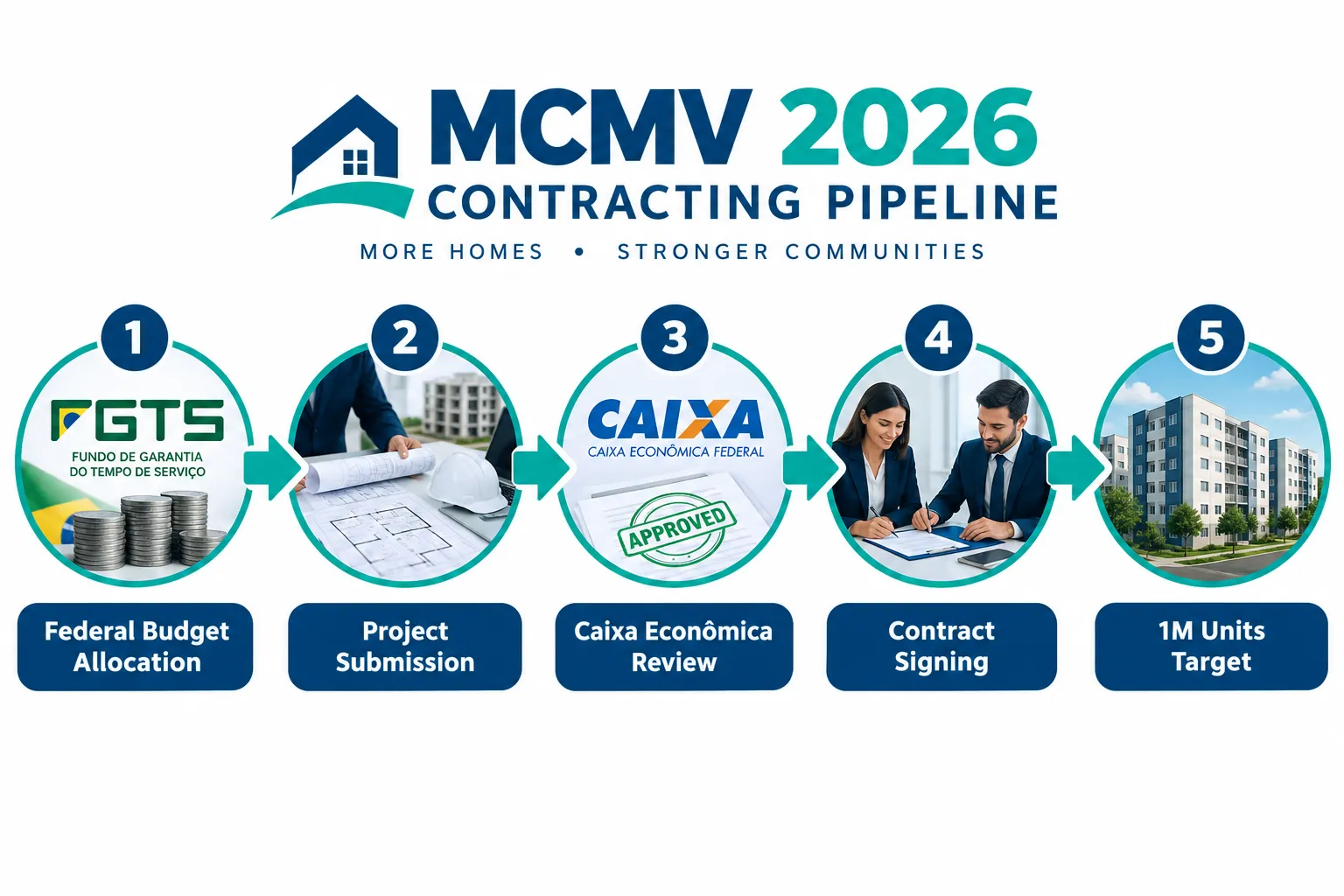
Brazil’s President Lula publicly committed to contracting 3 million homes by the end of 2026, framing the Minha Casa Minha Vida program as the centerpiece of his government’s economic and social legacy [1]. The Ministry of Cities confirmed that reaching this figure requires contracting more than 1 million additional units within 2026 alone, a target that, if met, would represent the most ambitious single-year housing contracting effort in the program’s history [4].
The numbers behind this ambition are substantial. By mid-2026, the program had already contracted over 2 million units since its relaunch under Law 14.620/2023 [5][9]. One report from Exame noted that the 2026 mid-year contracting target had been exceeded by 60%, suggesting the program’s operational machinery was running well ahead of projections [10]. The federal government announced the selection of 130,000 new units in a single batch in May 2025, illustrating the scale of individual contracting rounds [8].
Why does this matter for developers? Because MCMV is not a niche segment. It is the dominant driver of residential launches and sales volume across Brazil. In 2026, with record FGTS budgets and expanded subsidy bands, the program effectively sets the floor, and in many markets, the ceiling, for residential demand. Developers who are not positioned to participate are watching the largest demand pool in the market from the sidelines.
For a broader view of how MCMV fits within Brazil’s 2026 residential investment landscape, including the parallel Reforma Casa Brasil program, see this analysis of Minha Casa Minha Vida and Reforma Casa Brasil in 2026 unlocking R$39.8 billion for residential developers.
Program Structure and Income Segment Allocation
The relaunched MCMV operates across three income bands, with the heaviest subsidy concentration in Faixa 1 (families earning up to R$2,640/month). Faixas 2 and 3 extend eligibility to families earning up to R$8,000/month, using a combination of direct subsidies and below-market mortgage rates through Caixa Econômica Federal.
| Income Band | Monthly Income Ceiling | Primary Financing Mechanism |
|---|---|---|
| Faixa 1 | Up to R$2,640 | Direct subsidy + FGTS |
| Faixa 2 | Up to R$4,400 | Partial subsidy + FGTS mortgage |
| Faixa 3 | Up to R$8,000 | FGTS mortgage at reduced rates |
The 2026 expansion has placed particular emphasis on Faixa 1 delivery, given its social visibility in an election year. However, the expanded Faixa 2 and 3 reach has created a meaningful mid-income demand pipeline that intersects with developers’ standard product lines. Developers who have historically focused on middle-market launches are finding that MCMV-adjacent products, priced and sized to meet Faixa 2 and 3 criteria, can access program financing while maintaining healthier margin profiles.
Supply Chain Strategies for Developers Scaling to 1M Units
The Minha Casa Minha Vida Expansion 2026: Scaling to 1M Units and Supply Chain Strategies for Developers is not just a contracting story. It is fundamentally a production story. Contracting 1 million units in a single year means nothing if the construction supply chain cannot absorb the volume. For developers, the operational challenge is threefold: securing materials at scale, managing labor in a tight market, and maintaining delivery timelines in a standardized, high-volume environment.
Materials Procurement and Bulk Purchasing
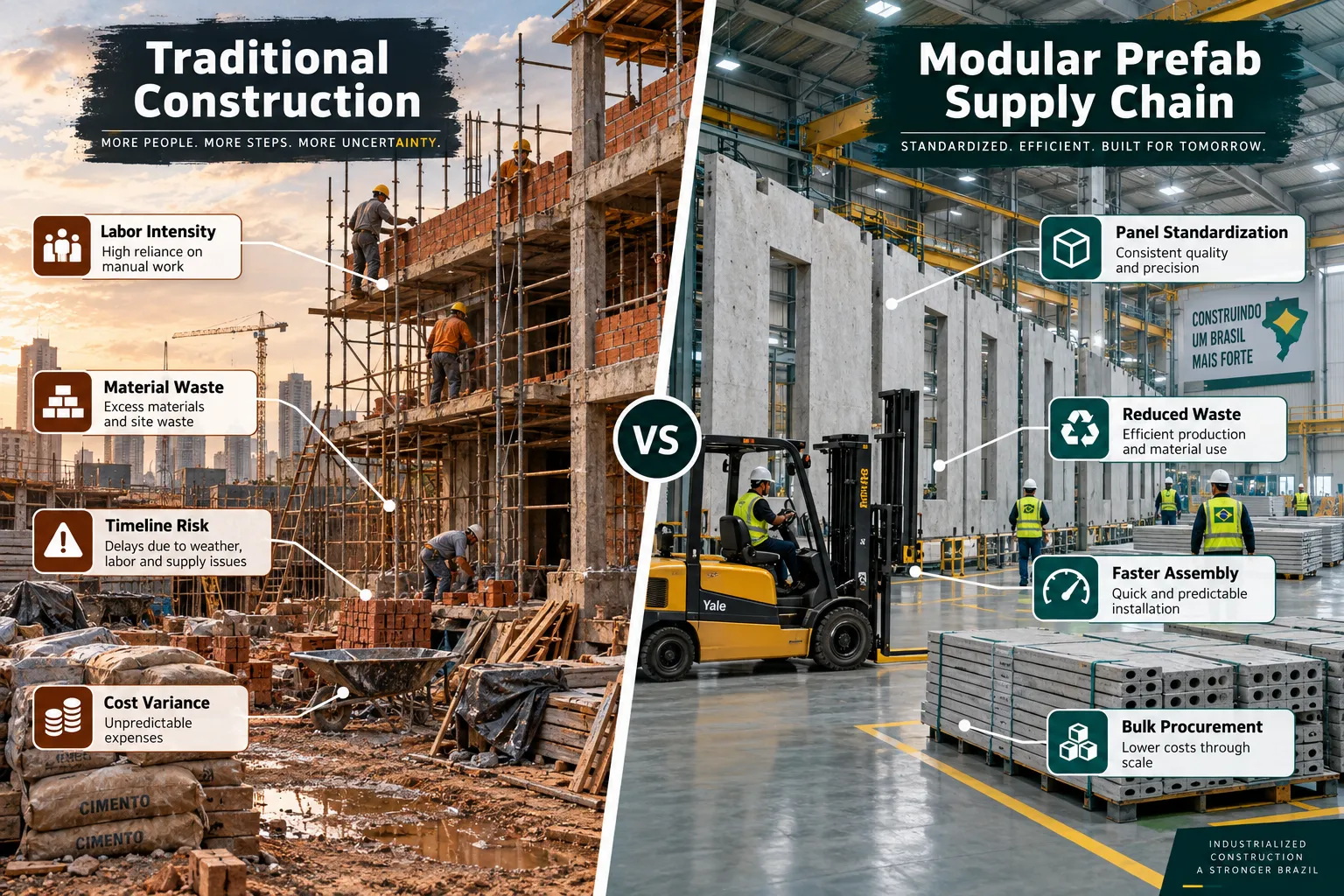
MCMV’s standardized unit typologies create a natural opportunity for bulk procurement. Because the program’s specifications are relatively uniform, particularly for Faixa 1 and 2 units, developers operating at scale can negotiate long-term supply agreements for steel, cement, ceramic tiles, electrical components, and plumbing fixtures. The key is committing to volume early, before contracting rounds are announced, to lock in pricing before demand spikes push input costs higher.
Critical procurement priorities for 2026:
- Cement and concrete: Demand surges from simultaneous contracting rounds can create regional shortages. Developers with pre-negotiated supply agreements or on-site batching capacity have a structural advantage.
- Steel reinforcement: Global steel price volatility remains a risk. Forward contracts or domestic supplier partnerships reduce exposure.
- Prefabricated components: The shift toward modular and prefabricated construction is accelerating in MCMV projects. Developers investing in prefab supply chains are cutting construction timelines by up to 30%, a critical advantage when monthly contracting targets create pressure on delivery schedules.
- Electrical and hydraulic systems: Standardized MCMV specifications allow for bulk purchasing of identical system packages across multiple projects simultaneously.
For a detailed look at how prefabrication is reshaping MCMV delivery, see this analysis of the modular prefab revolution in MCMV projects 2026 accelerating 1M unit delivery amid supply chain pressures.
Labor Management at Scale
Brazil’s construction labor market is tightening as MCMV volume accelerates. Developers scaling to multiple simultaneous sites face competition for skilled tradespeople, particularly masons, electricians, and finishing crews. Strategies that are gaining traction in 2026 include:
- Vertical integration of labor: Some larger developers are building in-house construction crews rather than relying entirely on subcontractors, trading higher fixed costs for schedule reliability.
- Training partnerships: Collaborating with SENAI and municipal vocational programs to develop project-specific labor pipelines.
- Prefabrication as a labor hedge: Shifting work from on-site to factory environments reduces dependence on field labor availability and improves quality consistency.
- Regional labor sourcing: Developers expanding into secondary cities, where MCMV demand is strong but competition for labor is lower than in São Paulo or Rio, are finding better workforce availability and lower wage pressure.
Technology and BIM Integration
Building Information Modeling (BIM) is becoming a practical necessity rather than a competitive differentiator for high-volume MCMV developers. BIM enables precise materials quantification, reduces waste, accelerates permitting, and supports the coordination of multiple simultaneous projects. Combined with 3D printing applications for specific components, technology adoption is directly reducing per-unit costs. For developers looking to understand the cost-saving potential, this overview of BIM and 3D printing for Brazilian residential launches 2026 provides a practical framework.
“The developers who will capture the most value from MCMV’s 2026 expansion are those who treat housing production as a manufacturing problem, not a one-off construction problem.”
Regional Diversification and Election-Year Risk Management
The Minha Casa Minha Vida Expansion 2026: Scaling to 1M Units and Supply Chain Strategies for Developers does not play out uniformly across Brazil’s territory. Regional demand concentrations, infrastructure availability, land costs, and labor market conditions vary significantly. Developers who approach the program as a single national market miss the strategic nuance that drives margin differentiation.
Regional Demand Hotspots
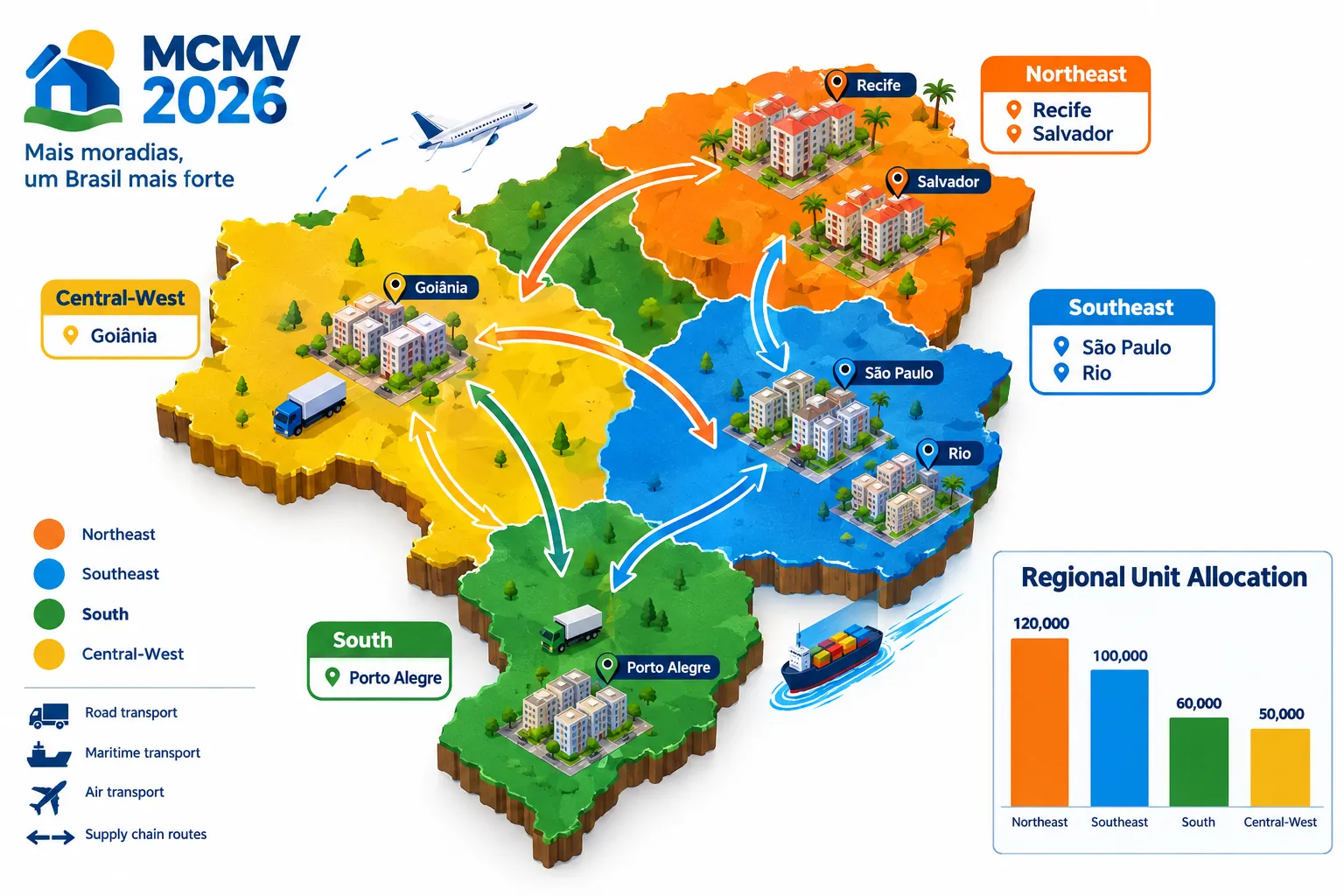
The Northeast has historically absorbed a disproportionate share of MCMV Faixa 1 contracts, driven by lower land costs, high housing deficits, and strong political prioritization. Cities like Recife, Salvador, Fortaleza, and João Pessoa are active contracting markets. The Southeast, particularly São Paulo’s metropolitan periphery and Rio de Janeiro’s suburban corridors, drives the highest absolute volume. The South and Central-West are growing in importance as secondary city demand expands.
For developers exploring secondary city opportunities beyond the major MCMV hotspots, this analysis of secondary cities surge 2026 developer playbooks for inland Brazil beyond MCMV hotspots outlines the key market dynamics.
Developers should also note that Novo PAC infrastructure investments are unlocking new viable development corridors in suburban and peri-urban areas. This is directly relevant to MCMV land sourcing strategies. The detailed breakdown of Novo PAC infrastructure investment playbook 2026 capturing 10-25% property premiums through strategic project timing is worth reviewing for site selection decisions.
Election-Year Dynamics: Acceleration and Risk
2026 is a federal election year in Brazil, and this creates a specific set of dynamics for MCMV developers. On the demand side, election years historically accelerate government contracting as the incumbent administration seeks to maximize visible delivery before October polling. The 1 million unit target for 2026 is explicitly linked to this political calendar [7].
On the risk side, election years create uncertainty about post-election program continuity, potential changes to subsidy structures, and the possibility of fiscal tightening if a new administration prioritizes deficit reduction. Developers must stress-test their pipelines against scenarios where contracting momentum slows sharply in late 2026 or early 2027.
Key risk management tactics for election-year MCMV exposure:
- Stagger contract commitments: Avoid concentrating all new contract signings in Q3 2026, when political volatility peaks. Spread exposure across the full year.
- Secure financing early: Lock in Caixa Econômica Federal credit lines and FGTS allocations before any potential post-election policy review.
- Diversify across income bands: Faixa 2 and 3 projects are less dependent on direct government subsidy and more resilient to program changes than Faixa 1.
- Maintain liquidity buffers: Construction cost overruns in a high-volume environment are more likely, not less. Adequate working capital is essential.
For a comprehensive analysis of the fiscal risks surrounding MCMV and the parallel Reforma Casa Brasil program in an election year, see this detailed review of election year fiscal risks 2026 stress testing housing pipelines amid MCMV and Reforma investments.
Financing Conditions and Mortgage Market Context
The FGTS-backed financing structure that underpins MCMV is operating with record budget allocations in 2026. This insulates the program from the high Selic rate environment that is constraining conventional mortgage credit. For Faixa 1 and 2 buyers, MCMV financing is effectively decoupled from the benchmark interest rate, a critical structural advantage in a market where the Selic remains elevated.
For Faixa 3 and mid-income adjacent products, fixed-rate mortgage availability is becoming an increasingly important demand driver. The expansion of fixed-rate products is supporting launches in the R$350,000, R$500,000 price range, which overlaps with the upper MCMV bands and standard mid-market developer product. This analysis of fixed rate mortgages expansion 2026 scaling mid-income launches under 14% credit growth forecast outlines how developers can position launches to capture this financing tailwind.
Operational Planning: What 1M Units Per Year Actually Requires
Scaling to 1 million contracted units in a single year is an extraordinary operational challenge. To put it in perspective: that is roughly 83,000 units contracted per month, or approximately 2,750 units per working day across all program participants. For individual developers, the implication is not that each firm must deliver 83,000 units, but that the aggregate system must, and each developer’s share of that system must be planned with industrial precision.
Practical operational benchmarks for MCMV developers in 2026:
- Monthly contracting targets: Developers with approved projects should align internal production planning with monthly contracting rounds. Missing a round means waiting for the next cycle.
- Permitting lead times: Municipal approval timelines remain a bottleneck in many markets. Developers who have pre-approved projects ready when contracting rounds open capture disproportionate share.
- Delivery vs. contracting gap: There is typically an 18-36 month gap between contract signing and unit delivery. Contracts signed in 2026 will translate into deliveries in 2027-2028, meaning developers must plan workforce and supply chain capacity for a multi-year production horizon.
- Quality control at scale: High-volume production environments create quality consistency risks. Standardized inspection protocols and prefabricated component quality assurance are essential to avoid post-delivery defect claims.
The modular and prefab construction approach is increasingly central to meeting these operational demands. Developers adopting these methods are reporting timeline reductions of up to 30% compared to conventional construction, which directly addresses the contracting-to-delivery gap. See this detailed breakdown of the modular and prefab construction boom 2026 cutting timelines by 30% in Brazil’s urban housing push.
Conclusion
The Minha Casa Minha Vida Expansion 2026: Scaling to 1M Units and Supply Chain Strategies for Developers represents the most concentrated housing production challenge Brazil’s construction sector has faced in a generation. The government’s ambition is clear, the financing is in place, and the contracting momentum is running ahead of target [10]. What separates developers who capture value from this cycle from those who struggle is operational readiness, not just the ability to sign contracts, but the capacity to deliver on them at scale, on time, and within budget.
Actionable next steps for developers:
- Audit your supply chain now. Identify single-source dependencies in cement, steel, and prefabricated components and establish backup supplier agreements before the next major contracting round.
- Pre-approve projects across multiple municipalities. Maintaining a pipeline of shovel-ready, pre-permitted projects is the fastest way to capture contracting rounds as they open.
- Evaluate prefabrication investment. If your current construction method relies entirely on on-site labor, model the timeline and cost impact of shifting 30-50% of production to prefabricated components.
- Stress-test your pipeline against election-year scenarios. Model a base case, an accelerated contracting case, and a post-election slowdown case. Ensure your liquidity position is adequate under all three.
- Diversify regional exposure. Concentrating all MCMV projects in a single metropolitan area creates both supply chain and political risk. Secondary city markets offer lower competition and often better margin profiles.
The 1 million unit target is ambitious, but the structural conditions, record FGTS budgets, strong political will, and a housing deficit measured in the tens of millions, make it achievable. Developers who build the operational infrastructure to participate at scale will be positioned to benefit not just in 2026, but throughout the multi-year delivery cycle that follows.
References
[1] “Vamos Contratar Tres Milhoes De Casas Ate O Final Deste Ano” Diz Lula Ao Anunciar Ampliacao De Investimentos Para O Minha Casa Minha Vida – https://www.gov.br/planalto/pt-br/acompanhe-o-planalto/noticias/2026/04/201cvamos-contratar-tres-milhoes-de-casas-ate-o-final-deste-ano201d-diz-lula-ao-anunciar-ampliacao-de-investimentos-para-o-minha-casa-minha-vida
[2] Minha Casa Minha Vida Tem Meta De Novas Moradias Para 2026 Veja Numeros – https://timesbrasil.com.br/brasil/minha-casa-minha-vida-tem-meta-de-novas-moradias-para-2026-veja-numeros/
[3] Governo Lula Quer Mais 1 Milhao De Novos Contratos No Mcmv Em 2026 – https://www.infomoney.com.br/economia/governo-lula-quer-mais-1-milhao-de-novos-contratos-no-mcmv-em-2026/
[4] Vamos Chegar A Mais De Tres Milhoes De Unidades Habitacionais Ate O Final Do Ano De 2026 Diz Jader Filho – https://agenciagov.ebc.com.br/noticias/202509/vamos-chegar-a-mais-de-tres-milhoes-de-unidades-habitacionais-ate-o-final-do-ano-de-2026-diz-jader-filho
[5] Mcmv Atinge 2 Milhoes De Moradias E Antecipa Meta De 2026 – https://agenciainfra.com/blog/mcmv-atinge-2-milhoes-de-moradias-e-antecipa-meta-de-2026/
[6] Minha Casa Minha Vida Fara Quase 3 Milhoes Entregas Ate 2026 Diz Ministro – https://www.cnnbrasil.com.br/economia/macroeconomia/minha-casa-minha-vida-fara-quase-3-milhoes-entregas-ate-2026-diz-ministro/
[7] Em Ano Eleitoral Governo Planeja Contratar 1 Milhao De Unidades Do Minha Casa Minha Vida – https://oglobo.globo.com/economia/noticia/2025/12/08/em-ano-eleitoral-governo-planeja-contratar-1-milhao-de-unidades-do-minha-casa-minha-vida.ghtml
[8] Governo Federal Anuncia A Selecao De 130 Mil Novas Unidades Habitacionais Pelo Minha Casa Minha Vida – https://www.gov.br/secom/pt-br/acompanhe-a-secom/noticias/2025/05/governo-federal-anuncia-a-selecao-de-130-mil-novas-unidades-habitacionais-pelo-minha-casa-minha-vida
[9] Novo Minha Casa Minha Vida Recebe Sancao Do Presidente Da Republica – https://www.gov.br/cidades/pt-br/assuntos/noticias-1/novo-minha-casa-minha-vida-recebe-sancao-do-presidente-da-republica
[10] Minha Casa Minha Vida Meta Para 2026 Foi Superada Em 60 – https://exame.com/esferabrasil/minha-casa-minha-vida-meta-para-2026-foi-superada-em-60/