
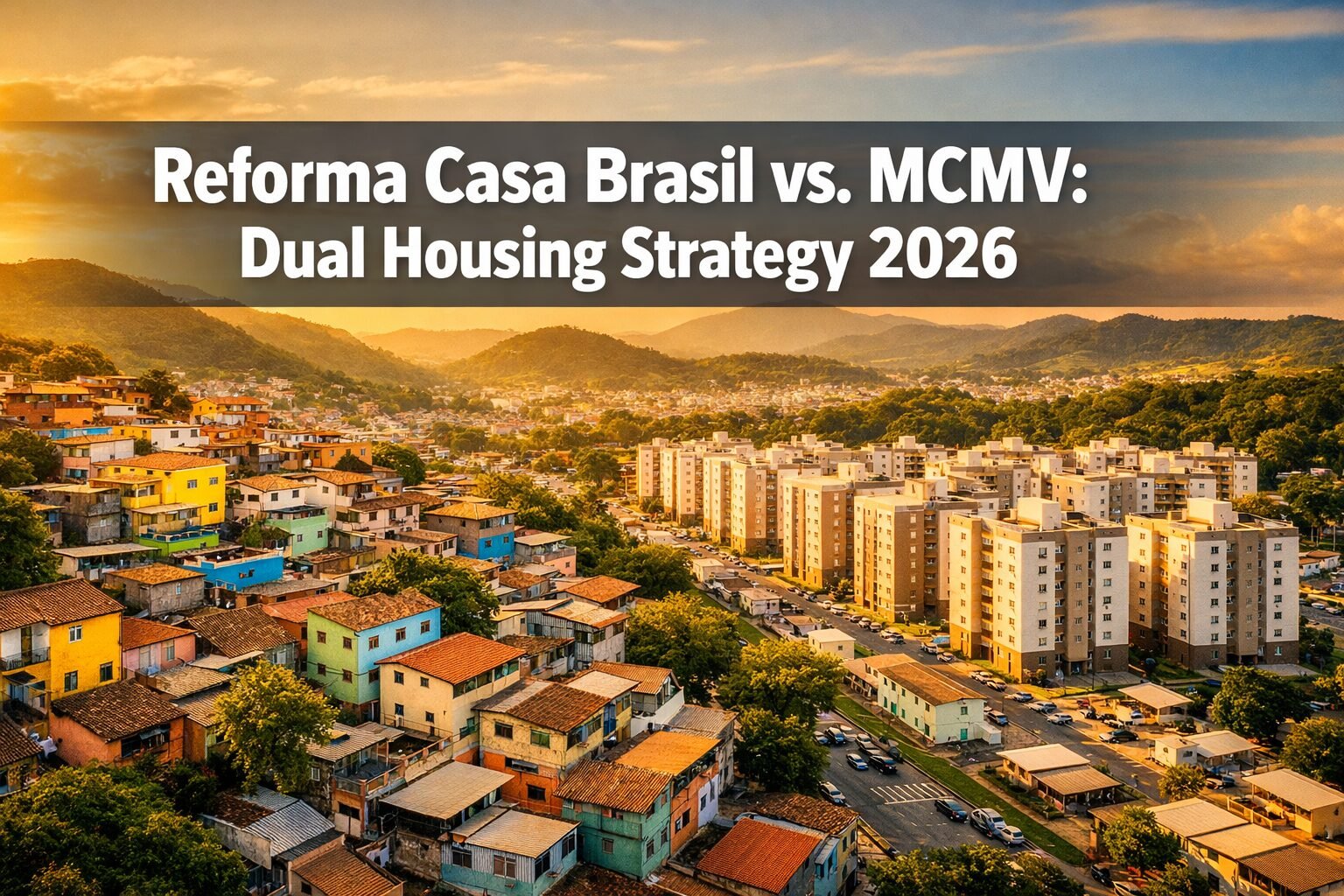
Brazil’s government injected R$ 40 billion into a brand-new housing renovation program in 2026 — and most developers are still treating it like a footnote to MCMV. That is a costly mistake.
The launch of Reforma Casa Brasil alongside the long-established Minha Casa Minha Vida (MCMV) program has created a genuinely dual-track housing policy environment. Understanding the strategic differences between these two programs is no longer optional for developers, investors, and construction firms seeking to maximize returns in Brazil’s competitive affordable housing market. The question of Reforma Casa Brasil vs. MCMV: Strategic Positioning for Developers in Brazil’s Dual Housing Program Landscape 2026 is now one of the most pressing decisions facing the sector.
This article breaks down both programs, compares their financial structures, target demographics, and supply chain implications — and offers clear guidance on how developers can position themselves for success.
Key Takeaways 📌
- Reforma Casa Brasil allocates R$ 40 billion for renovation of existing homes for approximately 1.5 million families, funded partly by oil royalties — a fundamentally different model from MCMV’s new construction focus [1].
- MCMV has contracted over 2 million units ahead of schedule through 2025, with 2026 targets exceeding 100,000 subsidized units and total historical investment surpassing R$ 140 billion [3].
- The two programs require different financing structures, supply chains, and contractor profiles — developers who conflate them risk misallocating resources.
- Combined 2026 housing investment across both programs reaches approximately R$ 39.8 billion, creating a significant market opportunity [3].
- Strategic positioning depends on a developer’s existing capabilities, regional presence, and risk tolerance — not a one-size-fits-all answer.

Understanding the Two Programs: Fundamentals First
What Is Reforma Casa Brasil?
Launched in 2026, Reforma Casa Brasil is a federal initiative with a R$ 40 billion budget targeting the renovation and repair of existing homes occupied by low-income families [1]. The program prioritizes households suffering from structural deficiencies — leaking roofs, crumbling walls, inadequate sanitation, and unsafe electrical systems [2].
Key program parameters include:
- 🏠 Target beneficiaries: Approximately 1.5 million families
- 💰 Maximum benefit per family: Up to R$ 30,000 for home repairs
- 🛢️ Funding sources: Oil royalties and SBPE (Brazilian Savings and Loan System) [1]
- 📍 Focus: Existing housing stock, not new construction
“Reforma Casa Brasil fills a gap that MCMV never addressed — the millions of Brazilians who own a home but live in dangerous or degraded conditions.” [2]
This is a qualitative improvement program. It does not add units to the housing stock; it upgrades the quality of existing ones.
What Is MCMV?
Minha Casa Minha Vida is Brazil’s flagship affordable housing program, first launched in 2009. Since inception, it has channeled over R$ 140–145 billion into new residential construction, primarily targeting families in income brackets 1 through 3 [3].
Key 2026 MCMV parameters include:
- 🏗️ Units contracted through 2025: Over 2 million — ahead of schedule
- 🎯 2026 delivery target: 100,000+ subsidized units
- 📈 Property value ceilings (updated January 2, 2026): Up to R$ 255,000–270,000 in major urban centers
- 👨👩👧 Focus: New construction for families without homeownership
The January 2026 rules update expanded access for lower-income families, broadening the eligible buyer pool and making MCMV projects more commercially viable in secondary cities [3].
Side-by-Side Comparison Table
| Feature | Reforma Casa Brasil | MCMV |
|---|---|---|
| Program Type | Renovation / Repair | New Construction |
| Budget (2026) | R$ 40 billion | Part of R$ 39.8B combined [3] |
| Families Targeted | ~1.5 million | Ongoing (2M+ contracted) |
| Max Benefit | R$ 30,000/family | Subsidized mortgage/unit |
| Funding Source | Oil royalties + SBPE | FGTS + Federal Budget |
| Housing Stock Impact | Improves existing | Adds new units |
| Contractor Profile | Small/mid renovation firms | Large-scale developers |
| Timeline | Short-cycle projects | Multi-year developments |
Strategic Positioning for Developers: Choosing Your Lane

The core strategic question in the Reforma Casa Brasil vs. MCMV: Strategic Positioning for Developers in Brazil’s Dual Housing Program Landscape 2026 debate is not which program is “better” — it is which program aligns with a developer’s existing strengths and growth strategy.
The MCMV Opportunity: Scale, Predictability, and Proven Returns
For established developers with access to capital, land banks, and large construction teams, MCMV remains the dominant opportunity. The program’s scale is unmatched. With over R$ 140 billion deployed since 2009 and 2 million units contracted ahead of schedule, MCMV has proven its ability to generate consistent deal flow [3].
Why MCMV works for large developers:
- ✅ Predictable subsidy structures and mortgage guarantees
- ✅ Bulk purchasing power reduces material costs
- ✅ Established regulatory and approval pathways
- ✅ Strong secondary market for completed units
- ✅ January 2026 rule updates expanded eligible buyer pool
The updated property value ceilings — now reaching R$ 270,000 in major urban centers — give developers more margin to work with while staying within program parameters [3]. This is particularly relevant for markets like Florianópolis, where real estate values have been rising steadily and where premium affordable housing is in high demand.
Risk factors for MCMV developers in 2026:
- ⚠️ High interest rates continue to pressure financing costs [3]
- ⚠️ Land availability in prime urban areas is shrinking
- ⚠️ Regulatory complexity in large-scale projects
- ⚠️ Political cycle risk — 2026 is an election year, and housing budgets can shift [6]
The Reforma Casa Brasil Opportunity: Agility, Volume, and Underserved Markets
Reforma Casa Brasil opens a different kind of opportunity — one that rewards agility over scale. The program’s R$ 40 billion budget, funded partly through oil royalties, flows toward renovation and repair rather than new construction [1]. This creates demand for a different type of contractor and developer.
Who benefits most from Reforma Casa Brasil:
- 🔨 Mid-size renovation contractors with regional networks
- 🏘️ Developers with community relationships in low-income neighborhoods
- 🛠️ Building materials suppliers focused on repair products (roofing, waterproofing, electrical)
- 📋 Project managers capable of running high-volume, short-cycle jobs
The program’s structure — up to R$ 30,000 per family for repairs — means individual contracts are smaller but faster to execute. A firm that can manage 500 renovation projects simultaneously operates very differently from one building a 200-unit apartment complex.
Key insight: Reforma Casa Brasil rewards operational density, not construction scale. The winning strategy is logistics mastery, not engineering complexity.
For developers exploring investment opportunities in Brazil’s property market, understanding this distinction is essential before committing capital.
Financing Structures: A Critical Difference
The funding architecture of each program demands different financial planning:
MCMV Financing:
- Relies heavily on FGTS (Fundo de Garantia do Tempo de Serviço) — Brazil’s workers’ severance fund
- Developers access subsidized credit lines through Caixa Econômica Federal
- Long-term project cycles require sustained working capital
- Risk: Interest rate sensitivity on construction financing [3]
Reforma Casa Brasil Financing:
- Funded through oil royalties and SBPE — more insulated from FGTS fluctuations [1]
- Shorter project cycles mean faster capital turnover
- Smaller per-project capital requirements lower the barrier to entry
- Risk: Disbursement delays common in government renovation programs
Developers already active in the studio and compact housing segment may find Reforma Casa Brasil’s shorter cycles and lower capital intensity more compatible with their financial models.
Supply Chain and Operational Implications
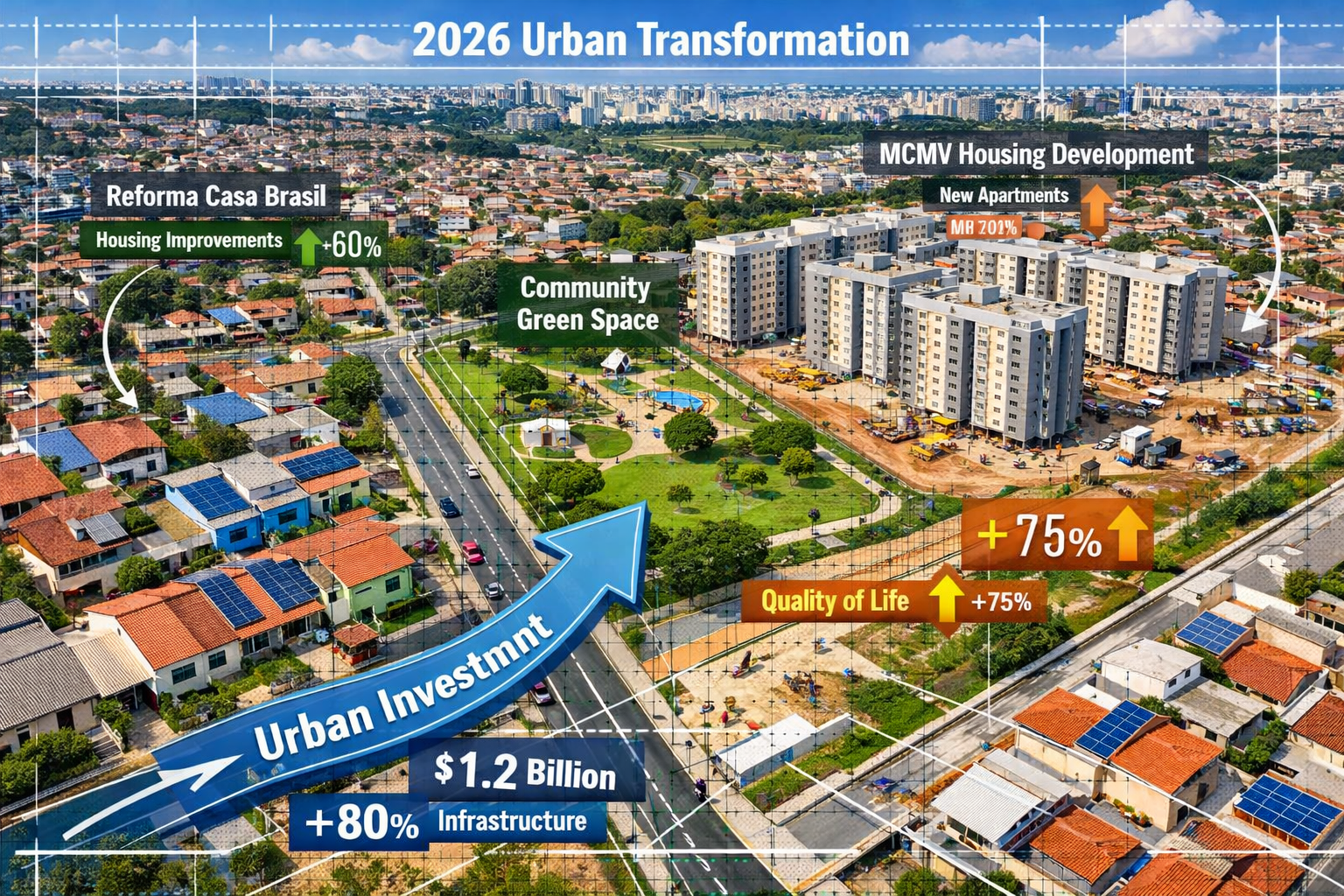
The supply chain implications of the Reforma Casa Brasil vs. MCMV: Strategic Positioning for Developers in Brazil’s Dual Housing Program Landscape 2026 divide are substantial and often overlooked.
MCMV Supply Chain Requirements
Large-scale MCMV projects demand:
- Bulk procurement of structural materials (concrete, steel, rebar)
- Long-term supplier contracts to lock in pricing
- On-site logistics for managing hundreds of workers
- Specialized subcontractors for MEP (mechanical, electrical, plumbing) systems
Developers who have mastered this model — like those behind projects such as Tramonto and Solis — understand that supply chain discipline is as important as design quality.
Reforma Casa Brasil Supply Chain Requirements
Renovation programs create demand for a different materials basket:
| Material Category | MCMV Priority | Reforma Casa Brasil Priority |
|---|---|---|
| Structural concrete | ⭐⭐⭐⭐⭐ | ⭐⭐ |
| Roofing / waterproofing | ⭐⭐ | ⭐⭐⭐⭐⭐ |
| Electrical components | ⭐⭐⭐ | ⭐⭐⭐⭐⭐ |
| Plumbing fixtures | ⭐⭐⭐ | ⭐⭐⭐⭐⭐ |
| Finishing materials | ⭐⭐⭐⭐ | ⭐⭐⭐⭐ |
| Heavy equipment | ⭐⭐⭐⭐⭐ | ⭐⭐ |
Building materials suppliers who pivot their inventory toward repair-focused products — waterproofing membranes, roofing tiles, circuit breakers, sanitation components — are well-positioned to capture Reforma Casa Brasil demand [1][2].
Labor Force Considerations
MCMV requires large, centralized labor pools — ideal for regions with established construction workforces.
Reforma Casa Brasil requires distributed, mobile teams capable of working on individual homes across wide geographic areas. This favors firms with:
- Strong local hiring networks
- Experienced renovation foremen (not just new construction supervisors)
- Efficient logistics for small-batch material delivery
Regional Strategy: Where to Focus in 2026
Brazil’s housing deficit is not evenly distributed. Developers must match program selection to regional market conditions.
High-Priority Regions for Reforma Casa Brasil
- Northeast Brazil: Highest concentration of substandard housing stock
- Peri-urban areas of major cities: Where homeownership is high but quality is low
- Flood-prone zones: Post-disaster repair demand is structurally elevated
High-Priority Regions for MCMV
- South and Southeast Brazil: Strong formal employment base supports mortgage qualification
- Mid-size cities (100K–500K population): Land is available, demand is strong
- Coastal growth corridors: Markets like Florianópolis, where the Ingleses region is experiencing rapid infrastructure investment, align well with MCMV’s updated price ceilings
For developers considering off-plan purchases and pre-launch investments, MCMV’s predictable subsidy structure provides a more bankable underwriting scenario than Reforma Casa Brasil’s shorter-cycle renovation contracts.
The Political Economy Factor: 2026 Is an Election Year
Brazil’s 2026 general elections add a layer of strategic complexity that developers cannot ignore. Housing programs have historically been amplified in election cycles, and 2026 is no exception.
Reports indicate that President Lula’s administration has allocated an additional R$ 20 billion for housing in 2026, with political motivations clearly at play [6]. This is both an opportunity and a risk:
Opportunity: Accelerated disbursements, expanded eligibility, and faster approvals as the government seeks visible results.
Risk: Post-election policy shifts could alter program parameters, funding levels, or administrative priorities.
Developer strategy: Lock in contracts and approvals before the October 2026 election cycle creates administrative uncertainty. Both MCMV and Reforma Casa Brasil offer windows for this — but the timelines differ. Reforma Casa Brasil’s shorter project cycles make it easier to complete work within the pre-election window [6].
Can Developers Pursue Both Programs Simultaneously?
The short answer: yes, but with intentional organizational separation.
Firms that attempt to run MCMV-scale new construction and Reforma Casa Brasil renovation projects under the same operational structure typically underperform in both. The management rhythms, labor profiles, material procurement strategies, and cash flow cycles are too different.
Best practice: Create separate business units or subsidiaries — one optimized for MCMV’s scale-driven model, another built for Reforma Casa Brasil’s distributed renovation model. This mirrors how large construction conglomerates in Brazil already separate their civil infrastructure and residential divisions.
Developers interested in understanding how performance-driven sales strategies apply across both program types can explore how sales performance is transforming Florianópolis’s real estate market as a case study in operational specialization.
Conclusion: Actionable Next Steps for Developers in 2026
The Reforma Casa Brasil vs. MCMV: Strategic Positioning for Developers in Brazil’s Dual Housing Program Landscape 2026 question does not have a universal answer — but it demands a deliberate one.
Here is a clear action framework:
✅ Immediate Actions (Next 30 Days)
- Audit your current capabilities — assess whether your firm is better suited for scale-driven new construction (MCMV) or distributed renovation (Reforma Casa Brasil)
- Map your regional presence — identify which program has stronger demand in your core markets
- Review the January 2026 MCMV rule updates to determine if new price ceilings open previously unviable projects
📅 Short-Term Actions (60–90 Days)
- Engage with Caixa Econômica Federal to understand current MCMV credit line availability and Reforma Casa Brasil disbursement timelines
- Build or acquire renovation capacity if Reforma Casa Brasil aligns with your market position — don’t try to retrofit a new-construction team
- Secure land or project pipelines before October 2026 to insulate against post-election policy uncertainty [6]
🔭 Long-Term Positioning
- Consider dual-program organizational structures if your firm has the capital and management depth to pursue both markets
- Invest in supply chain relationships specific to each program’s material demands
- Monitor oil royalty revenue flows — Reforma Casa Brasil’s funding is directly tied to this source, making it more sensitive to commodity price shifts than FGTS-backed MCMV [1]
Brazil’s housing market in 2026 is not a single opportunity — it is two distinct markets running in parallel. The developers who recognize this early, position deliberately, and build the right operational infrastructure for each program will capture disproportionate value from one of the largest combined housing investments in the country’s history.
To explore current development opportunities and learn more about strategic real estate positioning in Brazil’s high-growth markets, visit Quadragon’s full portfolio of developments or get in touch with the team directly.
References
[1] Governo Lanca Reforma Casa Brasil Com Aporte De R 40 Bi Mais De 1 Milhao De Familias Terao Ate R 30 Mil Para Consertar Casas Ctl01 – https://en.clickpetroleoegas.com.br/governo-lanca-reforma-casa-brasil-com-aporte-de-r-40-bi-mais-de-1-milhao-de-familias-terao-ate-r-30-mil-para-consertar-casas-ctl01/
[2] Reforma Casa Brasil X Outros Programas Habitacionais Qual A Diferenca – https://aceitei.com/en/reforma-casa-brasil-x-outros-programas-habitacionais-qual-a-diferenca/
[3] Brazils Construction Sector 2026 Housing Programs Support Rates High Risks Persist – https://www.fastmarkets.com/insights/brazils-construction-sector-2026-housing-programs-support-rates-high-risks-persist/
[6] Lula More R 20 Bi For Accommodation In Election Year 15 04 2026 – https://ground.news/article/lula-more-r-20-bi-for-accommodation-in-election-year-15-04-2026