
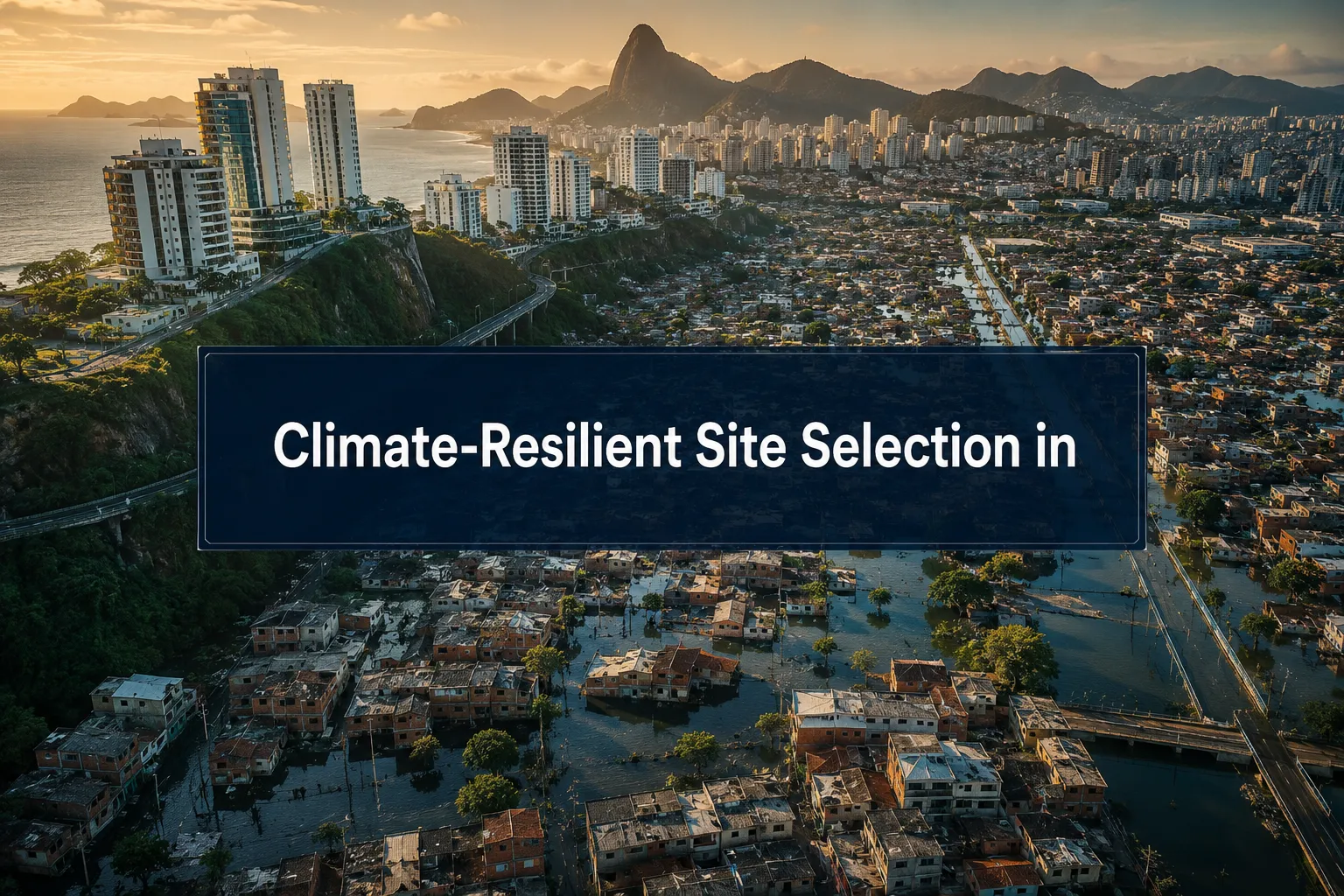
Brazil’s May 2024 Rio Grande do Sul floods destroyed or severely damaged more than 420,000 homes and triggered record insurance claims that exposed a systemic gap between development ambitions and physical reality [10]. That single event reset how lenders, insurers, and regulators think about where Brazilian real estate can safely be built. Climate-resilient site selection in Brazil, covering flood, heat, drainage, and insurance factors developers can’t ignore, is no longer a sustainability checkbox. In 2026, it is a core feasibility variable that shapes financing, underwriting, and long-term asset value from the first day a site enters the pipeline.
Key Takeaways
- Catastrophic flood events have permanently re-priced low-lying urban land in southern and southeastern Brazil, and insurance markets are tightening coverage for high-risk locations.
- High-resolution parcel-level risk maps now give developers actionable data on flood, landslide, and heat exposure before any land acquisition.
- Drainage design and micro-topography are the two most controllable variables in flood-prone cities and can determine whether a site is insurable at standard terms.
- Brazil’s Forest Code and the CAR rural environmental registry directly constrain land use, financing eligibility, and asset liquidity.
- Sites with documented resilience features are beginning to command measurable rent and valuation premiums, creating a commercial incentive to invest in climate-safe design.
Why Climate Risk Has Become a Feasibility Filter in Brazil
For most of the past decade, climate exposure was treated as a post-approval design problem in Brazilian development. Engineers added drainage calculations after a site was purchased. Insurance was arranged after construction was complete. That sequence is now financially dangerous.
Financial regulators in Brazil have begun embedding physical climate risk into credit and investment frameworks. The Banco Central do Brasil’s climate risk guidelines require financial institutions to assess physical and transition risks in their lending portfolios. This means a developer presenting a project on a flood-exposed site to a major bank in 2026 faces a materially different credit conversation than the same developer did five years ago [6].
At the same time, the reinsurance market has hardened sharply. Climate-related losses have pushed reinsurers to reprice Brazilian risk, raise retentions, and in some cases withdraw capacity from specific geographies [7]. When reinsurance becomes expensive or unavailable, primary insurers pass costs directly to policyholders, or decline to cover them at all [4].
The practical result is a two-tier market. Sites with demonstrable climate resilience attract standard or even preferential financing and insurance terms. Sites without it face higher premiums, restricted coverage, or outright rejection by lenders who can no longer ignore the exposure [1].
Flood Risk: Reading the Landscape Before You Read the Cadastre
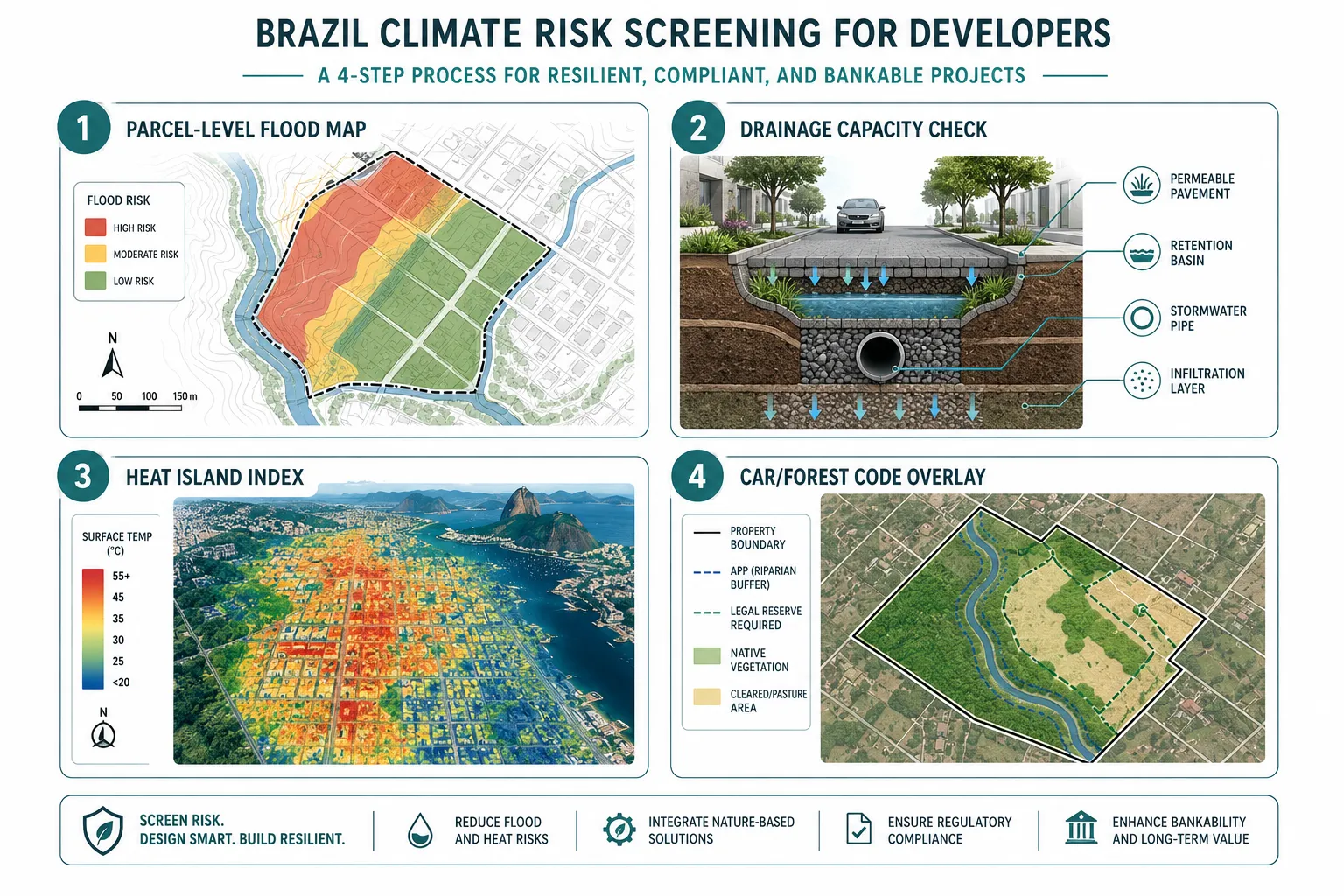
Flood risk in Brazil is not evenly distributed, and the tools to measure it have become substantially more precise. The Brazilian Cities Environmental Safety Risk Map, updated in 2026, provides municipality-level and, in some cases, parcel-level visibility into flood, landslide, and extreme weather exposure across the country [3]. Developers who ignore these maps at the acquisition stage are absorbing risk that will surface at the financing, permitting, or insurance stage.
The key flood screening variables for any Brazilian site are:
- Altitude relative to drainage basin: Sites below the 100-year flood line in any watershed are structurally exposed regardless of current zoning.
- Soil permeability and imperviousness: Dense urban surfaces with no permeable cover accelerate runoff and increase peak flood levels.
- Proximity to watercourses and APPs: Permanent Preservation Areas (APPs) under Brazil’s Forest Code prohibit construction within defined buffers of rivers, lakes, and springs. Building within or adjacent to an APP without authorization creates legal, financial, and physical exposure simultaneously [9].
- Historical inundation records: Municipal civil defense databases and CEMADEN (the National Center for Monitoring and Early Warning of Natural Disasters) maintain event histories that reveal which parcels have flooded before, even when current zoning does not reflect that history.
The Rio Grande do Sul disaster is the clearest recent proof of what happens when these filters are skipped. Entire residential neighborhoods built on floodplain land that was technically zoned for development were destroyed or rendered uninhabitable [10]. The Porto Alegre residential revival and post-flood recovery strategies now being pursued by developers in the region are built on a fundamentally different site-selection logic than the projects they replaced.
“A site that floods once every ten years is not a development opportunity, it is a liability with a recurring trigger.”
Drainage Design and Micro-Topography: The Variables Developers Control
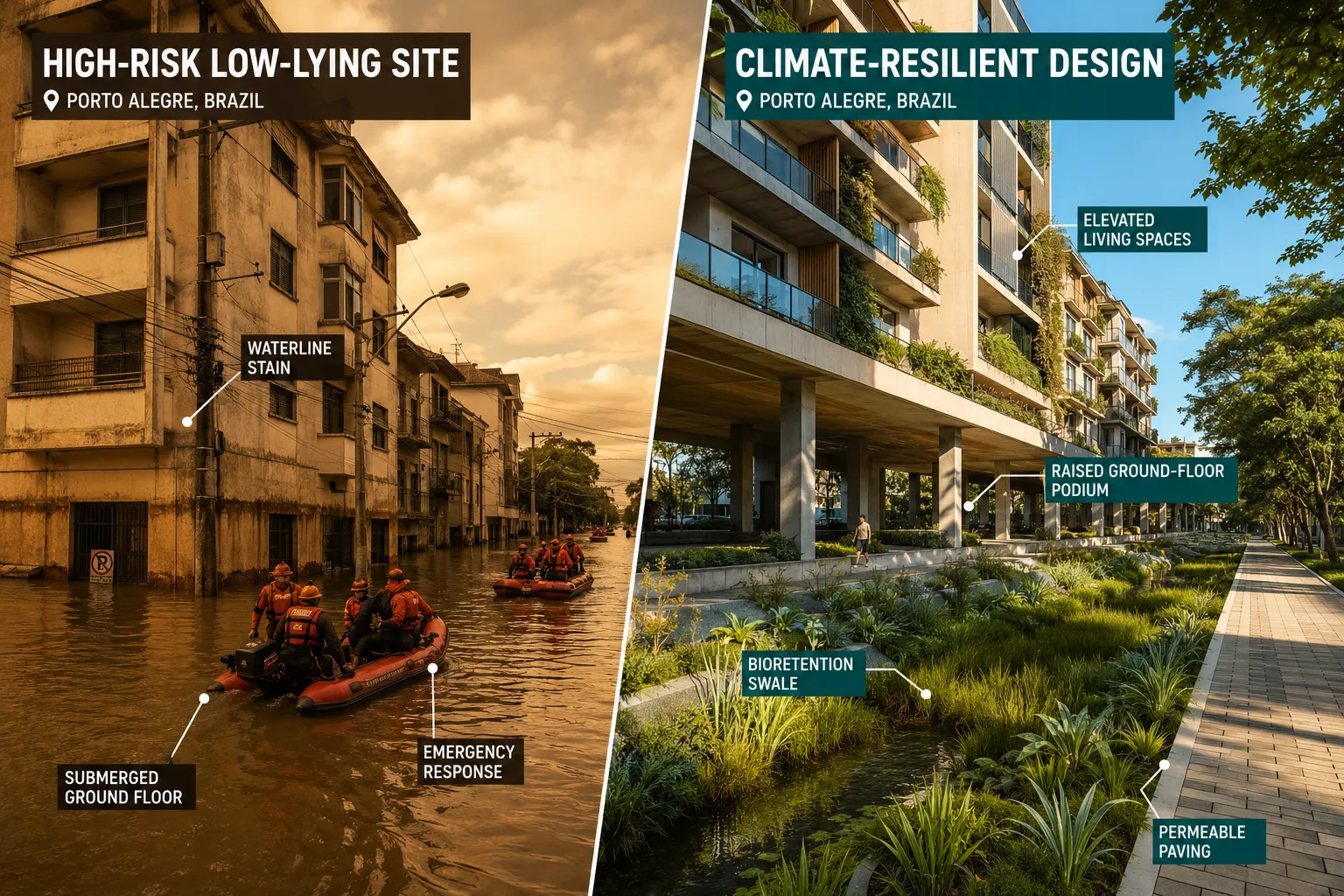
Once a site passes the macro-level flood screening, drainage design and micro-topography become the decisive variables. These are also the variables developers most directly control, which makes them the highest-leverage investment in climate resilience.
Micro-topography refers to the fine-grained elevation variation within a parcel, the difference between a site that sheds water toward the street and one that collects it in a low point. A site that sits 1.5 meters above the surrounding street grade behaves entirely differently in a flood event than one that is flush with or below street level. Ground-floor podium design, finished floor elevation, and the direction of site grading are all decisions made early in schematic design that have outsized consequences for flood performance.
Drainage design at the project scale involves several interacting systems:
| System | Function | Climate-Resilience Benefit |
|---|---|---|
| Permeable paving | Reduces surface runoff volume | Lowers peak flow into municipal drains |
| Bioretention swales | Captures and filters stormwater on-site | Reduces downstream flood contribution |
| Detention basins | Holds excess runoff during peak events | Delays and attenuates flood peaks |
| Green roofs | Absorbs rainfall before it reaches ground | Reduces total runoff volume per event |
| Elevated ground floors | Keeps habitable space above flood level | Directly protects units and reduces claims |
Brazilian municipal drainage systems in most secondary cities were designed for rainfall intensities that are now routinely exceeded. Developers who design projects to handle stormwater on-site rather than relying on municipal infrastructure are not just being responsible, they are protecting their own assets from the failure of systems they do not control.
For developers active in secondary cities, where drainage infrastructure is often the weakest, this is particularly critical. The secondary cities surge and developer playbooks for inland Brazil increasingly factor drainage capacity into feasibility analysis as a non-negotiable input.
Heat Risk: The Emerging Filter Beyond the Floodplain
Flood risk dominates the climate conversation in Brazil, but heat and drought are rapidly becoming co-equal filters for site selection, particularly in the Northeast, the Cerrado, and the urban peripheries of major metropolitan areas.
Urban heat islands, zones where dense impervious surfaces and low vegetation cover produce temperatures 3 to 7 degrees Celsius above surrounding areas, directly affect habitability, energy costs, and health outcomes for residents. In cities like Fortaleza, Recife, and interior São Paulo, summer heat stress is already a quality-of-life issue that buyers and renters factor into location decisions [2].
Heat risk screening for Brazilian sites should include:
- Urban heat island index: Available through satellite thermal data and increasingly integrated into municipal risk platforms.
- Prevailing wind corridors: Sites that block or channel cooling breezes perform very differently from thermally identical sites with open exposure.
- Vegetation cover and tree canopy: Mature tree canopy reduces surface temperatures by 5 to 10 degrees Celsius in direct sun and has a measurable effect on perceived comfort and rental appeal.
- Orientation and shading: Building orientation relative to the sun path is a design variable with significant energy and comfort consequences in tropical and semi-arid climates.
Climate risk is also inflating rents in perceived “safe” locations while pushing lower-income residents toward cheaper land that is disproportionately exposed to heat and flood [2]. This dynamic has direct implications for social housing and MCMV-segment developers, who face the greatest pressure to use low-cost land that is often the most climate-exposed.
Forest Code, CAR, and the Regulatory Dimension of Site Risk
Brazil’s Forest Code (Lei 12.651/2012) and the associated CAR (Cadastro Ambiental Rural) system create a regulatory layer that directly intersects with climate risk in site selection. The Forest Code defines APPs and Legal Reserve requirements that restrict development on environmentally sensitive land. Non-compliance creates legal liability, financing ineligibility, and title risk, all of which translate directly into asset illiquidity [9].
Key Forest Code considerations for developers:
- APP verification: Any site near water bodies, hilltops, hillsides above 45 degrees, or restinga vegetation requires APP boundary confirmation before acquisition.
- CAR registration status: Rural and peri-urban land without a valid CAR registration faces restrictions on rural credit and may be ineligible for certain federal financing programs.
- Irregular occupation history: Sites with a history of irregular occupation in APP zones carry legal risk that does not disappear with a change of ownership.
- Slope restrictions: The Forest Code prohibits development on slopes above 45 degrees and restricts it on slopes between 25 and 45 degrees, which directly affects hillside sites in cities like Rio de Janeiro, Florianópolis, and parts of São Paulo.
Developers pursuing urban renovation opportunities under programs like Reforma Casa Brasil should conduct Forest Code due diligence as a standard part of site screening, particularly in older urban areas where historical development patterns did not respect APP boundaries. The Reforma Casa Brasil 2026 urban renovation tactics framework increasingly requires environmental compliance documentation as a condition of subsidy access.
Insurance: How Underwriting Is Changing the Economics of Site Selection
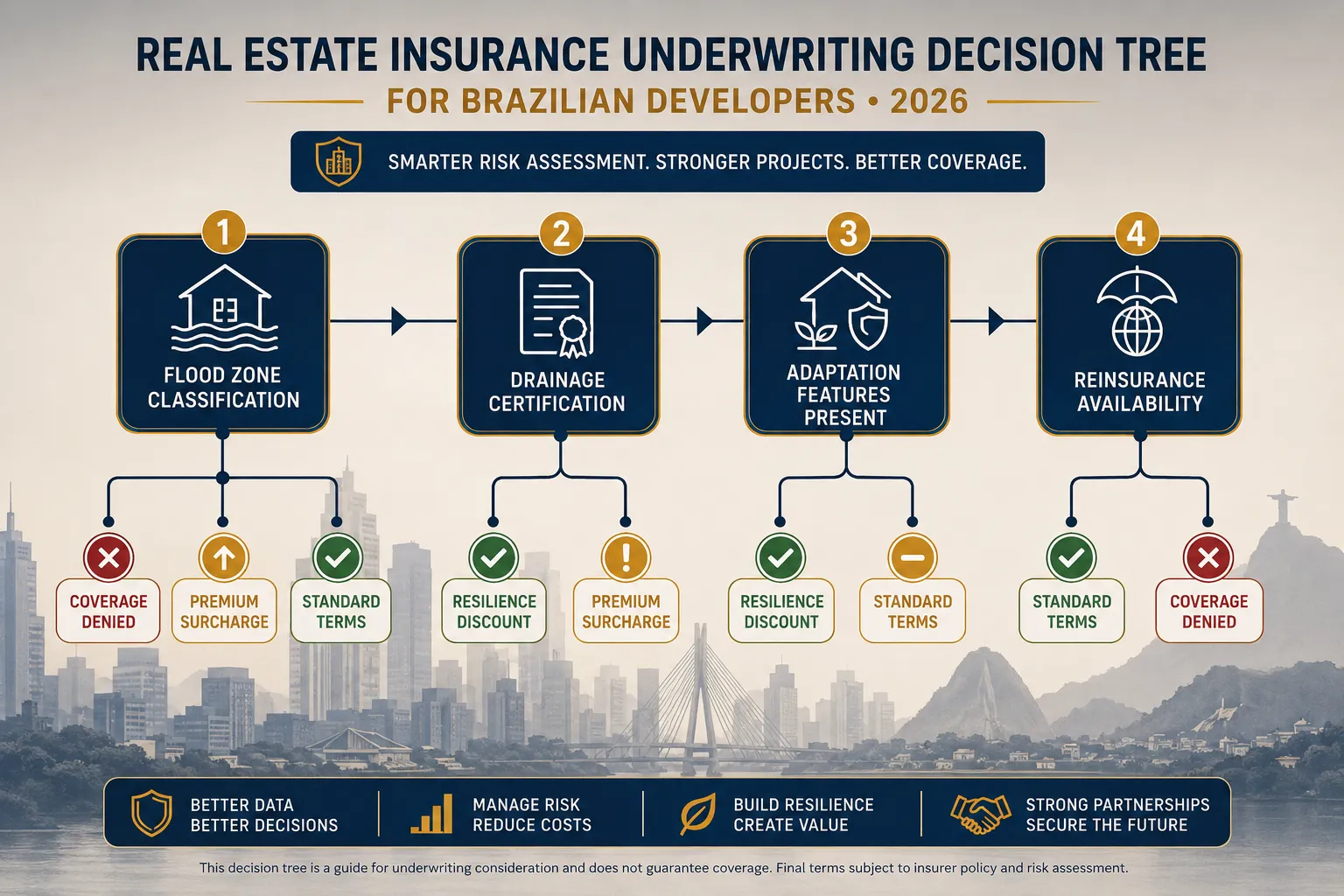
The insurance market’s response to escalating climate losses in Brazil is the most immediate commercial signal that site selection criteria must change. Insurers are not waiting for regulation, they are repricing, restricting, and in some markets withdrawing coverage from high-risk locations [1][4][7].
What is changing in 2026:
- Premium surcharges for flood-exposed locations: Properties in mapped flood zones are facing premium increases of 30 to 80 percent in some southern Brazilian markets, where loss experience from 2024 events has been fully incorporated into actuarial models [7].
- Coverage exclusions for unmitigated risk: Some insurers are excluding flood coverage entirely for ground-floor units in high-risk zones unless specific mitigation measures, elevated finished floors, flood barriers, sump systems, are documented [8].
- Reinsurance-driven capacity withdrawal: International reinsurers have reduced their Brazilian natural catastrophe capacity, which constrains primary insurers’ ability to offer coverage in the highest-risk locations regardless of premium [4][5].
- Resilience discounts emerging: Conversely, projects that document drainage design, elevated construction, and climate-adaptation features are beginning to receive preferential underwriting terms, a direct commercial return on resilience investment [6].
For developers financing projects through major Brazilian banks, insurance availability is not optional. Lenders require property insurance as a condition of construction and mortgage financing. A site that cannot be insured at commercially viable terms cannot be financed through standard channels. This makes insurance underwriting a de facto feasibility gate that operates in parallel with, and sometimes ahead of, formal permitting.
The safest cities in Brazil for real estate investment analysis increasingly incorporates insurance availability and premium levels as a proxy for climate risk, recognizing that the market has already priced what risk maps are only beginning to quantify.
Practical Screening Tools for Climate-Resilient Site Selection
The data infrastructure for climate-resilient site selection in Brazil has improved substantially. Developers who build these tools into their standard acquisition process gain a material advantage over competitors still relying on zoning maps alone.
Recommended screening toolkit:
- CEMADEN risk maps: National-level flood, landslide, and drought risk data, available by municipality and updated with event data.
- Brazilian Cities Environmental Safety Risk Map (2026): Provides comparative environmental safety scores across Brazilian cities, useful for portfolio-level screening [3].
- i4sea physical climate risk platform: Offers parcel-level physical climate risk assessment integrated with investment decision frameworks [6].
- IBGE topographic data: Elevation and watershed data for micro-topography analysis at the site level.
- Municipal Civil Defense records: Historical flood and landslide event data by neighborhood, available from most state civil defense agencies.
- CAR and SICAR databases: Online verification of Forest Code compliance status for any rural or peri-urban parcel.
- Insurance broker pre-screening: Engaging a specialist broker before acquisition to test insurance availability and indicative premium levels for a specific site and project type.
This toolkit does not replace engineering due diligence, but it enables a rapid first-pass screen that eliminates the highest-risk sites before significant acquisition costs are incurred. For developers managing large pipelines across multiple cities, systematic pre-screening using these tools can prevent the kind of late-stage feasibility failures that have become more common as climate risk reprices land.
Developers exploring coastal and tourism-led projects should note that coastal sites face a distinct combination of storm surge, sea-level rise, and erosion risk that requires additional screening layers beyond standard inland flood analysis. The tourism-led coastal development strategies for 2026 increasingly integrate coastal climate risk into site selection as a standard step.
The Pricing Premium for Climate-Safe Sites
The commercial case for climate-resilient site selection is not purely defensive. Evidence is accumulating that climate-safe locations and well-adapted buildings command measurable premiums in both sale and rental markets.
Where the premium is emerging:
- Rental markets in flood-affected cities: Following the 2024 Rio Grande do Sul floods, rents in elevated, flood-safe neighborhoods in Porto Alegre increased significantly as displaced residents competed for limited safe housing stock [2]. This is a direct market signal that climate safety has rental value.
- ESG-driven institutional buyers: Institutional investors with ESG mandates are applying climate risk filters to Brazilian real estate acquisitions, creating a buyer premium for documented resilience [6].
- Green building certifications: LEED, AQUA-HQE, and EDGE certifications increasingly incorporate climate resilience criteria, and certified buildings in Brazil’s major markets trade at documented premiums over uncertified equivalents.
- Insurance cost differentials: A project that qualifies for standard insurance terms rather than a high-risk surcharge has a lower total cost of ownership that can be partially captured in pricing.
For developers considering foreign investment partnerships, the climate resilience of a site is increasingly a due diligence criterion for international capital. The foreign direct investment boom in Brazil properties in 2026 is being shaped in part by international investors who apply climate screening as a standard part of their underwriting process.
The best places to invest in real estate in Brazil analysis in 2026 now routinely incorporates climate risk scores alongside traditional metrics like yield, liquidity, and infrastructure access, reflecting how thoroughly the investment community has absorbed climate exposure as a value variable.
Conclusion: Actionable Next Steps for Developers
Climate-resilient site selection in Brazil, covering flood, heat, drainage, and insurance factors developers can’t ignore, has moved from a forward-looking concern to an immediate operational requirement. The market signals are clear: insurance is repricing, lenders are scrutinizing, and buyers are beginning to pay premiums for safety. Developers who act on this now build a durable competitive advantage.
Actionable next steps:
Integrate climate screening into acquisition checklists today. Add CEMADEN flood maps, the Brazilian Cities Environmental Safety Risk Map, and CAR compliance verification as mandatory pre-LOI steps for every site.
Engage insurance brokers before signing purchase agreements. Test insurance availability and indicative terms for the specific site and intended use before committing capital. An uninsurable site is an unfinanceable site.
Invest in drainage design early in schematic phase. Permeable paving, bioretention, and elevated ground floors cost far less when designed in from the start than when retrofitted after permitting.
Conduct Forest Code due diligence on every acquisition. APP boundaries, CAR status, and slope restrictions must be verified before purchase, not after.
Document resilience features for underwriting and marketing. Compile a climate resilience dossier for each project, drainage certifications, elevation surveys, adaptation features, and use it proactively with insurers, lenders, and buyers.
Monitor the regulatory trajectory. Brazil’s financial regulators are moving toward mandatory climate risk disclosure for real estate assets. Developers who build compliant data practices now will face lower compliance costs when mandatory frameworks arrive.
The developers who treat climate risk as a site-selection advantage, rather than a constraint to be managed after the fact, will be the ones whose projects remain financeable, insurable, and valuable across the full investment horizon.
References
[1] Insurers Brace For Strong El Nino As Climate Risks Mount – https://valorinternacional.globo.com/markets/news/2026/08/12/insurers-brace-for-strong-el-nino-as-climate-risks-mount.ghtml
[2] Seguranca Para Quem Pode Pagar Como O Risco Climatico Inflaciona Alugueis E Expulsa Moradores 16082026 – https://noticias.r7.com/cidades/seguranca-para-quem-pode-pagar-como-o-risco-climatico-inflaciona-alugueis-e-expulsa-moradores-16082026/
[3] Brazilian Cities Environmental Safety Risk Map 2026 – https://scorecidades.com.br/en/brazilian-cities-environmental-safety-risk-map-2026/
[4] Seguradoras Se Preparam Para El Nino Mais Intenso – https://valor.globo.com/financas/noticia/2026/08/12/seguradoras-se-preparam-para-el-nino-mais-intenso.ghtml
[5] El Nino Seguradoras Prevencao Sinistros – https://diariodocomercio.com.br/financas/el-nino-seguradoras-prevencao-sinistros/
[6] Physical Climate Risk Investment Criterion – https://i4sea.com/en/blog/physical-climate-risk-investment-criterion
[7] Clima Encarece Premios E Muda Logica Do Resseguro – https://valor.globo.com/publicacoes/especiais/seguros-e-resseguros/noticia/2026/04/23/clima-encarece-premios-e-muda-logica-do-resseguro.ghtml
[8] Seguro Contra Eventos Climaticos Enchente Vendaval No Brasil – https://www.repseguros.com.br/noticias-e-artigos/seguro-contra-eventos-climaticos-enchente-vendaval-no-brasil
[9] Brazil Environmental Policy – https://www.riotimesonline.com/brazil-environmental-policy/
[10] brazilreports – https://brazilreports.com/historic-flooding-in-southern-brazil-triggers-record-insurance-claims/6130/