
Brazil’s federal government authorized the construction of nearly 2,777 new popular housing units in a single batch in September 2026 alone [9], a routine event in a year when the Minha Casa Minha Vida (MCMV) program has become the most active affordable housing machine in the Western Hemisphere. With a program target of 3 million units by end-2026 [10] and over 1 million units currently under construction, the question for popular housing developers is no longer whether demand exists. The question is whether their supply chains, procurement models, and launch strategies can keep pace with a government that is authorizing new units faster than most developers can pour foundations.
MCMV Subsidized Launches 2026: Scaling to 100,000+ Units with Supply Chain Mastery for Popular Housing Developers is not simply a policy story. It is an operational challenge that separates developers who capture stable, government-backed volume from those who watch contracts pass to better-prepared competitors.
Key Takeaways
- The MCMV FAR cycle for 2025-2026 targets 110,000 subsidized urban units for private developers, with rolling batch authorizations creating predictable launch windows.
- The April 2026 rule change expanded the program to a new middle-income “Classe Media” segment, widening the addressable market for developers beyond the lowest-income brackets.
- Supply chain mastery, including prefabrication, bulk procurement, and just-in-time delivery, is the primary differentiator for developers aiming to scale past 100,000 units.
- Secondary cities and municipal contracting limits are reshaping where volume opportunities concentrate, demanding geographic diversification strategies.
- FGTS-backed financing and subsidy intensity for the lowest-income tiers provide developers with near-guaranteed offtake, reducing demand-side risk significantly.
The Scale of the Opportunity: What 100,000+ Units Actually Means
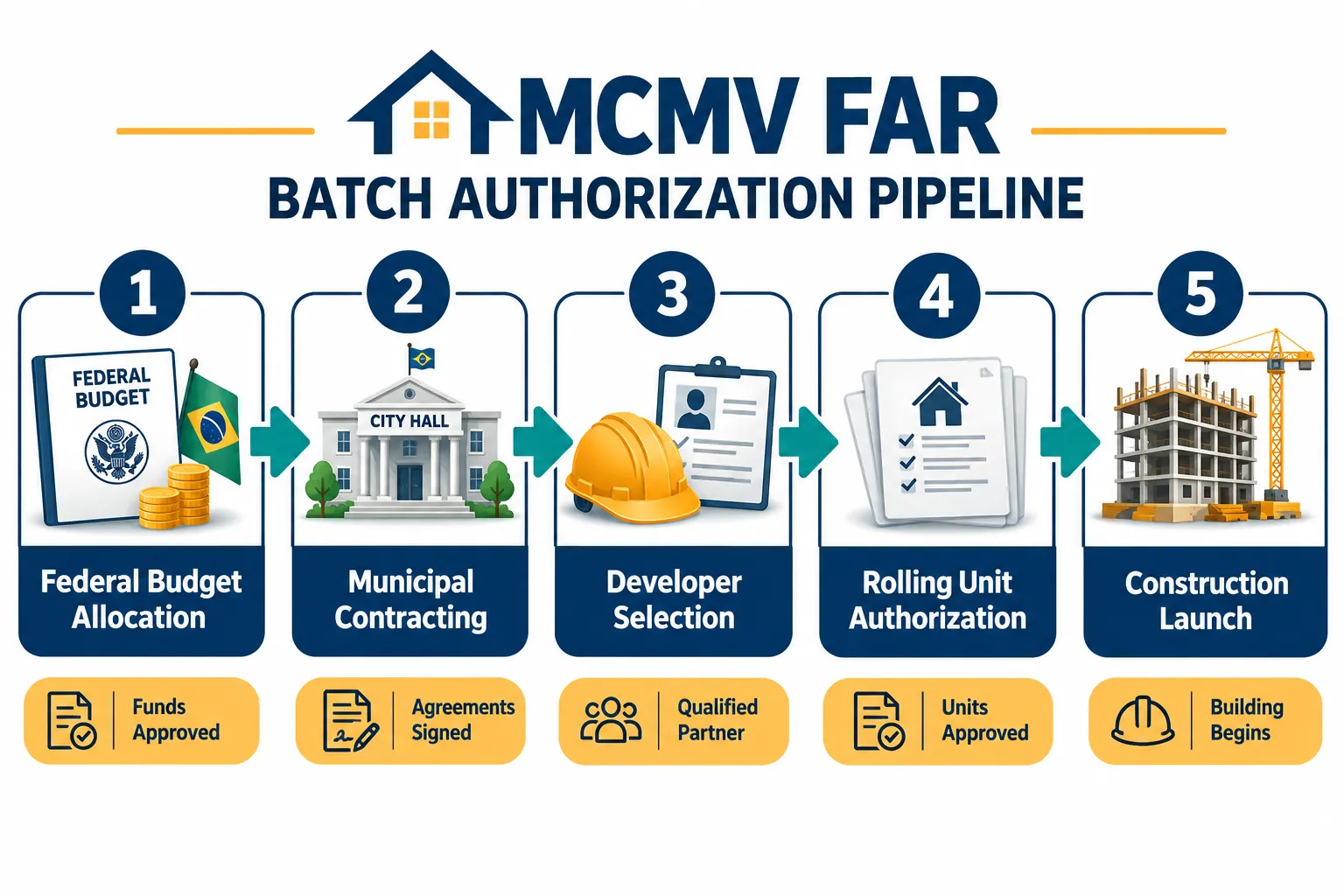
The FAR (Fundo de Arrendamento Residencial) selection cycle for 2025-2026 designated approximately 110,000 subsidized urban units for private developers [5]. This figure sits within a broader program that has already delivered 1,876 units in a single federal ceremony in August 2025 [4] and authorized 2,713 housing units across 16 states in a single May 2025 batch [6]. These are not one-off announcements. They represent a rolling authorization model where the federal government continuously releases new unit batches, giving developers who are ready to execute a near-continuous pipeline of contracted work.
The political framing matters. The Lula administration has positioned 2026 as “the year of housing,” with MCMV hitting its intermediate targets ahead of schedule and projecting 3 million total units by December 2026 [10]. That political commitment translates into budget continuity. For developers, budget continuity means predictable subsidy flows, faster municipal approvals, and a government that is incentivized to remove bottlenecks rather than create them.
What the numbers look like in practice:
| Metric | Figure |
|---|---|
| FAR 2025-2026 urban unit target | ~110,000 units [5] |
| Program total target by end-2026 | ~3 million units [10] |
| September 2026 single-batch authorization | 2,777 units [9] |
| Units delivered in August 2025 ceremony | 1,876 units [4] |
| Units authorized in May 2025 batch | 2,713 units across 16 states [6] |
For a developer operating at scale, capturing even 5% of the FAR cycle means 5,500 units of contracted, subsidy-backed volume. At average construction costs in the popular segment, that represents a multi-billion-real revenue base with government-guaranteed offtake through FGTS financing [7].
How the April 2026 Rule Changes Reshape Developer Strategy
The April 2026 regulatory update was the most significant structural shift in the MCMV program in several years. The government expanded eligibility to a new “Classe Media” segment [1], opening the program to middle-income households that had previously been excluded. This was not a cosmetic adjustment. It changed the income brackets, raised property value caps, and created a new product tier that sits between the fully subsidized Faixa 1 units and the open-market mid-range segment.
Updated income and value structure (mid-2026):
- Faixa 1 (lowest income): Full subsidy gratuity for qualifying households; near-zero mortgage burden; developer receives full payment through government transfer [8].
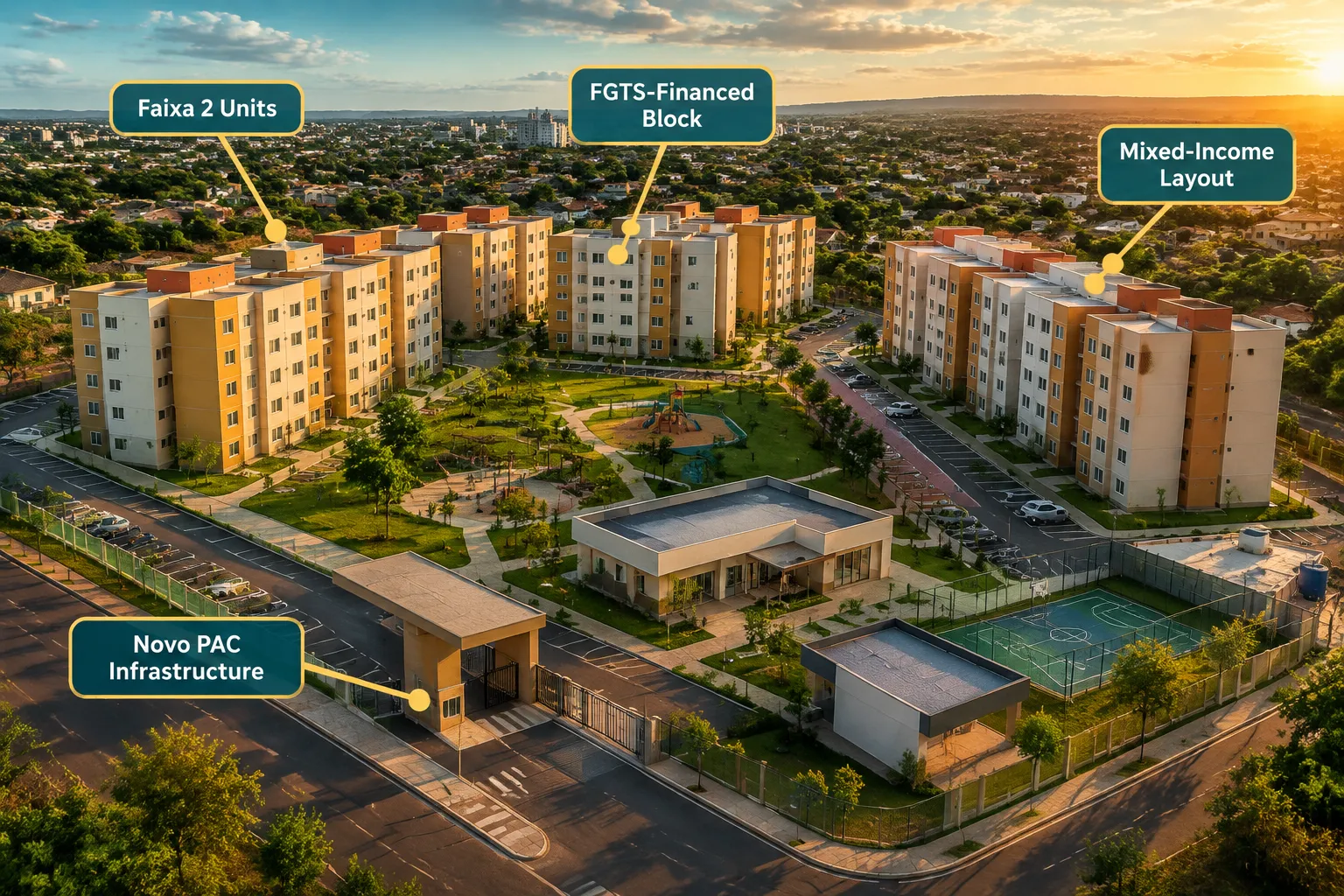
- Faixa 2 and Faixa 3: Partial subsidies with FGTS-backed mortgages; income ceilings raised in the April 2026 update [1].
- Classe Media segment: New tier introduced April 2026; targets households previously above MCMV thresholds; property value caps raised to accommodate urban markets [3].
“The expansion to the Classe Media segment effectively doubles the addressable market for developers who can design products at the upper boundary of the MCMV envelope.”
For developers, the Classe Media addition is strategically significant for two reasons. First, it allows the same construction platform, similar unit sizes, similar specifications, to serve a wider income range by adjusting finish levels and amenity packages. Second, it reduces concentration risk. A developer previously dependent on Faixa 1 contracts was exposed to the full force of any budget freeze. A developer who spans Faixa 1 through Classe Media has a more diversified revenue base.
The FGTS-financed development strategy leveraging R$30.5B in mandatory severance funds for affordable housing projects in 2026 provides a detailed breakdown of how FGTS capital flows into each segment, which is essential reading for developers structuring their financing models around the new brackets.
Supply Chain Mastery: The Core Differentiator for Scaling to 100,000+ Units
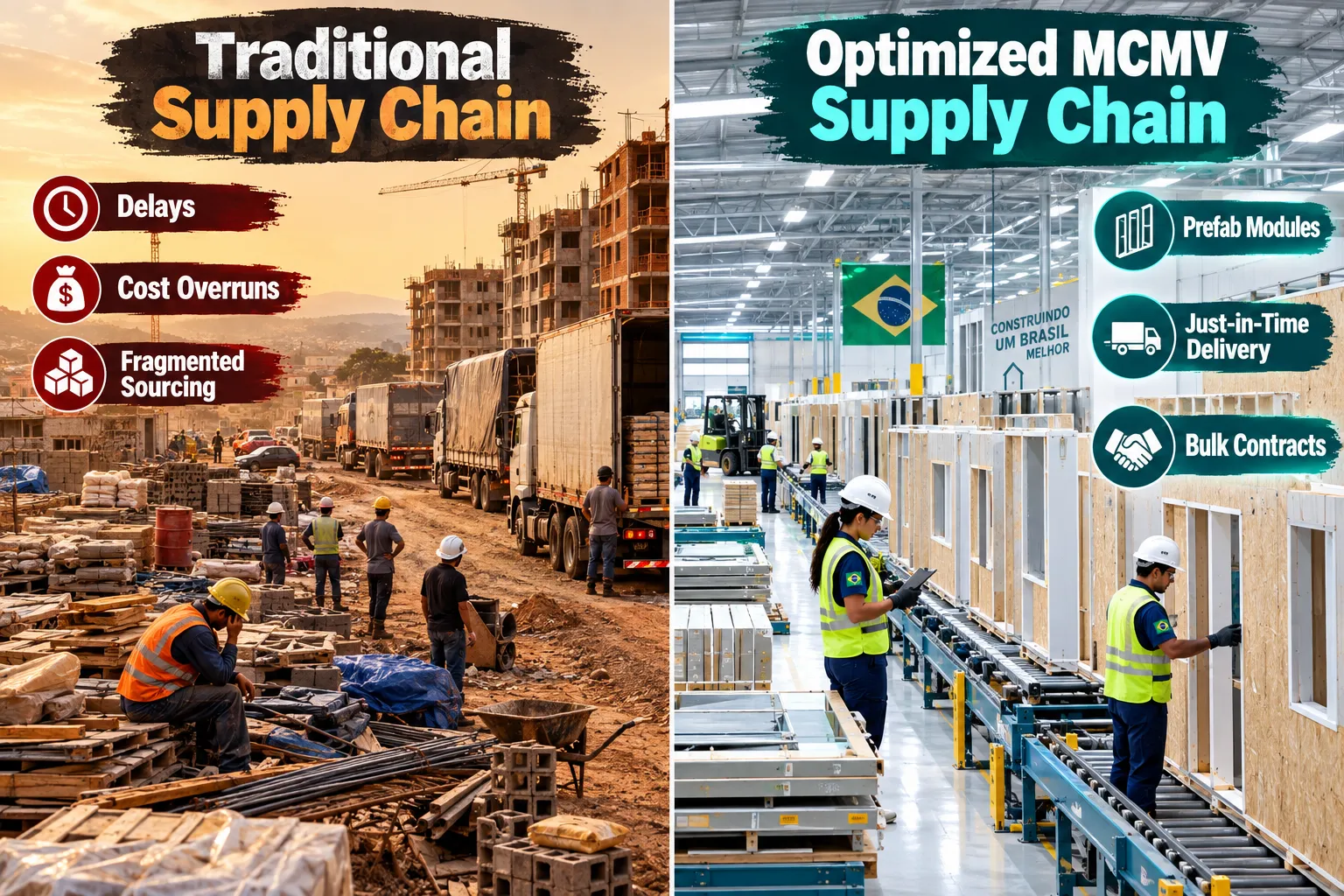
Winning MCMV contracts is the easier half of the challenge. Executing them profitably at scale, while managing material costs, labor availability, and delivery timelines across multiple simultaneous sites, is where most developers lose margin. The record 2025 launch and sales figures [2] created a surge in construction activity that exposed supply chain weaknesses across the sector. Cement, steel, and skilled labor all faced pressure as multiple large developers competed for the same inputs in the same regional markets.
Developers who scaled successfully in 2025 and are positioned to dominate MCMV Subsidized Launches 2026: Scaling to 100,000+ Units with Supply Chain Mastery for Popular Housing Developers share three operational characteristics:
Prefabrication and Modular Construction Integration
The shift toward modular and prefabricated components is no longer a niche strategy. It is becoming a baseline requirement for any developer targeting 1,000+ units per year in the popular segment. Prefab wall panels, pre-cast staircases, and modular bathroom pods reduce on-site labor hours, compress construction timelines by 20-30%, and allow quality control to move from the site to the factory floor.
The modular prefab revolution in MCMV projects 2026 accelerating 1M unit delivery amid supply chain pressures documents how leading developers are integrating prefab components into their MCMV pipelines and the cost-per-unit improvements being achieved. For developers still building entirely with traditional in-situ methods, the timeline and cost gap versus prefab-enabled competitors is widening.
Separately, the modular and prefab construction boom 2026 cutting timelines by 30% in Brazil’s urban housing push provides sector-wide data on adoption rates and the suppliers entering this space.
Bulk Procurement and Long-Term Supplier Contracts
Spot-market purchasing of materials is a margin killer at scale. Developers executing 5,000+ units annually need framework agreements with cement producers, steel suppliers, and fixture manufacturers that lock in pricing for 12-24 months. These agreements require volume commitments that smaller developers cannot make, creating a structural advantage for larger operators who can aggregate demand across multiple projects.
Key procurement levers for MCMV-scale developers:
- Cement and concrete: Negotiate regional supply agreements tied to projected unit starts per quarter.
- Steel reinforcement: Use futures-linked pricing clauses to hedge against commodity volatility.
- Electrical and plumbing fixtures: Standardize specifications across all MCMV product lines to enable bulk orders; resist the temptation to customize per project.
- Windows and doors: Pre-order based on authorized unit counts; the rolling authorization model gives developers 60-90 days of lead time before construction must begin.
Labor Pipeline Management
Brazil’s construction labor market is tight in the markets where MCMV volume is highest. Developers who rely on open-market hiring for each project face wage inflation and quality inconsistency. The leading operators maintain long-term relationships with labor subcontractors, offer training programs that feed skilled workers into their pipelines, and structure projects to maintain continuity of employment between sites, reducing the incentive for workers to move to competitors.
Geographic Strategy: Where the 100,000+ Units Are Concentrated
Municipal contracting limits and the program’s focus on larger cities create a geographic concentration that developers must map carefully. The MCMV program applies different authorization scales depending on city size, with larger municipalities receiving higher unit allocations per batch [5].
The secondary cities of the Northeast, the interior of Sao Paulo state, and the outskirts of major metropolitan areas are currently the highest-volume opportunity zones. These markets combine high housing deficits, lower land costs, and strong municipal government motivation to partner with developers on MCMV contracts.
The secondary cities housing boom 2026 MCMV-driven development plays in Northeast interiors and Sao Paulo outskirts provides a market-by-market breakdown of where unit authorizations are concentrating and which municipalities are most active in contracting.
For developers already operating in capital cities, the MCMV 1M unit milestone 2026 supply chain plays for developers targeting the final push outlines how the final phase of the 3-million-unit target is being distributed geographically and what that means for project pipeline planning.
Geographic opportunity matrix:
| Region | MCMV Opportunity Level | Key Drivers |
|---|---|---|
| Northeast Interior | Very High | High deficit, low land cost, active state programs |
| Sao Paulo Outskirts | High | Population growth, municipal demand, logistics access |
| South (Parana, SC, RS) | Medium-High | Strong FGTS uptake, stable labor markets |
| North (Manaus, Belem) | Growing | Novo PAC infrastructure investment, deficit scale |
| Southeast Capitals | Medium | Higher land costs offset by volume; Classe Media tier relevant |
The Rolling Authorization Model: Turning Policy Cycles into Launch Pipelines
One of the most underappreciated features of the current MCMV structure is its rolling authorization model. Rather than announcing a single annual allocation, the federal government issues unit authorizations in continuous batches, as seen in the September 2026 authorization of 2,777 units [9] and the May 2025 batch of 2,713 units across 16 states [6]. This creates a predictable cadence that developers can use to plan their launch pipelines with more precision than is possible in most housing markets.
For MCMV Subsidized Launches 2026: Scaling to 100,000+ Units with Supply Chain Mastery for Popular Housing Developers, the rolling model has three practical implications:
Pipeline staging: Developers can stagger project starts across multiple batches rather than front-loading all activity into a single launch window, reducing supply chain pressure and labor competition.
Municipal relationship management: Each batch authorization requires municipal government engagement. Developers who maintain active relationships with housing secretariats in target cities are better positioned to receive unit allocations in each new batch.
Financial planning: The batch model allows developers to align equity drawdowns and construction financing with known authorization timelines, improving cash flow predictability.
The fiscal risks are real and should not be minimized. Federal budget pressures, political transitions, and macroeconomic shocks can delay or reduce batch authorizations. Developers who build their entire business model around MCMV volume without maintaining some exposure to market-rate segments are accepting concentration risk. The new SFH credit expansion 2026 scaling launches with 80% LTV and R$2.25M ceiling for mid-range condos provides a useful framework for how mid-range SFH credit can complement MCMV volume in a balanced developer portfolio.
Financial Architecture: Subsidies, FGTS, and Developer Economics
The financial structure of MCMV projects differs fundamentally from market-rate development. Understanding the subsidy architecture is essential for developers evaluating whether to enter or expand in this segment.
How the subsidy and financing stack works:
- Faixa 1 units: The government pays the full unit cost directly to the developer through the FAR fund. The beneficiary household pays nothing or a nominal amount. Developer risk is almost entirely on the construction execution side, not the demand side [8].
- Faixa 2 and 3 units: Partial subsidy reduces the effective mortgage burden on buyers. FGTS funds cover a significant portion of the purchase price. Buyers use their FGTS balances as down payments, further reducing default risk [7].
- Classe Media units: Primarily FGTS-financed with less direct subsidy; property value caps raised to reflect urban market prices [3].
The subsidy intensity for Faixa 1 means developers face essentially zero demand-side risk on those units. The risk profile is entirely operational: can the developer build to specification, on time, and within the contracted cost? This is why supply chain mastery is not a competitive advantage, it is a survival requirement. A developer who runs over budget on a Faixa 1 contract absorbs the entire overrun, since the government payment is fixed at contract.
For Classe Media units, the economics more closely resemble market-rate development, with FGTS financing providing the demand-side support but less direct subsidy buffer on the supply side. This is where the April 2026 rule changes create the most interesting developer opportunity: the Classe Media segment allows developers to apply their MCMV operational efficiency to a higher-value product with better margin potential.
Conclusion: Actionable Steps for Developers Targeting MCMV Scale in 2026
The window for capturing large-scale MCMV volume in 2026 is open, but it will not remain open indefinitely. The program’s 3-million-unit target [10] creates a defined endpoint, and the developers who build the operational infrastructure to execute at scale now will be best positioned for whatever successor program follows.
Actionable next steps for popular housing developers:
- Audit your supply chain immediately. Identify the three to five input categories where spot-market purchasing is eroding margin and negotiate framework agreements before the next batch authorization cycle.
- Invest in prefabrication capacity. Even a partial shift to prefab components, starting with bathrooms and staircases, can compress timelines and reduce on-site labor dependency.
- Map your municipal relationships. Identify the five to ten municipalities in your target regions with the highest MCMV authorization activity and assign dedicated relationship managers to each.
- Diversify across MCMV tiers. Build product lines that span Faixa 2, Faixa 3, and the new Classe Media segment to reduce concentration risk and capture the full subsidy envelope.
- Align financial planning with batch cycles. Model your equity drawdowns and construction financing against the rolling authorization calendar, not against a single annual budget assumption.
- Monitor fiscal signals. The political commitment to housing in 2026 is strong, but budget pressures are real. Maintain a market-rate or SFH product line as a hedge against any slowdown in MCMV authorizations.
The developers who treat MCMV Subsidized Launches 2026: Scaling to 100,000+ Units with Supply Chain Mastery for Popular Housing Developers as an operational discipline, not just a sales opportunity, will build the durable competitive advantages that outlast any single program cycle.
References
[1] Minha Casa Minha Vida New Rules 600k April 2026 – https://www.riotimesonline.com/minha-casa-minha-vida-new-rules-600k-april-2026/
[2] Mercado Imobiliario Bate Recordes 2025 – https://g1.globo.com/economia/noticia/2026/02/23/mercado-imobiliario-bate-recordes-2025.ghtml
[3] Minha Casa Minha Vida Classe Media 1 – https://www.gov.br/cidades/pt-br/acesso-a-informacao/acoes-e-programas/habitacao/programa-minha-casa-minha-vida/minha-casa-minha-vida-classe-media/minha-casa-minha-vida-classe-media-1
[4] Governo Federal Entrega 1 876 Unidades Do Minha Casa Minha Vida – https://www.gov.br/casacivil/pt-br/assuntos/noticias/2025/agosto/governo-federal-entrega-1-876-unidades-do-minha-casa-minha-vida
[5] Mcmv Far 1 – https://www.gov.br/cidades/pt-br/assuntos/minha-casa-minha-vida-selecoes/mcmv-far-1
[6] Minha Casa Minha Vida Mais 2 713 Moradias Em 16 Estados – https://www.gov.br/casacivil/pt-br/assuntos/noticias/2025/maio/minha-casa-minha-vida-mais-2-713-moradias-em-16-estados
[7] Mcmv Fgts – https://www.gov.br/cidades/pt-br/acesso-a-informacao/acoes-e-programas/habitacao/programa-minha-casa-minha-vida/mcmv-fgts
[8] Sobre O Minha Casa Minha Vida 1 – https://www.gov.br/cidades/pt-br/acesso-a-informacao/acoes-e-programas/habitacao/programa-minha-casa-minha-vida/sobre-o-minha-casa-minha-vida-1
[9] Federal Government Authorizes Construction Of Almost Three Thousand En – https://www.mixvale.com.br/2026/09/03/federal-government-authorizes-construction-of-almost-three-thousand-en/
[10] Minha Casa Minha Vida Atinge Metas Antecipadas E Projeta 3 Milhoes De Moradias Ate 2026 – https://www.gov.br/casacivil/pt-br/assuntos/noticias/2026/marco/minha-casa-minha-vida-atinge-metas-antecipadas-e-projeta-3-milhoes-de-moradias-ate-2026