
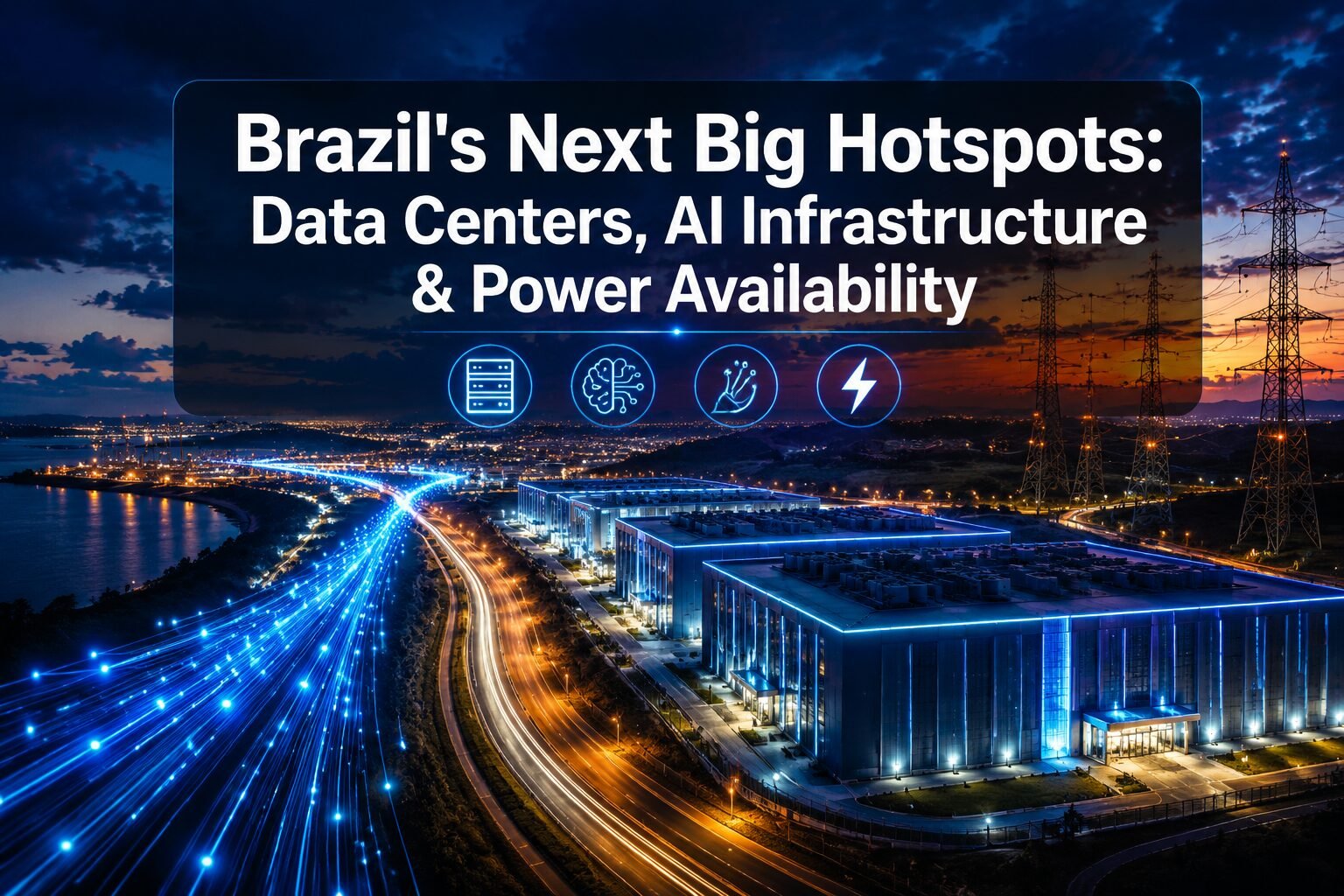
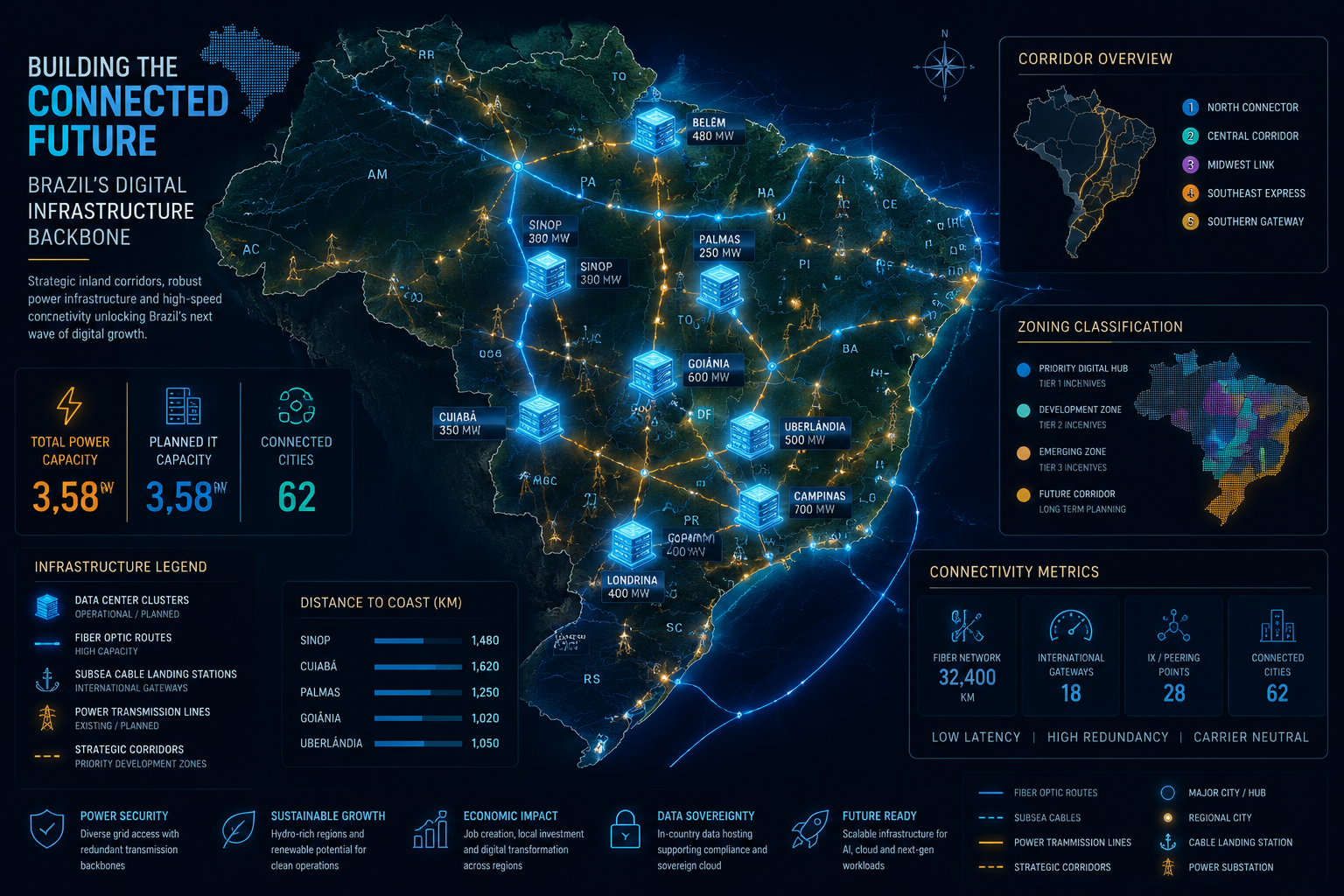
Brazil added more than 3 gigawatts of new data center capacity to its development pipeline between 2023 and 2026 — a figure that rivals the total installed base of many European nations. That single statistic explains why global hyperscalers, sovereign wealth funds, and regional real estate developers are all asking the same question: which Brazilian locations can actually support this infrastructure surge?
The answer is not found on a traditional office market map. It is found on power grid diagrams, fiber route schematics, zoning registers, and environmental licensing queues. Data Centers, AI Infrastructure, and Power Availability: Brazil’s Next Commercial Development Hotspots are being defined not by prestige addresses but by kilowatts, latency, and permitting speed.
Key Takeaways 📌
- Power access is the primary filter — locations with substation proximity and grid capacity are winning data center projects over traditional business districts.
- Inland and industrial corridors are attracting more investment than coastal office markets due to land cost, zoning flexibility, and renewable energy proximity.
- Fiber density and latency to São Paulo’s internet exchange (IX.br) remain critical secondary criteria for site selection.
- Environmental licensing speed varies dramatically by state and municipality, making permitting timelines a competitive differentiator.
- Real estate investors who understand the infrastructure layer of commercial development can identify high-appreciation zones before mainstream capital arrives.
Why Power Availability Rewrites the Commercial Real Estate Map
Every data center consumes electricity at a scale that most commercial buildings never approach. A single hyperscale facility can draw 50 to 200 megawatts continuously — equivalent to powering tens of thousands of homes. Before any developer breaks ground, the fundamental question is brutally simple: can the local grid deliver, and at what cost?
Brazil’s energy matrix is one of the most renewable-heavy in the world, with hydroelectric, wind, and solar sources supplying roughly 85% of the national grid. That clean energy profile is a major selling point for technology companies with net-zero commitments. However, the availability of that energy at a specific substation, in a specific municipality, on a specific timeline, is what actually determines whether a project moves forward.
The Substation Bottleneck
Transmission infrastructure in Brazil is managed through a combination of federal operator ONS (Operador Nacional do Sistema Elétrico) and regional distributors. The critical constraint is not national generation capacity — Brazil has that in abundance — but last-mile substation capacity at the distribution level.
Locations where substations have been recently upgraded, or where new 138kV or 230kV lines have been commissioned, jump immediately to the top of site-selection shortlists. States that have proactively invested in grid modernization — including Minas Gerais, Goiás, and parts of São Paulo’s interior — are now reaping commercial development dividends.
💡 Pull Quote: “The most valuable commercial land in Brazil in 2026 is not beachfront or downtown — it is a flat, zoned parcel within 2 kilometers of a high-capacity substation and a fiber backbone route.”
Renewable Energy Proximity as a Differentiator
The Nordeste region — particularly Ceará, Rio Grande do Norte, and Bahia — has emerged as a surprising contender for data center investment. Wind and solar generation capacity in the Nordeste is among the cheapest in the world on a per-megawatt-hour basis. Several large-scale projects have already secured Power Purchase Agreements (PPAs) that lock in electricity costs well below the national average.
This dynamic is reshaping commercial development logic. Industrial and logistics parks near renewable energy generation hubs are being repositioned as potential data center campuses, attracting a new class of tenant that traditional real estate developers had never considered.
For investors tracking the best places to invest in Brazilian property, understanding which municipalities sit on advantageous grid nodes is becoming as important as understanding demographic growth trends.
Fiber, Latency, and the Geography of Connectivity
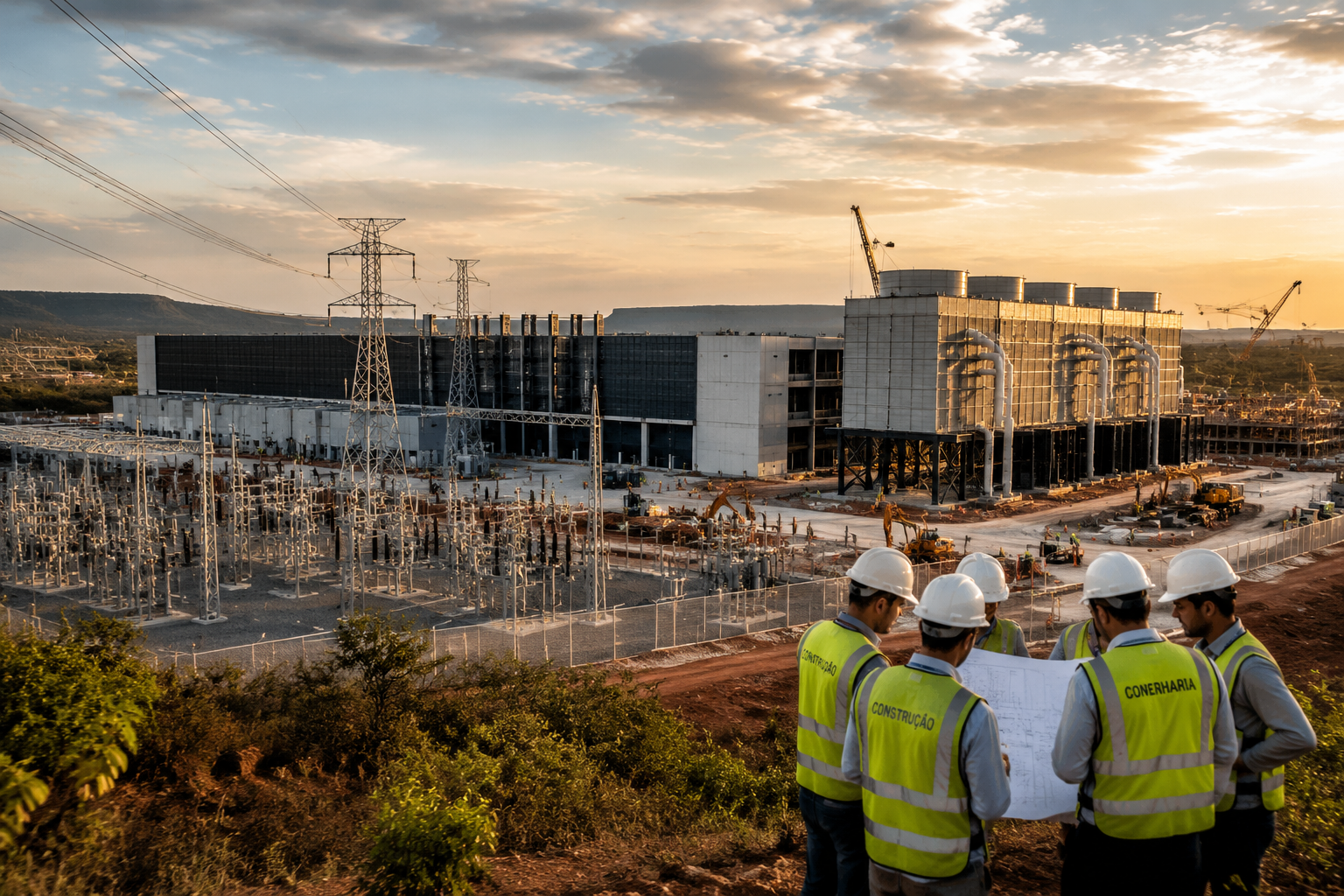
Power is necessary but not sufficient. A data center without fiber connectivity to major internet exchange points is commercially useless. Brazil’s primary internet exchange, IX.br in São Paulo, handles the vast majority of the country’s internet traffic. Every data center project in the country is evaluated, in part, by its latency to that exchange.
The São Paulo Gravity Well
São Paulo remains the undisputed anchor of Brazil’s digital infrastructure. The metropolitan region hosts the highest concentration of existing data centers, the deepest fiber density, and the most mature ecosystem of carriers, cloud on-ramps, and managed service providers.
However, land prices and power costs inside São Paulo’s core have risen sharply. This is pushing new development to the São Paulo interior corridor — municipalities like Campinas, Sorocaba, Jundiaí, Hortolândia, and Sumaré — where:
- Industrial zoning is abundant and permitting is faster
- Land costs are 40–70% lower than São Paulo capital
- Fiber routes along major highways (Anhanguera, Bandeirantes, Castelo Branco) provide sub-5ms latency to IX.br
- Power substations have been expanded to serve industrial demand
This corridor is arguably the single most active zone for AI infrastructure and data center development in Latin America right now.
Secondary Fiber Corridors Gaining Traction
Beyond São Paulo’s orbit, several other connectivity corridors are attracting attention:
| City/Region | Latency to IX.br | Key Advantage |
|---|---|---|
| Campinas, SP | ~3–5ms | Mature fiber, industrial zoning |
| Curitiba, PR | ~8–12ms | Strong tech ecosystem, cooler climate |
| Porto Alegre, RS | ~15–20ms | Southern fiber hub, data sovereignty angle |
| Fortaleza, CE | ~35–45ms | Submarine cable landing station, cheap renewables |
| Brasília, DF | ~10–15ms | Government cloud demand, stable grid |
Fortaleza deserves special mention. The city is a landing point for multiple transatlantic submarine cables connecting Brazil to Europe, the United States, and Africa. For workloads that require international connectivity rather than domestic latency optimization, Fortaleza offers a compelling infrastructure argument that is only beginning to translate into commercial real estate demand.
Zoning, Permitting, and the Inland Industrial Corridor Advantage
The third pillar of data center site selection — after power and fiber — is the regulatory environment. Environmental licensing, land use zoning, and construction permitting can add 12 to 36 months to a project timeline if the municipality is unprepared or hostile to large industrial-scale electrical consumers.
Why Inland Industrial Zones Are Winning
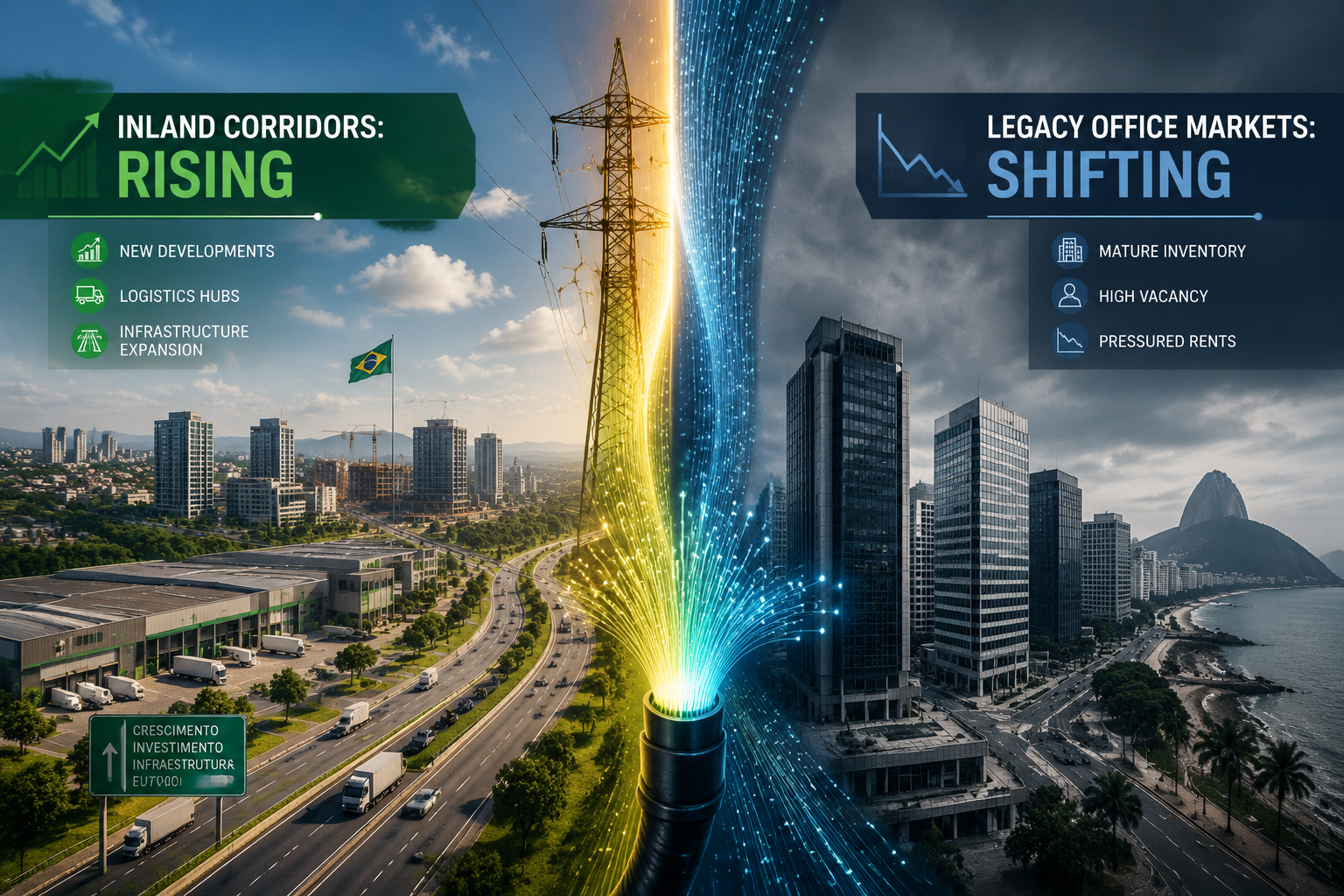
Traditional office markets — São Paulo’s Faria Lima, Rio de Janeiro’s Porto Maravilha, Recife’s Marco Zero — were designed for people-centric commercial activity. Data centers are not people-centric. They require:
- Large, flat land parcels (often 5–50 hectares)
- Heavy industrial electrical connections (not standard commercial service)
- Cooling water access or space for dry cooling systems
- Security buffers and controlled access perimeters
- Low flood risk and stable soil for raised floor construction
Urban commercial districts rarely offer all of these simultaneously. Industrial zones on the periphery of mid-sized cities — particularly in São Paulo’s interior, Minas Gerais’s Triângulo Mineiro, and Goiás near Anápolis — check every box at a fraction of the cost.
Municipalities that have proactively created “data center friendly” zoning categories — allowing heavy electrical consumption under industrial classification without requiring lengthy rezoning processes — are seeing faster project approvals. Goiás, in particular, has been aggressive in marketing its combination of cheap renewable energy, available industrial land, and streamlined licensing as a package to attract hyperscale investment.
The Environmental Licensing Variable
Brazil’s environmental licensing system (SISNAMA) is robust but can be slow. Projects that require EIA/RIMA (full environmental impact assessments) face timelines that can stretch beyond two years. Savvy developers are selecting sites where:
- The land is already classified for industrial use (avoiding rezoning triggers)
- Water consumption is minimized through air-cooled or closed-loop systems (reducing environmental review scope)
- The municipality has a pre-approved industrial development zone with streamlined licensing pathways
States like Minas Gerais and Goiás have invested in creating these pre-cleared industrial corridors specifically to attract data center and logistics investment — a strategy that is paying off in 2026.
How This Reshapes Commercial Real Estate Investment Logic
The convergence of data centers, AI infrastructure, and power availability is not just a technology story. It is a commercial real estate story with profound implications for investors, developers, and urban planners.
The Ripple Effect on Surrounding Property Markets
When a hyperscale data center campus establishes itself in a municipality, the effects on surrounding commercial and residential real estate are significant:
- Employment creation in construction, operations, and supporting services drives housing demand
- Infrastructure upgrades (roads, power, fiber) benefit the entire surrounding area
- Supplier ecosystems — cooling equipment, security services, electrical contractors — cluster nearby
- Prestige effect attracts other technology tenants to the region
This pattern is already visible in Campinas and Hortolândia, where data center campuses have catalyzed broader commercial development. Investors tracking real estate market trends in Greater Florianópolis and other growth markets should note that infrastructure-led development cycles tend to compress appreciation timelines significantly.
Florianópolis: A Case Study in Infrastructure-Driven Appreciation
Florianópolis illustrates the broader principle well. The city’s combination of fiber connectivity (as a regional hub), a growing technology sector, quality of life, and improving power infrastructure has made it one of Brazil’s most dynamic commercial and residential real estate markets. Life in Florianópolis increasingly attracts the technology professionals who build and manage digital infrastructure — creating a virtuous cycle of demand.
The growth of the Ingleses region in Florianópolis demonstrates how infrastructure investment — roads, utilities, connectivity — directly translates into property value appreciation, a dynamic that plays out at larger scale in Brazil’s emerging data center corridors.
Off-Plan Investment in Infrastructure-Adjacent Zones 🏗️
For real estate investors, one of the most effective strategies in infrastructure-driven markets is acquiring off-plan properties in municipalities where data center or AI infrastructure projects have been announced but not yet completed. The appreciation curve between announcement and operational status is typically steep.
Understanding the advantages of buying off-plan is essential for investors looking to capture this appreciation window. Developers with projects in infrastructure-adjacent zones — like those offered by Quadragon Empreendimentos — are well-positioned to benefit from these macro trends.
The AI Demand Multiplier
The emergence of generative AI as a mainstream commercial technology has fundamentally changed the scale of data center demand. Training large language models and running inference workloads at scale requires GPU clusters that consume power at densities traditional data centers were never designed to handle.
Where a conventional enterprise data center might consume 5–10 kilowatts per rack, AI-optimized facilities require 30–100+ kilowatts per rack. This changes the infrastructure calculus entirely:
- Cooling systems must be redesigned (liquid cooling becomes necessary)
- Power delivery infrastructure must be upgraded
- Backup generation requirements increase dramatically
- The premium on substation proximity intensifies
Brazilian hyperscalers and cloud providers investing in AI infrastructure are therefore even more selective about location than traditional colocation operators. The sites that qualify — those with genuine high-density power availability, fiber redundancy, and permitting clarity — represent a small and increasingly valuable subset of Brazil’s commercial land inventory.
Key Locations to Watch in 2026 📍
Based on the convergence of power availability, fiber infrastructure, zoning readiness, and active investment signals, the following locations stand out as Brazil’s most credible data center and AI infrastructure hotspots:
🔵 Campinas–Hortolândia–Sumaré Corridor (SP) The most mature market outside São Paulo capital. Multiple operational campuses, deep fiber, and continued expansion.
🟢 Anápolis–Goiânia Corridor (GO) Cheap renewable energy, proactive state government, industrial zoning, and improving fiber connectivity make this a rising star.
🟡 Curitiba Metropolitan Region (PR) Cooler climate reduces cooling costs, strong technology ecosystem, and southern Brazil’s most developed fiber infrastructure.
🔴 Fortaleza (CE) Submarine cable landing station plus ultra-cheap wind and solar energy creates a unique value proposition for latency-tolerant workloads.
🟣 Brasília and Surrounding Municipalities (DF/GO) Government cloud mandates and data sovereignty requirements are driving dedicated investment in the federal capital region.
Conclusion: Infrastructure Is the New Address
The era of evaluating commercial real estate purely by proximity to city centers, transport hubs, or consumer populations is giving way to a new paradigm. For the most capital-intensive category of commercial development — data centers and AI infrastructure — power availability, fiber routes, zoning clarity, and permitting speed are the determinant variables.
Brazil’s inland industrial corridors, renewable energy zones, and fiber-connected secondary cities are not consolation prizes for developers priced out of São Paulo. They are the primary targets of some of the world’s largest infrastructure investors, precisely because they offer what premium urban addresses cannot: scale, power, and speed to market.
Actionable Next Steps for Investors and Developers
- Map your target municipalities against substation capacity data — ONS and ANEEL publish grid expansion plans that signal where power will be available in 12–36 months.
- Engage with state development agencies in Goiás, Minas Gerais, and Ceará, which have active programs to attract data center investment.
- Evaluate industrial-zoned land parcels near highway fiber corridors before hyperscale announcements drive prices up.
- Track environmental licensing queues in target municipalities to identify which sites have pre-cleared pathways.
- Consider residential and mixed-use investments in municipalities where data center campuses are planned — the employment and infrastructure ripple effects are reliable appreciation drivers.
For investors seeking exposure to Brazil’s infrastructure-driven growth story through real estate, staying informed through resources like Quadragon’s latest market news provides an important edge in identifying the next wave of high-appreciation zones before they become common knowledge.
The map of Brazil’s commercial development hotspots is being redrawn — not by architects, but by electrical engineers and fiber planners. The investors who read that map first will capture the most value.