
Brazil’s residential real estate market is expanding at a compound annual growth rate of roughly 5.52%, but Goiania is outpacing the national average by a factor of three, a gap that signals a structural shift, not a temporary spike [1]. In 2026, the city’s combination of rapid urbanization, a growing professional class, and a chronic housing deficit has made Goiania Central Brazil Hotspots 2026: Mid-Tier Condo Strategies Amid 5.52% Market CAGR one of the most closely watched conversations in Brazilian property investment circles. For developers and investors who understand where to position within the mid-tier segment, the upside case for 50%-plus five-year appreciation is not speculative, it is grounded in supply-demand fundamentals and zoning momentum.
Key Takeaways
- Goiania’s real estate market is growing roughly three times faster than the national average, with the city now ranked as Brazil’s third-largest property market by transaction volume [3].
- Mid-tier condos in the 45-70 m² range are the fastest-absorbing product type, driven by affordability, SFH credit access, and strong rental demand from medical professionals and young workers.
- Hotspot neighborhoods, Setor Bueno, Setor Marista, Setor Oeste, and the emerging Southwest and Aparecida zones, each offer distinct entry price points and appreciation trajectories.
- Zoning reforms enabling higher-density development along transit corridors are the primary catalyst for value uplift in 2026 and beyond.
- Due diligence, developer track record verification, and financing structure are the three non-negotiable pillars for protecting returns in a market with rising competition and regulatory complexity.
Why Goiania Outpaces the 5.52% National CAGR Backdrop
Brazil’s broader residential sector has been recovering steadily, supported by Minha Casa Minha Vida expansion and the gradual normalization of the Selic rate cycle. The national CAGR of approximately 5.52% reflects a market finding its footing after years of macroeconomic turbulence. Goiania, however, is operating on a different trajectory entirely.
The city’s real estate market moved more than R$8 billion in transactions during 2025 alone, maintaining stability even as interest rates remained elevated [4]. In early 2026, sales volumes accelerated further, with data showing Goiania growing at roughly three times the pace of the national market [1]. This is not a coincidence, it is the product of several converging structural forces.
Key drivers behind Goiania’s outperformance:
- Population and income growth: Goiania is the capital of Goias state and a regional economic anchor. Its population has grown consistently, with a rising share of middle-income households seeking formal housing.
- Housing deficit: The city’s deficit in the mid-tier segment remains significant, creating persistent absorption pressure on new launches.
- Infrastructure investment: Road upgrades, sanitation improvements under Novo PAC, and expanding urban mobility networks are lifting land values in previously underserved corridors.
- Medical and educational hub status: Goiania is one of Brazil’s leading medical tourism destinations, generating a steady demand base for furnished short-stay and long-term rentals near hospital clusters.
For investors tracking real estate investment returns in Brazil, Goiania’s divergence from the national average is a clear signal to allocate attention and capital to this market in 2026.
“Goiania is no longer a secondary market story. It is the third-largest real estate market in Brazil, and the data in 2026 confirms it is behaving like one.” [3]
Mapping the Hotspots: Where Mid-Tier Condos Are Concentrating Value
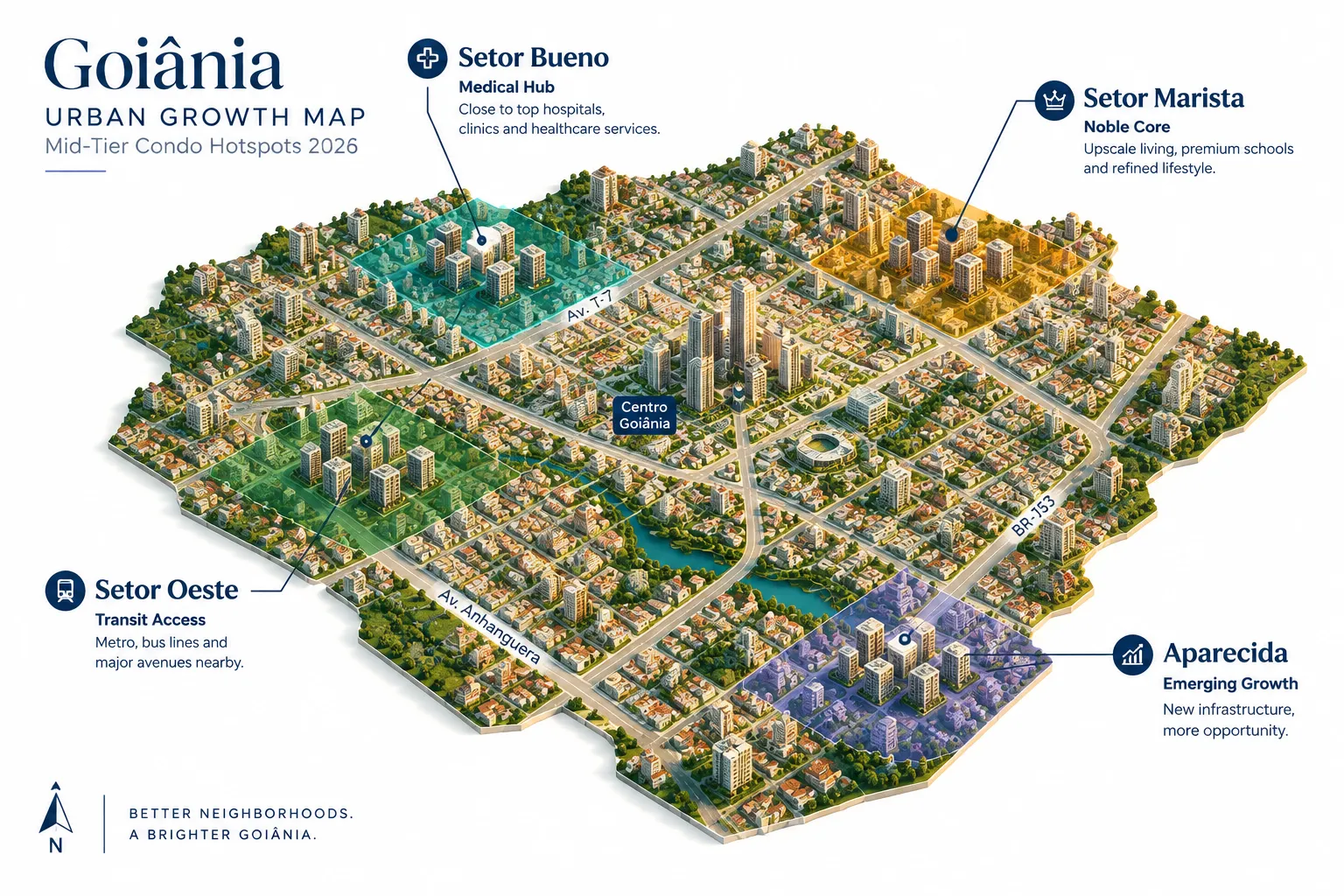
Understanding Goiania Central Brazil Hotspots 2026: Mid-Tier Condo Strategies Amid 5.52% Market CAGR requires a neighborhood-level view. Not all districts are performing equally, and entry price points vary significantly across the city’s zones.
Noble and Established Sectors
Setor Bueno and Setor Marista remain the benchmark neighborhoods for mid-to-upper mid-tier condo demand. These areas combine proximity to Goiania’s main hospital cluster, premium retail, and established infrastructure. Average asking prices in these sectors range from approximately R$7,000 to R$9,500 per square meter for quality mid-tier product [2][6].
Setor Oeste offers a slightly lower entry point while maintaining strong fundamentals, good transit access, mature commercial activity, and a resident profile of established professionals and families. Price per square meter in Setor Oeste typically runs 10-15% below Bueno, making it attractive for investors seeking value with appreciation upside.
Emerging and High-Growth Zones
The Southwest sector and the Aparecida district are the two areas drawing the most developer attention in 2026 [8]. Both zones benefit from:
- Active zoning reclassification enabling higher-density residential development
- Proximity to planned and ongoing infrastructure upgrades
- Lower land acquisition costs compared to the noble core
- A younger buyer demographic with strong FGTS-backed financing capacity
Jardim Goias and the Leste Universitario corridor are also appearing on developer radars, driven by university population density and a growing demand for compact, well-located rental units.
Price Benchmarks at a Glance
| District | Segment | Approx. R$/m² | Key Driver |
|---|---|---|---|
| Setor Bueno | Mid-Upper | R$7,500, R$9,500 | Medical hub, premium retail |
| Setor Marista | Mid-Upper | R$7,000, R$9,000 | Noble address, lifestyle amenities |
| Setor Oeste | Mid-Tier | R$5,800, R$7,200 | Transit access, value entry |
| Southwest / Aparecida | Emerging Mid | R$4,200, R$6,000 | Zoning uplift, younger buyers |
| Jardim Goias | Mid-Tier | R$5,000, R$6,800 | University demand, rental yield |
Sources: [2][6][8]
The Goias state market as a whole recorded strong price momentum entering 2026, with residential property values rising across both the capital and secondary municipalities [5]. This broader regional trend reinforces the case for Goiania-focused strategies.
Mid-Tier Condo Strategies: Product, Financing, and Yield Optimization
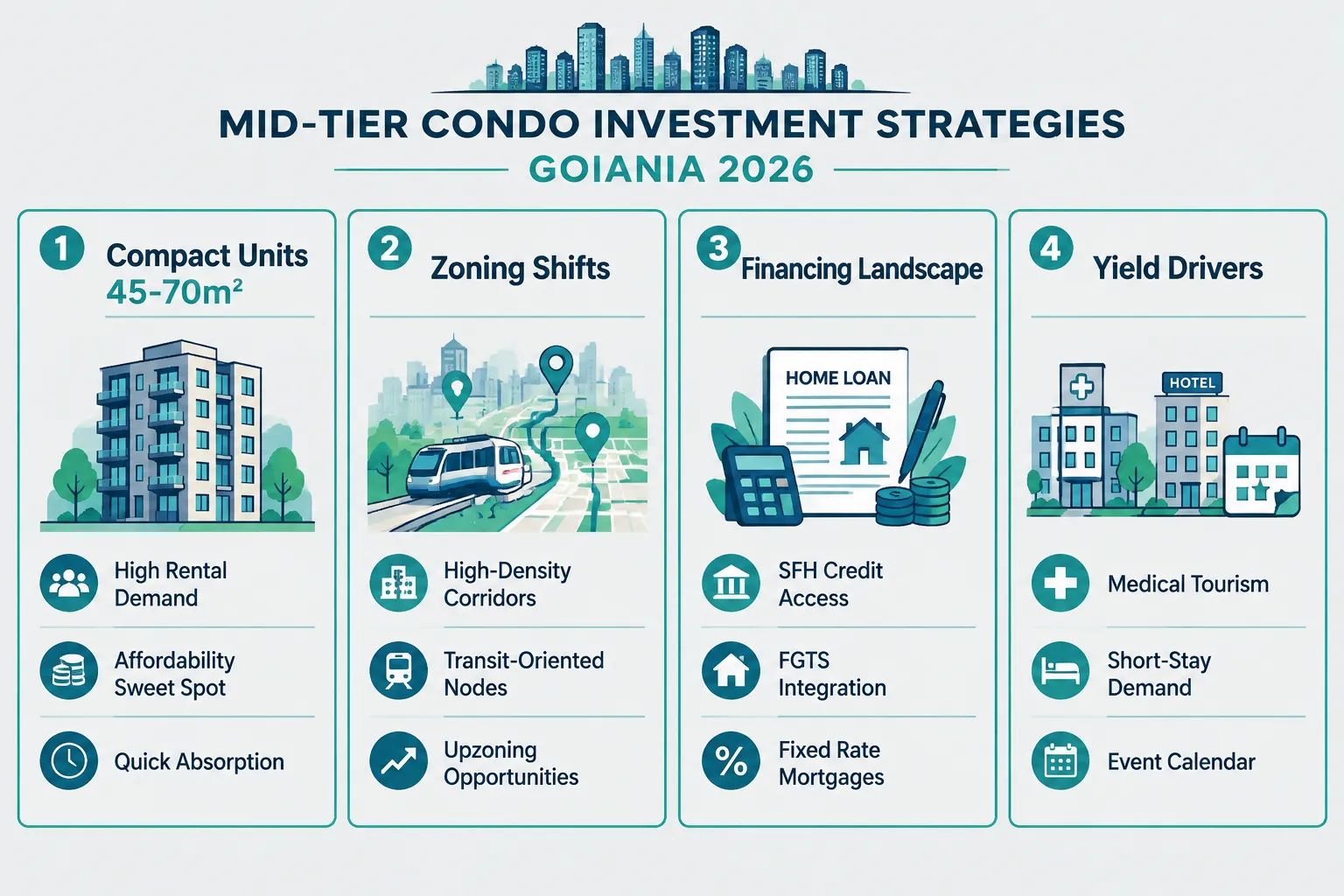
The most effective Goiania Central Brazil Hotspots 2026: Mid-Tier Condo Strategies Amid 5.52% Market CAGR approach centers on a specific product profile: compact, well-specified units in the 45-70 m² range, priced within SFH credit eligibility thresholds, and located within 15-20 minutes of employment and healthcare anchors.
Why 45-70 m² Is the Sweet Spot
This unit size hits the intersection of three demand curves simultaneously:
- First-time buyers using FGTS and SFH credit to purchase their first formal home
- Young professionals and medical residents seeking quality rental accommodation near hospital clusters
- Investors targeting short-stay and furnished rental yields, particularly around Goiania’s medical tourism calendar
The SFH credit cap expansion in 2026 has been a significant tailwind for this segment. Developers who have structured launches within the new eligibility ceiling are seeing faster pre-sales absorption and lower financing risk. For a deeper look at how this credit expansion is reshaping launch strategies, the analysis on SFH credit expansion to R$2.25m cap and mid-market launch strategies is directly applicable to the Goiania context.
Zoning Shifts as a Value Catalyst
One of the most underappreciated drivers in Goiania’s 2026 market is the active reclassification of land along transit corridors and urban expansion zones. Municipalities in Brazil’s mid-size cities are increasingly adopting transit-oriented development frameworks, and Goiania is no exception.
High-density zoning wins are concentrated in:
- Corridors connecting the Southwest sector to the city center
- Areas adjacent to planned BRT (Bus Rapid Transit) route expansions
- Peripheral neighborhoods where Reforma Casa Brasil retrofitting programs are active
Developers who acquire land ahead of formal zoning reclassification, and who can demonstrate compliance with new density parameters, are positioned for land value uplifts of 20-35% before a single unit is sold. The Reforma Casa Brasil urban retrofit strategies for mid-tier markets framework offers a directly relevant tactical playbook for this approach in Goiania’s peripheral neighborhoods.
Rental and Short-Stay Yield Dynamics
Goiania’s rental market in 2026 is being shaped by two distinct demand pools:
Long-term rental demand is driven by the city’s large medical and educational workforce. Furnished 1- and 2-bedroom units near Setor Bueno’s hospital cluster command rental premiums of 15-20% above unfurnished equivalents, with vacancy rates remaining low.
Short-stay and Airbnb demand is growing, particularly around Goiania’s medical tourism calendar, patients and families traveling for procedures generate consistent demand for quality short-stay accommodation near hospital zones. Developers incorporating flexible unit layouts and building-level amenity packages (co-working spaces, concierge services, secure parking) are capturing this yield premium.
For investors considering the short-stay angle, the broader discussion on rental market opportunities in Brazil and innovative management solutions provides a useful framework for structuring management arrangements that maximize net yields.
Amenity Positioning for Buyer Premiums
Mid-tier buyers in Goiania in 2026 are increasingly sophisticated in their expectations. The post-pandemic shift toward health and wellness amenities has reached the mid-market segment, and developers who integrate gyms, outdoor fitness areas, and co-working lounges into their amenity packages are achieving 8-12% pricing premiums over comparable units without these features. The analysis on wellness amenities in mid-market developments and post-pandemic buyer premiums is highly relevant for developers calibrating their specification decisions in Goiania.
Risk Considerations and Due Diligence for 2026
Goiania’s growth story is compelling, but the market is not without risk. Investors and developers entering in 2026 should stress-test their assumptions against several key variables.
Macroeconomic and Financing Risk
The Selic rate, while on a gradual downward path, remains elevated relative to historical norms. This keeps mortgage costs high for end buyers and compresses affordability at the upper end of the mid-tier range. Developers should model scenarios where financing costs remain sticky through 2027, ensuring that pre-sales absorption targets are achievable even without a significant rate reduction.
The broader analysis on election year fiscal risks and stress-testing housing pipelines is essential reading for any developer with a multi-year pipeline in Goiania, as 2026’s political calendar introduces potential policy discontinuity risk.
Regulatory and Zoning Complexity
Goiania’s rapid growth is straining municipal planning capacity. Zoning reclassifications that appear straightforward can face delays, appeals, or reversals. The city’s registry and title infrastructure, while improving, still presents documentation challenges that require specialist legal support.
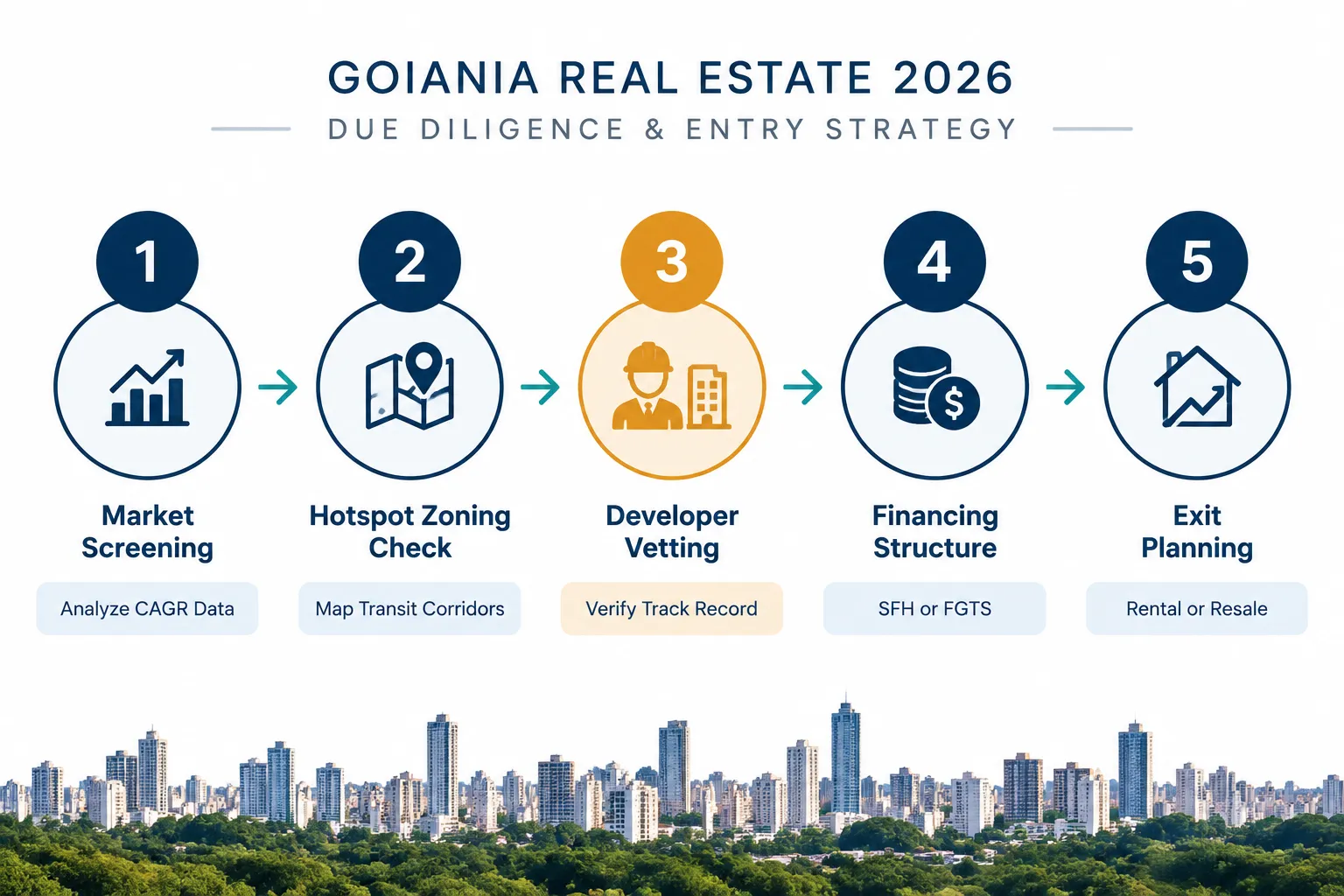
Due diligence non-negotiables for Goiania in 2026:
- Full chain-of-title verification through a qualified local notary
- Confirmation of zoning classification at both municipal and state levels
- Environmental clearance checks, particularly for Southwest sector land near cerrado preservation zones
- Developer track record verification, including delivery history and financial health
Automated due diligence tools are increasingly being deployed by institutional buyers in Goiania to accelerate these checks without sacrificing rigor [3]. The proptech revolution in Brazil and AI valuation tools driving development efficiency covers how these technologies are being applied in markets exactly like Goiania.
Competitive Intensity
Goiania’s strong fundamentals have attracted a significant increase in developer activity. Launch volumes in 2026 are running ahead of 2024 levels, and some micro-markets, particularly around Setor Bueno, are showing early signs of supply pressure at specific price points. Investors should monitor launch pipelines carefully and prioritize projects with genuine differentiation (location, specification, or brand) over commodity product.
Positioning Goiania Within a Broader Brazil Portfolio
For investors already active in Brazil’s coastal or southern markets, Goiania offers a diversification argument that is difficult to ignore. The city’s growth is driven by domestic fundamentals, not tourism cycles, not foreign currency dynamics, making it a relatively stable allocation within a diversified Brazilian real estate portfolio.
Compared to coastal markets where short-stay yields are the primary return driver, Goiania’s mid-tier condo market offers a more balanced return profile: moderate but consistent capital appreciation (supported by the 5.52%+ CAGR backdrop), reliable long-term rental income, and a growing short-stay component that adds yield optionality without dependency.
For investors evaluating where to invest in real estate in Brazil across multiple city types, Goiania’s position as the third-largest market with above-average growth rates and a deep mid-tier demand base makes it a core allocation rather than a speculative bet [3].
Conclusion: Actionable Steps for Mid-Tier Condo Investment in Goiania 2026
The data for Goiania Central Brazil Hotspots 2026: Mid-Tier Condo Strategies Amid 5.52% Market CAGR points clearly toward a market in structural expansion, not cyclical recovery. The city’s urbanization trajectory, combined with zoning reforms, SFH credit expansion, and a diversified demand base, creates a compelling environment for mid-tier condo strategies across multiple sub-segments.
Actionable next steps for investors and developers:
- Prioritize the 45-70 m² unit format within SFH credit eligibility thresholds, this is where absorption velocity is highest and financing risk is lowest.
- Map zoning reclassification activity in the Southwest sector and Aparecida before committing to land acquisition, the uplift opportunity is real but requires early positioning.
- Integrate wellness and co-working amenities into mid-tier specifications to capture the 8-12% pricing premium that differentiated product is achieving over commodity alternatives.
- Stress-test financing assumptions against a scenario where the Selic rate remains above 12% through 2027, projects that work in this scenario are genuinely resilient.
- Deploy specialist due diligence support, title verification, zoning confirmation, and developer vetting are non-negotiable in a market where complexity is rising alongside opportunity.
- Monitor launch pipeline data quarterly, competitive intensity is increasing in Goiania’s noble sectors, and supply signals should inform both timing and pricing decisions.
Goiania’s urbanization leap is not a future story, it is happening now, and the mid-tier condo segment is at its center. Investors who move with discipline and data in 2026 are positioned to capture a meaningful share of what the next five years have to offer.
References
[1] Mercado De Imoveis De Goiania Cresce 3 Vezes Mais Que O Do Brasil – https://empreenderemgoias.com.br/2026/06/10/mercado-de-imoveis-de-goiania-cresce-3-vezes-mais-que-o-do-brasil/
[2] Mercado Imobiliario Goiania 2026 – https://www.faenzoimoveis.com/blog/mercado-imobiliario-goiania-2026
[3] Goiania E O 3 Maior Mercado Imobiliario Do Brasil Em 2026 Dados Riscos E Como Automatizar A Due Diligence – https://dihub.com.br/blog/goiania-e-o-3-maior-mercado-imobiliario-do-brasil-em-2026-dados-riscos-e-como-automatizar-a-due-diligence
[4] Mercado Imobiliario De Goiania Movimenta Mais De R 8 Bilhoes Em 2025 E Mantem Estabilidade – https://www.podergoias.com.br/materia/25491/mercado-imobiliario-de-goiania-movimenta-mais-de-r-8-bilhoes-em-2025-e-mantem-estabilidade
[5] Mercado Imobiliario Registra Alto Em Goias – https://ohoje.com/2026/01/12/mercado-imobiliario-registra-alto-em-goias/
[6] Goiania – https://tulugar.com/en/market/brasil/goiania
[7] Price History – https://www.globalpropertyguide.com/latin-america/brazil/price-history
[8] Regioes De Goiania Devem Concentrar Valorizacao Imobiliaria Em 2026 – https://timesbrasil.com.br/empresas-e-negocios/imoveis/regioes-de-goiania-devem-concentrar-valorizacao-imobiliaria-em-2026/
[9] House – https://www.properstar.com/brazil/goiania-loc/buy/house
[10] Goiania Brazil Rising Investment Hub Foreign Investors – https://www.linkedin.com/pulse/goi%C3%A2niabrazil-rising-investment-hub-foreign-investors-rafael-faggin-twwzf