
Developers who acquired land within 10 kilometers of Brazil’s BR-040 corridor before its $1 billion concession award saw valuations surge before a single kilometer of new asphalt was poured. That pattern is about to repeat — at scale. The Highway Concession Boom 2026: Property Value Uplift Tactics for Developers Along Brazil’s 15 New Routes is not a future opportunity; it is an active land grab unfolding right now across Brazil’s underserved inland regions, where connectivity upgrades are converting dormant agricultural corridors into high-demand real estate markets.
Brazil’s federal government has committed to the largest road concession program in the world [1], with 10–15 new highway auctions expected in 2026 alone as part of President Lula’s infrastructure push — bringing the total to 35 concessions by the end of the current government term. For developers who understand how to read infrastructure signals, these routes represent a rare, time-sensitive window to capture 15–25% property value premiums by positioning assets before institutional capital floods the corridor.
Key Takeaways 📌
- 15 new highway concession routes are being auctioned in 2026 as part of Brazil’s record-breaking infrastructure pipeline, creating direct property uplift opportunities along each corridor.
- Land acquisition timing is everything — developers who move 12–24 months ahead of construction commencement consistently capture the largest valuation premiums.
- Inland and secondary cities along new routes offer the highest upside, as connectivity scarcity is resolved almost overnight by concession-linked upgrades.
- Mixed-use and logistics-adjacent developments near highway interchanges are the highest-performing asset classes in post-concession corridors.
- Brazil’s broader infrastructure push — including $7.2 billion in port investments [1] — amplifies the value of highway-adjacent land in multimodal logistics zones.
Understanding Brazil’s 2026 Highway Concession Pipeline
Brazil’s highway sector is currently the most-invested infrastructure segment in the country [7], and the numbers behind the 2026 pipeline are staggering. The federal government has projected US$21.5 billion in investments tied to new highway auctions [5], with the Transport Ministry describing the program as the world’s largest road concession initiative [1].
The Scale of What’s Coming
Key facts developers must internalize:
| Metric | Detail |
|---|---|
| New concessions expected by end of term | 35 total [1] |
| New highway auctions in 2026 | 10–15 [1] |
| Additional highway km added to PPP agenda | 1,400 km [7] |
| VINCI Highways BR managed km | ~1,200 km [2] |
| BR-040 concession value | ~$1 billion [3] |
| Port sector investment projected through 2026 | $7.2 billion [1] |
VINCI Highways recently commenced operations on the Via Cristais corridor (Belo Horizonte–Cristalina), a 594-kilometer, 30-year concession managed under Brazil’s National Land Transportation Agency (ANTT) [2]. The OHLA consortium’s $1 billion award for BR-040 — covering 218.9 kilometers connecting Rio de Janeiro and Minas Gerais — is projected to generate over 130,000 direct and indirect jobs [3]. These are not abstract statistics. They are demand generators for housing, logistics, retail, and mixed-use development along every kilometer of new route.
💬 “Our pipeline is now the largest road concession program in the world.” — Brazil’s Transport Minister [1]
The additional 1,400 kilometers of highways recently folded into Brazil’s PPP and concessions agenda [7] signals that the government is actively expanding the footprint beyond the original 15 routes — meaning developer opportunity zones are growing, not shrinking.
How Highway Concessions Drive Property Value Uplift
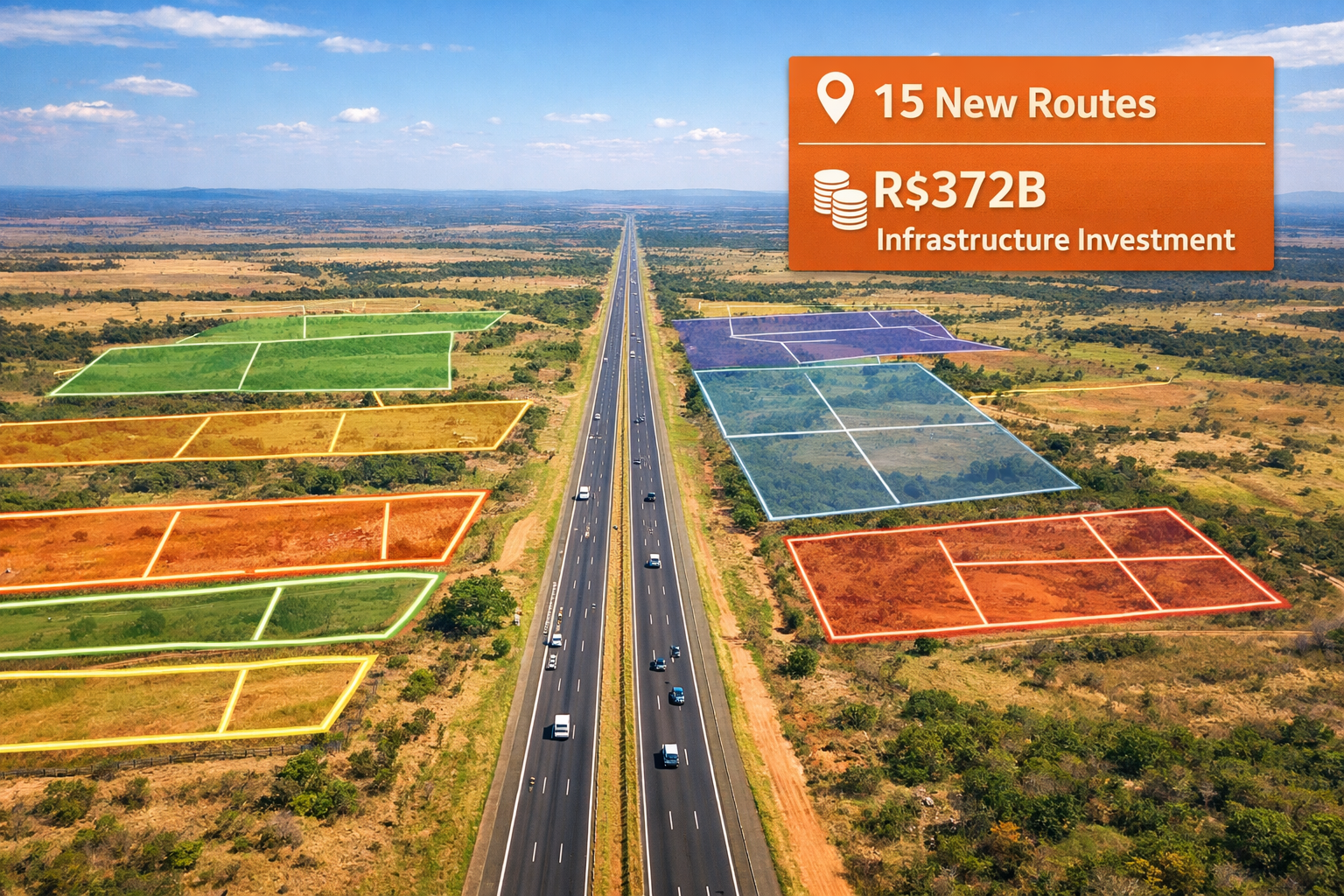
The relationship between infrastructure investment and real estate appreciation is well-documented globally, but Brazil’s concession model creates a particularly sharp and predictable uplift curve. Understanding the mechanics allows developers to front-run the market rather than react to it.
The Four-Stage Value Curve
Property values along new concession corridors typically follow a four-stage pattern:
- Pre-announcement (Stealth Phase): Land trades at agricultural or undeveloped rates. Informed developers accumulate positions quietly.
- Announcement & Auction (Signal Phase): Values begin rising 8–15% as institutional awareness grows. This is the last window for mid-tier developers.
- Construction Commencement (Momentum Phase): Values accelerate 15–25% above pre-announcement baselines as demand for worker housing, logistics, and retail explodes.
- Operations Commencement (Maturity Phase): Stabilized but elevated values; premium is locked in for early movers.
Why Inland Corridors Outperform Coastal Markets
Brazil’s coastal cities — São Paulo, Rio de Janeiro, Florianópolis — already price in connectivity. The 15–25% premium opportunity is concentrated in inland secondary cities where:
- Road quality has historically suppressed land values below fundamental potential
- Agricultural land is being re-zoned as urban expansion follows infrastructure
- Local governments are incentivizing development to capture tax base growth
- Competition from institutional developers remains lower than in coastal markets
For developers already active in high-growth coastal markets, understanding the best places to invest in Brazilian property provides a useful benchmark for comparing inland corridor yields against established coastal returns.
Asset Classes With the Highest Uplift Potential
Not all property types benefit equally. Ranked by typical value uplift near new concession corridors:
- 🏭 Logistics and distribution centers — highest demand, driven by reduced transport costs
- 🏘️ Residential subdivisions near interchange towns — worker housing and middle-class migration
- 🏪 Commercial strips along access roads — fuel, food, services serving highway traffic
- 🏗️ Mixed-use developments in corridor cities with populations of 50,000–200,000
- 🌾 Agricultural land with rezoning potential — lowest entry cost, highest risk/reward ratio
Highway Concession Boom 2026: Property Value Uplift Tactics for Developers Along Brazil’s 15 New Routes — Strategic Playbook
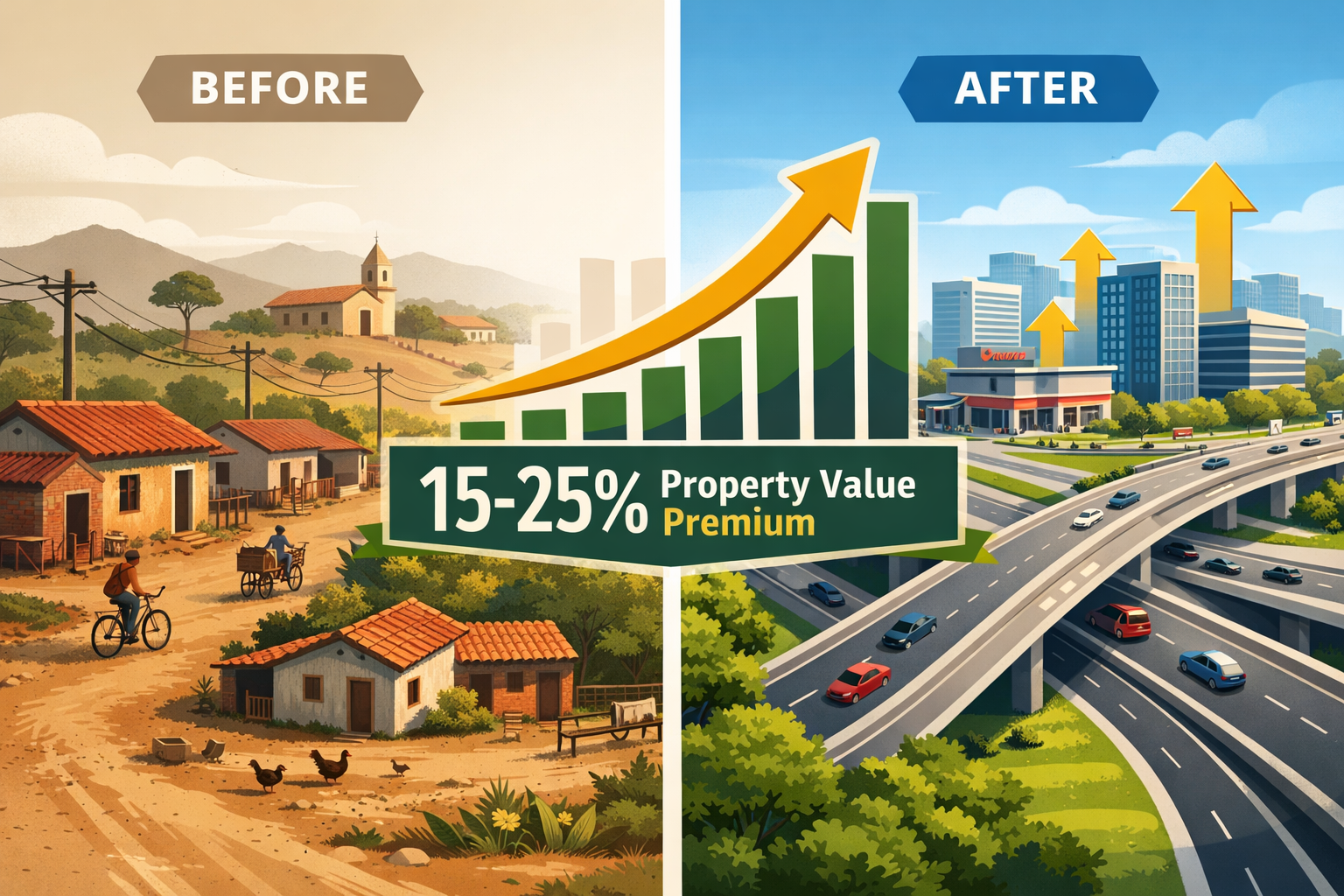
Capturing the value uplift described above requires more than geographic proximity to a new route. Developers who consistently outperform the market apply a disciplined set of tactics that combine timing, zoning intelligence, and capital structure optimization.
Tactic 1: Map the Interchange, Not the Highway
The highway itself is not the value driver — the interchange is. Every new concession route creates 8–15 interchange points, and each one becomes a micro-economy anchor. Developers should:
- Identify planned interchange locations from ANTT concession documentation (publicly available)
- Acquire land within a 2–5 km radius of planned interchanges before construction begins
- Prioritize interchanges near existing towns with 20,000+ population (built-in demand base)
- Avoid mid-corridor positions with no interchange access — these rarely generate residential demand
Tactic 2: Time Land Acquisition to the Auction Calendar
The auction announcement date is the single most important timing signal. Historical data from Brazilian concession corridors shows that land values within 10 km of new routes begin rising 6–12 months before the auction date as rumors and pre-qualification activity leak into local markets.
The optimal acquisition window is 12–24 months before the scheduled auction, when:
- Route alignment is confirmed but not yet widely publicized
- Local landowners have not yet repriced assets to reflect infrastructure premium
- Financing is available at pre-appreciation valuations
With 10–15 auctions expected in 2026 [1], developers who are not already in acquisition mode for 2026 routes are already behind the curve. The time to act is now.
Tactic 3: Partner With Local Developers in Corridor Cities
Inland corridor cities have existing local developers who understand municipal politics, zoning boards, and community dynamics. Joint ventures with local partners allow outside developers to:
- Access off-market land parcels before they reach brokers
- Navigate municipal approval processes faster
- Reduce political risk in communities where outside capital can face resistance
- Share infrastructure costs (roads, utilities) that are often prohibitive for single developers
This tactic mirrors successful models used in Florianópolis’s growth corridors. Developers tracking the real estate market performance in Greater Florianópolis will recognize the same dynamics playing out in inland markets — just at an earlier stage of the cycle.
Tactic 4: Structure Pre-Sales to Fund Land Acquisition
Brazil’s incorporação imobiliária (property development) model allows developers to sell units off-plan before construction begins, using buyer deposits to fund land acquisition and early construction costs. This structure is especially powerful in corridor markets because:
- Pre-sale prices can be set below projected post-completion values, attracting buyers
- Developers capture the appreciation curve without fully funding construction upfront
- Pre-sale velocity validates demand before committing full capital
For developers new to this model, understanding how off-plan property purchases generate value is essential reading before entering corridor markets.
Tactic 5: Target Multimodal Logistics Zones
Brazil’s infrastructure investment is not limited to highways. The $7.2 billion in port sector investment projected through 2026 — including 60 port auctions planned over four years [1] — means that highway corridors connecting inland agricultural regions to port cities carry double the value uplift potential: they serve both domestic connectivity and export logistics demand.
Developers who identify highway-port multimodal intersections — where new concession routes connect to port expansion zones — are positioning in the highest-demand segments of the Brazilian logistics real estate market.
Tactic 6: Monitor the 1,400 km PPP Expansion
The recent addition of 1,400 kilometers of highways to Brazil’s PPP and concessions agenda [7] means that the opportunity set extends well beyond the initially announced 15 routes. Developers should:
- Subscribe to ANTT and Ministry of Transport announcement feeds
- Engage infrastructure law firms to receive early-stage route alignment intelligence
- Build relationships with state-level secretaries of infrastructure who often know route alignments before federal announcements
Risk Factors Developers Must Manage
No infrastructure-linked real estate strategy is without risk. The following factors require active management:
⚠️ Concession delay risk: Brazilian infrastructure projects have historically experienced timeline slippage. Developers should underwrite land acquisitions assuming a 12–18 month delay buffer beyond announced construction timelines.
⚠️ Route alignment changes: Final route alignments can shift by several kilometers from initial announcements. Acquiring land based on preliminary maps carries misalignment risk. Confirm alignment from ANTT’s final environmental licensing documentation before committing.
⚠️ Municipal zoning lag: Infrastructure arrives faster than municipal zoning updates in many inland cities. Developers may face delays in obtaining residential or commercial permits even after highway construction begins. Engage municipal planning departments early.
⚠️ Currency and financing risk: For international developers, BRL/USD volatility can erode returns. Structuring revenues and costs in the same currency where possible reduces exposure.
⚠️ Community opposition: Large-scale developments in previously low-density corridor towns can face community resistance. Early stakeholder engagement is not optional — it is a risk management tool.
Connecting Corridor Strategy to Established Markets
While inland corridor opportunities offer the highest uplift percentages, sophisticated developers balance their portfolios across both emerging corridor markets and established high-demand urban centers.
Brazil’s coastal innovation hubs — particularly Florianópolis — demonstrate what corridor cities can become once infrastructure matures. The growth of the Ingleses region in Florianópolis provides a template: a previously underserved area transformed by infrastructure investment into a premium residential and commercial market.
Developers building corridor-focused portfolios should also examine studio apartment investment advantages in Florianópolis as a comparable case study in how compact, well-located units near infrastructure nodes outperform larger, less-connected assets.
The Highway Concession Boom 2026: Property Value Uplift Tactics for Developers Along Brazil’s 15 New Routes strategy is most powerful when corridor acquisitions are paired with positions in mature markets that provide stable cash flow while corridor assets appreciate.
Conclusion: Act Before the Auction Bell Rings
The Highway Concession Boom 2026: Property Value Uplift Tactics for Developers Along Brazil’s 15 New Routes represents one of the most clearly signaled real estate opportunities in Latin America’s recent history. The government has publicly committed to the world’s largest road concession program [1]. The auction calendar is known. The value uplift mechanics are proven. The only variable is whether developers act before or after the market prices in the opportunity.
Actionable Next Steps for Developers in 2026:
- Audit the 2026 auction calendar — Download ANTT’s published concession schedule and map all routes against your existing land bank and target markets.
- Identify 3–5 interchange zones along new routes where population density and existing town infrastructure support residential or mixed-use development.
- Begin local partner outreach in target corridor cities — relationships take 6–12 months to convert into deal flow.
- Engage a Brazilian infrastructure law firm to access pre-announcement route intelligence and environmental licensing documents.
- Model pre-sale structures for corridor projects to reduce upfront capital requirements and validate demand before full commitment.
- Diversify across corridor and established markets — explore current development projects in proven Brazilian markets to balance portfolio risk while corridor assets mature.
The auction bell for Brazil’s 15 new highway routes is ringing. Developers who have already mapped their positions will capture the premium. Those still deliberating will pay it.
References
[1] Brazil Projects New Logistics Concessions By 2026 – https://brazilstockguide.com/insights/brazil-projects-new-logistics-concessions-by-2026/
[2] Vinci Brazil Concession – https://highways.today/2025/04/28/vinci-brazil-concession/
[3] Ohla Wins 1 Billion Highway Concession Contract In Brazil For Br 040 – https://www.ohla-group.com/en/ohla-wins-1-billion-highway-concession-contract-in-brazil-for-br-040/
[4] Odebrecht Wins Brazilian Highway Concession – https://www.globalhighways.com/wh8/wh10/news/odebrecht-wins-brazilian-highway-concession?page=20
[5] Brazil Prepares New Highway Auction With Us215 Billion In Projected Investments – https://www.bnamericas.com/en/news/brazil-prepares-new-highway-auction-with-us215-billion-in-projected-investments
[6] Is 2026 The Year Brazil Unlocks Its Infrastructure Ambitions – https://www.agri-pulse.com/articles/24227-is-2026-the-year-brazil-unlocks-its-infrastructure-ambitions
[7] Brazil Sees The Inclusion Of Another 1400 Km Of Highways In The Ppp And Concessions Agenda – https://www.bnamericas.com/en/news/brazil-sees-the-inclusion-of-another-1400-km-of-highways-in-the-ppp-and-concessions-agenda