
Brazil’s residential rents rose 9.4% in 2025, more than double the country’s consumer price inflation, and analysts at both FipeZAP and FGV expect upward pressure to persist well into 2026 [1][10]. That single data point is reshaping how institutional developers think about the entire residential pipeline. Rather than building to sell, a growing cohort of asset managers and large-scale developers is asking a different question: what if the building itself is the product, and monthly rent is the revenue stream?
This article examines the forces driving the Rental Market Boom and Build-to-Rent Models: Scaling Institutional Residential Projects in Brazil’s Urban Fringe for 2026, from the macroeconomic triggers behind surging rents to the profitability frameworks, PropTech tools, and site-selection logic that make urban-fringe build-to-rent (BTR) projects viable at scale. It also compares the BTR model directly against the traditional sales pipeline to help developers and investors decide where to allocate capital.
Key Takeaways
- Brazilian residential rents rose 9.4% in 2025, more than double inflation, with FGV recording the highest annual rental variation since its index launched in 2019 [1][10].
- High interest rates are the primary structural driver: as mortgage costs rise, middle-income households shift from buying to renting, expanding the tenant pool for institutional BTR projects.
- Gross rental yields averaged 5.9-5.96% per year in 2025 across 36 monitored cities, providing a measurable income benchmark for rental-focused investment strategies [1][8].
- Urban-fringe locations offer cheaper land for large-scale BTR development, especially where Novo PAC infrastructure investments are improving connectivity.
- PropTech platforms, from AI-driven site selection to centralized property management systems, are critical to making institutional BTR economics work at volume.
Why Rents Are Surging: The Structural Drivers Behind the 2026 Rental Boom
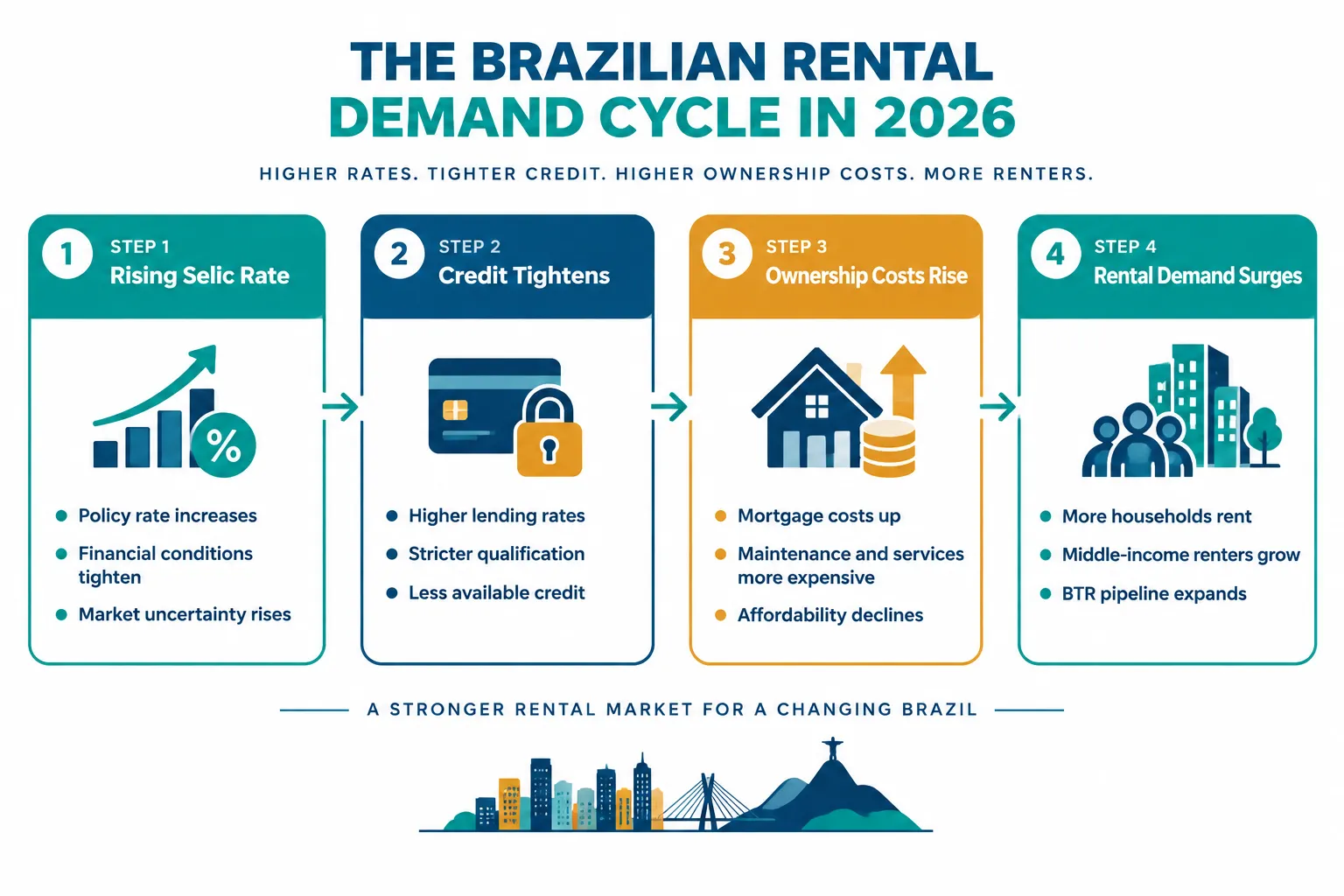
The FGV Índice de Variação de Aluguéis Residenciais (IVAR) recorded an 8.85% average rise in residential rents in 2025, the highest annual rate since the index was launched in 2019 [10]. FipeZAP’s own data for December 2025 put the average rent at R$50.98/m² across 36 monitored cities, meaning a typical 50 m² apartment on a new contract costs approximately R$2,549 per month [1]. Monthly momentum also remained firm: IVAR showed a 0.51% gain in December 2025, accelerating from 0.37% in November [10].
Three structural forces explain this trajectory.
1. High Interest Rates Pricing Out Buyers
Brazil’s Selic rate remained elevated through 2025, pushing mortgage costs well above the comfort threshold for middle-income households. When ownership becomes financially out of reach, households do not disappear, they rent instead. This dynamic is not cyclical; it is structural as long as credit conditions remain tight. For a deeper look at how financing shifts are reshaping demand, see the analysis of fixed-rate mortgage models vs floating-rate financing and Brazil’s stabilizing Selic trajectory.
2. Restricted Supply in Central Areas
Urban land scarcity in São Paulo, Rio de Janeiro, and other major capitals limits new residential supply near employment centers. Restricted supply combined with growing demand is the textbook formula for sustained rent inflation [10][14].
3. Persistent Services Inflation
FGV economist Matheus Dias has noted that services inflation compounds rental pressure, because landlords incorporate rising operating costs into lease renewals [10]. An Infomoney analysis for November 2025 recorded a 0.59% monthly rent increase and approximately 9.7% over 12 months, far above the 4-4.5% consumer price inflation range [14].
“Rent adjustments will continue to accelerate in 2026, driven by high interest rates, persistent services inflation and restricted housing supply, especially in central areas.”, FGV economist Matheus Dias [10]
Despite this strength, the pace is moderating from its post-pandemic peak. From January to August 2025, average rents rose 6.83%, compared with 10.18% in the same period of 2024 [4][13]. This signals a maturing cycle: still well above inflation, but no longer accelerating at extraordinary rates. Analysts quoted by G1 and other outlets expect rent increases to stay above inflation at least through the first half of 2026 [2][12].
Build-to-Rent Models Explained: How Institutional Projects Differ from Traditional Sales Pipelines
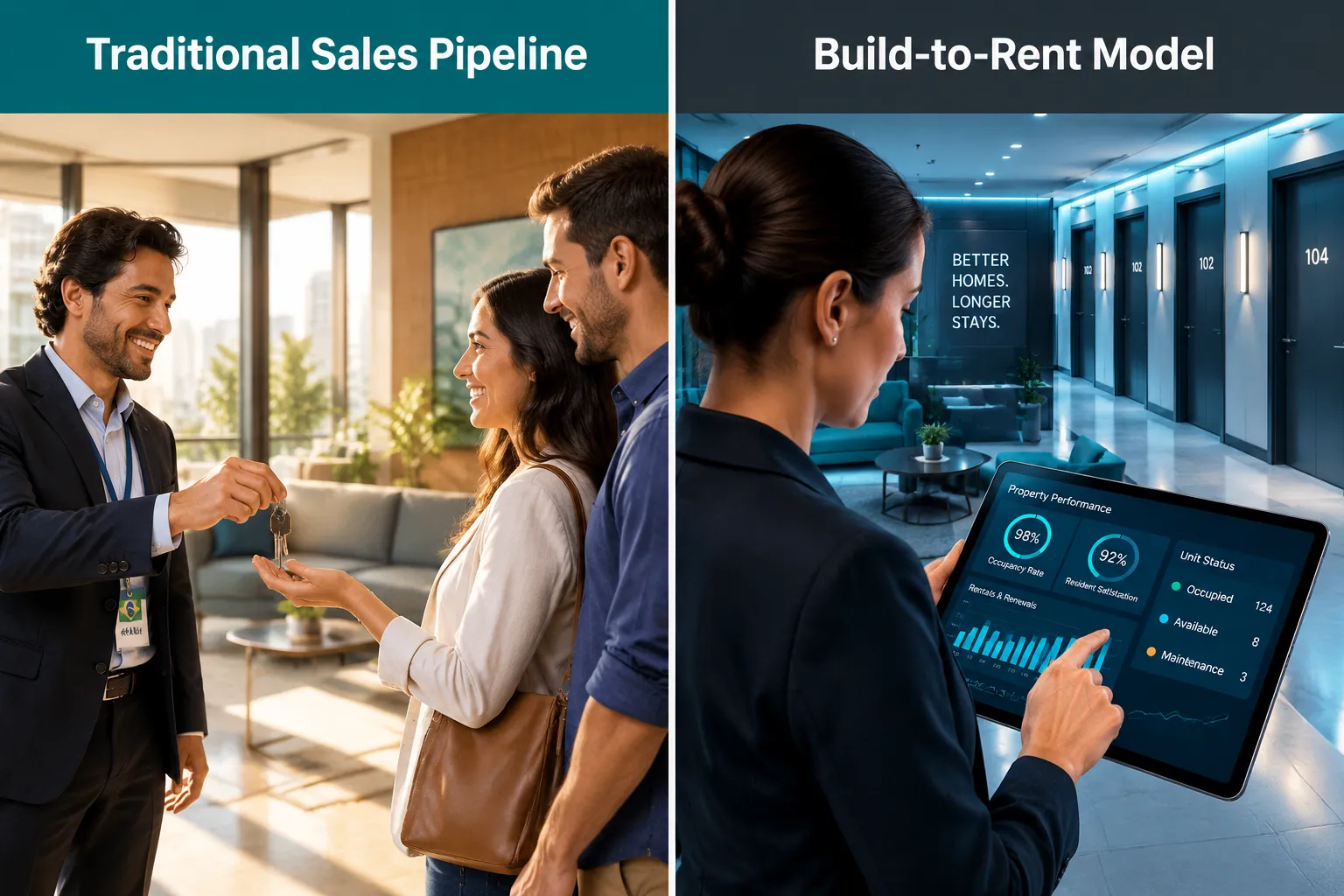
Brazil’s BTR model, locally described as “prédios só para alugar”, involves a single institutional owner retaining an entire residential building and operating it as a long-term rental business [15]. Revenue comes from recurring monthly rents rather than unit sales. This is a fundamentally different business model from the traditional Brazilian residential developer playbook, which relies on pre-selling units off-plan and using buyer deposits to fund construction.
Traditional Sales Pipeline vs. Build-to-Rent: A Comparison
| Dimension | Traditional Sales Pipeline | Build-to-Rent Model |
|---|---|---|
| Revenue timing | Lump sum at delivery or pre-sale | Recurring monthly income |
| Capital recovery | Fast (12-36 months post-launch) | Gradual (5-10+ year horizon) |
| Market risk | High exposure to credit cycle | Diversified across many tenants |
| Gross yield benchmark | Margin on sale price (variable) | 5.9-5.96% gross yield p.a. [1][8] |
| Management complexity | Ends at delivery | Ongoing, requires PropTech systems |
| Inflation hedge | Partial (asset value) | Strong (rents indexed above CPI) |
| Ideal investor profile | Developer seeking capital turnover | Institutional fund, REIT, family office |
The gross yield figure is critical context. FipeZAP calculated average gross residential rental yields at 5.93% per year in July 2025, and the full-year 2025 figure settled in the 5.9-5.96% range [1][8]. While this sits marginally below certain Selic-indexed fixed-income benchmarks, it offers diversification, inflation linkage, and asset appreciation that pure fixed-income products do not. Media coverage in investment-oriented outlets has noted growing interest in “renda imobiliária” vehicles that monetize the strong rental cycle rather than relying on capital gains alone [1][2].
For developers exploring how rental market opportunities in Brazil in 2026 can be captured through innovative management solutions, the BTR model represents a structural shift in how residential assets are conceived from the ground up.
Scaling Institutional Residential Projects in Brazil’s Urban Fringe for 2026: Site Selection and Land Economics
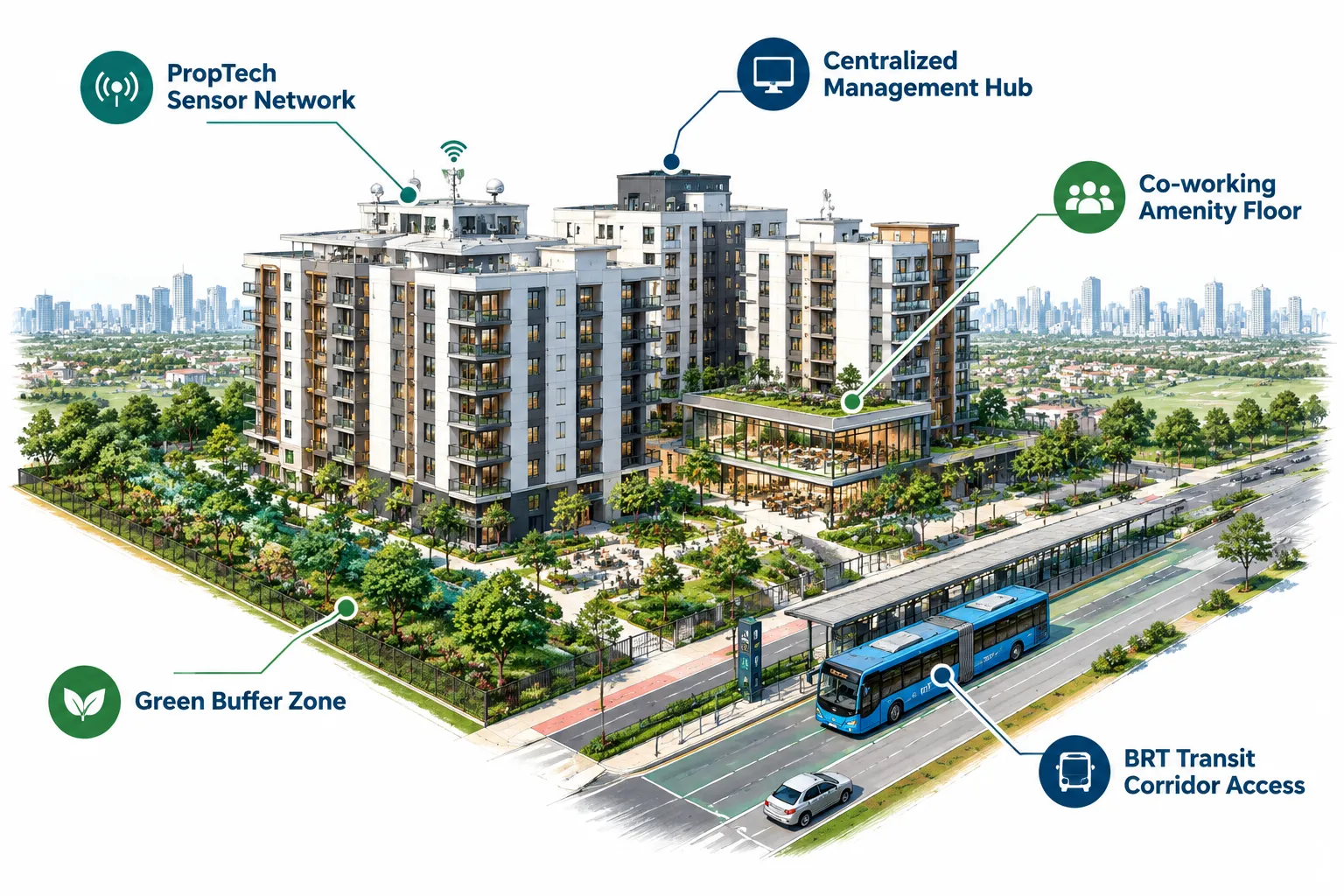
The core economic logic of the Rental Market Boom and Build-to-Rent Models: Scaling Institutional Residential Projects in Brazil’s Urban Fringe for 2026 rests on a simple land-cost arbitrage: urban-fringe locations offer significantly cheaper land per square meter than central districts, allowing developers to build larger communities at lower entry costs while still capturing the strong rental demand generated by households priced out of central ownership.
What Makes Urban-Fringe Sites Viable in 2026
Several converging factors are improving the investment case for urban-fringe BTR development:
- Infrastructure investment: Novo PAC highway and railway projects are extending connectivity from major metros into previously underserved peripheries. Developers tracking Novo PAC infrastructure investments and their impact on inland development sites can identify corridors where land values have not yet priced in future connectivity gains.
- Sanitation upgrades: Novo PAC sanitation programs are unlocking residential development in areas that previously lacked basic infrastructure. The relationship between sanitation investments and residential development in Brazil’s underserved urban peripheries is a key enabler for BTR viability outside city centers.
- Middle-income demand pool: Households earning 5-10 minimum wages, too wealthy for Minha Casa Minha Vida subsidies, too stretched by high Selic rates to buy, represent the primary BTR tenant market. Urban-fringe locations with good BRT or metro access can serve this demographic effectively.
- Scale advantages: Larger land parcels on the fringe allow developers to build 200-500+ unit communities, spreading management costs across more units and making PropTech investment economically justified.
Key Site-Selection Criteria for BTR Urban-Fringe Projects
| Criterion | Minimum Threshold | Why It Matters |
|---|---|---|
| Distance to employment center | Under 45 min by transit | Tenant retention and occupancy |
| Land cost as % of total project cost | Below 20% | Preserves yield margin |
| Existing or planned BRT/metro access | Confirmed corridor | Reduces vacancy risk |
| Sanitation infrastructure status | Completed or funded | Avoids regulatory delays |
| Population growth rate (municipality) | Above 1.5% per year | Demand sustainability |
The secondary cities surge also creates BTR opportunities beyond the São Paulo and Rio metropolitan areas. Developers with playbooks for scaling residential projects in inland Brazil beyond MCMV hotspots are increasingly finding that mid-sized cities with strong employment bases, particularly in agribusiness, logistics, and manufacturing, generate stable rental demand with lower competition from institutional players.
PropTech as the Operating System for Institutional BTR at Scale
Managing 300 rental units in a single complex is categorically different from managing 300 individually owned condominiums. Institutional BTR only becomes economically efficient when technology handles the operational overhead that would otherwise require large on-site teams. This is where PropTech moves from a nice-to-have feature to a structural requirement.
Core PropTech Capabilities for BTR Operations
Tenant acquisition and screening AI-driven platforms can score prospective tenants against payment history databases, income verification APIs, and behavioral signals, reducing default rates and vacancy periods. For context on how AI and digital tools are transforming Brazilian residential development, the overview of PropTech innovations including AI-driven site selection and VR tours in Brazil is directly relevant.
Centralized lease management Cloud-based platforms allow a single management team to handle lease renewals, rent adjustments, maintenance requests, and compliance documentation across hundreds of units. Automated IGPM or IPCA indexation triggers ensure that rent adjustments happen on schedule without manual intervention.
Predictive maintenance IoT sensor networks embedded during construction (a key advantage of purpose-built BTR over converted stock) can flag HVAC, plumbing, and electrical issues before they become costly failures, reducing maintenance spend per unit by an estimated 15-25% compared to reactive maintenance models.
Dynamic pricing Similar to hotel revenue management, BTR operators can use occupancy data, local market comparables, and seasonal demand signals to optimize rent levels at lease renewal, capturing more of the upside in a rising market like 2026 while managing vacancy risk in softer periods.
Resident experience apps Digital portals for rent payment, service requests, amenity booking, and community communication reduce churn by improving the tenant experience, a critical metric given that tenant turnover is the single largest operational cost in a BTR portfolio.
The intersection of construction technology and BTR is also worth noting. Developers using BIM and 3D printing for high-volume residential launches can design BTR buildings with standardized unit layouts that reduce both construction costs and ongoing maintenance complexity, since every unit uses identical fixtures and systems.
Profitability Models: Making the Numbers Work for Urban-Fringe BTR
The financial case for BTR in Brazil’s urban fringe in 2026 rests on four levers: land cost, construction cost, rental yield, and occupancy rate. Each lever is interdependent, and institutional developers must stress-test all four before committing capital.
Illustrative BTR Project Economics (Urban Fringe, 300 Units)
- Land cost per unit: R$25,000, R$45,000 (urban fringe vs. R$80,000, R$150,000 in prime central districts)
- Construction cost per m²: R$3,500, R$4,500 (using BIM-optimized, standardized layouts)
- Average unit size: 45-55 m²
- Target gross yield: 5.9-6.5% per year [1][8]
- Stabilized occupancy target: 93-96%
- Operating expense ratio: 25-35% of gross rental income (management, maintenance, taxes, insurance)
- Net yield range: 4.0-4.8% per year at stabilization
At these parameters, a 300-unit urban-fringe BTR project with an all-in cost of approximately R$180,000 per unit (land plus construction plus soft costs) and an average rent of R$2,200/month generates a stabilized net operating income that supports both debt service and equity returns, particularly for institutional investors with lower cost-of-capital than individual landlords.
The tax reform dimension matters here. Developers need to account for the fiscal changes introduced by Brazil’s 2026 tax reform cycle, which affects cost structures for residential rental income. A careful review of tax reform impacts on Brazil property development and the new fiscal rules for residential launches is essential before finalizing project pro formas.
Risk Factors to Model
- Selic rate trajectory: If rates decline faster than expected, some households will shift back to ownership, reducing tenant demand. However, the structural housing deficit means this effect is likely to be gradual.
- Construction cost inflation: INCC (National Construction Cost Index) has historically run above general inflation, compressing margins if not locked in through fixed-price EPC contracts.
- Regulatory risk: Short-term rental regulation changes, particularly relevant for mixed-use BTR projects, can alter the competitive landscape. The evolving framework around short-term rental regulation and condo design in Brazil is worth monitoring for developers considering hybrid BTR/short-stay models.
The Rental Market Boom and Build-to-Rent Models: What 2026 Means for Institutional Investors
The convergence of the Rental Market Boom and Build-to-Rent Models: Scaling Institutional Residential Projects in Brazil’s Urban Fringe for 2026 creates a specific window of opportunity. Rents are rising faster than inflation [1][10], land on the urban fringe remains underpriced relative to future connectivity improvements, and the institutional BTR sector in Brazil is still early-stage, meaning first-movers can establish scale before the market becomes crowded.
Several signals support a constructive 2026 outlook:
- FipeZAP’s 12-month residential rent index accumulated a 9.93% increase through September 2025 [9], and analysts project continued above-inflation growth through at least mid-2026 [2][12].
- The IVAR’s December 2025 monthly acceleration (0.51% vs. 0.37% in November) suggests that end-of-year lease renewals are not softening [10].
- Capital-city rental appreciation has outpaced smaller markets, reinforcing the case for targeting well-connected urban-fringe locations near major employment centers [4][7].
At the same time, the gradual normalization of the rental cycle, growth rates moderating from 10.18% in early 2024 to 6.83% in the same period of 2025 [4][13], means that developers who underwrite projects at peak-cycle rent growth assumptions face downside risk. Conservative underwriting using 5-7% annual rent growth is more defensible than projecting a continuation of 2024’s extraordinary pace.
Conclusion
The data are unambiguous: Brazil’s rental market entered 2026 with structural momentum that is unlikely to reverse quickly. Rents rose 9.4% in 2025, the IVAR hit a six-year high, and the forces driving demand, high credit costs, restricted central supply, and a large middle-income household base priced out of ownership, remain firmly in place [1][10][14].
For institutional developers and investors, the actionable response is not simply to note the trend but to build infrastructure around it. The following steps represent a practical starting point:
- Conduct urban-fringe corridor analysis in the three to five metropolitan areas with the strongest rental growth, mapping Novo PAC infrastructure timelines against current land costs to identify sites where connectivity improvements are not yet priced in.
- Model BTR economics at the 200-500 unit scale, using the 5.9% gross yield benchmark as a floor and stress-testing occupancy assumptions at 90%, 93%, and 96%.
- Invest in PropTech infrastructure from day one, not as an afterthought. Centralized management platforms, predictive maintenance systems, and digital tenant acquisition tools are what make BTR margins work at institutional scale.
- Review the 2026 tax reform implications for rental income structures before finalizing fund or SPE structures.
- Adopt conservative rent-growth underwriting, 5-7% annually, to ensure projects remain viable even as the rental cycle continues its gradual normalization.
The Rental Market Boom and Build-to-Rent Models: Scaling Institutional Residential Projects in Brazil’s Urban Fringe for 2026 is not a speculative thesis. It is a data-supported structural shift in how Brazil’s largest asset class generates returns. Developers and investors who move from observation to execution in 2026 will be best positioned to capture the recurring income streams that a maturing BTR market will deliver over the decade ahead.
References
[1] Aluguel Sobe 944 Em 2025 E Mantem Mercado Aquecido Mostra Indice Fipezap – https://www.infomoney.com.br/minhas-financas/aluguel-sobe-944-em-2025-e-mantem-mercado-aquecido-mostra-indice-fipezap/
[2] Aluguel Sobe 944percent Em 2025 E Reforca Interesse Por Renda Imobiliaria – https://g1.globo.com/sp/vale-do-paraiba-regiao/especial-publicitario/zullo-imoveis-dicas-de-imoveis/noticia/2026/01/25/aluguel-sobe-944percent-em-2025-e-reforca-interesse-por-renda-imobiliaria.ghtml
[4] Aluguel Residencial 2025 – https://portas.com.br/dados-inteligencia/aluguel-residencial-2025/
[7] Aluguel Aumenta Quase O Dobro Da Inflacao No Primeiro Semestre Veja Ranking Das Capitais – https://exame.com/mercado-imobiliario/aluguel-aumenta-quase-o-dobro-da-inflacao-no-primeiro-semestre-veja-ranking-das-capitais/
[8] Fipezap 202507 Residencial Locacao – https://downloads.fipe.org.br/indices/fipezap/fipezap-202507-residencial-locacao.pdf
[9] Fipezap 202509 Residencial Locacao – https://downloads.fipe.org.br/indices/fipezap/fipezap-202509-residencial-locacao.pdf
[10] Variacao Media Do Aluguel Registrou Em 2025 O Maior Patamar Em 6 Anos Diz Fgv Valor Economico – https://www.abecip.org.br/imprensa/noticias/variacao-media-do-aluguel-registrou-em-2025-o-maior-patamar-em-6-anos-diz-fgv-valor-economico
[12] Aluguel Sobe 944percent Em 2025 E Reforca Interesse Por Renda Imobiliaria – https://g1.globo.com/sp/vale-do-paraiba-regiao/especial-publicitario/zullo-imoveis-dicas-de-imoveis/noticia/2026/01/25/aluguel-sobe-944percent-em-2025-e-reforca-interesse-por-renda-imobiliaria.ghtml
[13] Aluguel Residencial 2025 – https://portas.com.br/dados-inteligencia/aluguel-residencial-2025/
[14] Aluguel Sobe 944 Em 2025 E Mantem Mercado Aquecido Mostra Indice Fipezap – https://www.infomoney.com.br/minhas-financas/aluguel-sobe-944-em-2025-e-mantem-mercado-aquecido-mostra-indice-fipezap/