

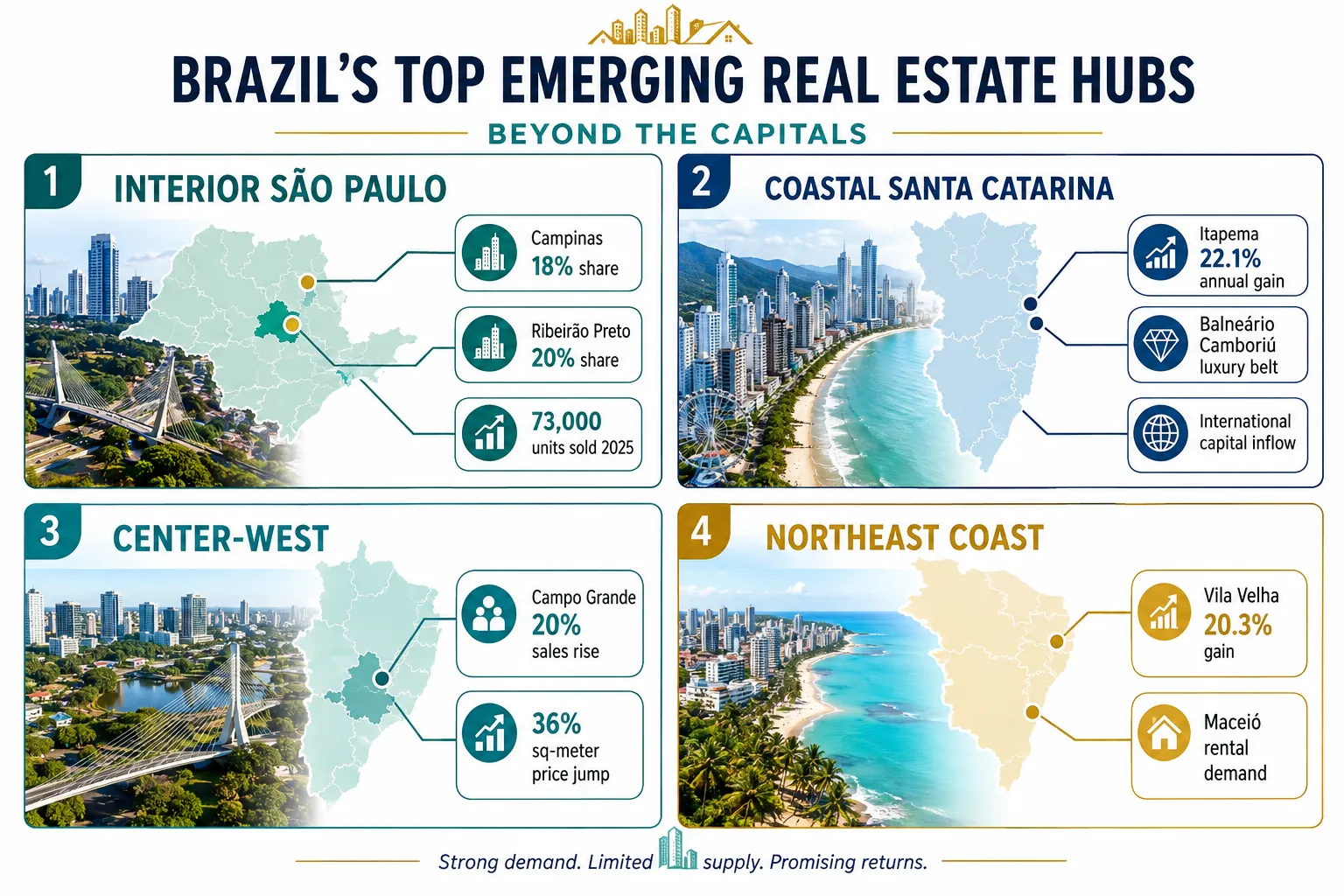
Brazil’s interior real estate market sold 73,000 new units in 2025 alone, a 17% jump over 2024, while recording a historic VGV of R$37 billion, all outside the country’s major state capitals [2][7]. That single data point reframes the entire investment conversation. For anyone still treating São Paulo and Rio de Janeiro as the only viable addresses for Brazilian property allocation, the numbers tell a different story in 2026.
The search for top cities for 2026 Brazilian real estate investments: beyond capitals to high-yield emerging hubs has moved from a contrarian thesis to a mainstream strategy backed by census data, institutional capital flows, and record launch activity. Urbanization patterns, infrastructure spending under Novo PAC, and the migration of both residents and developers to mid-sized cities have created a new geography of opportunity that rewards investors who look past the obvious.
This guide curates the most compelling emerging hubs based on urbanization trends, infrastructure catalysts, economic fundamentals, and price-appreciation data, giving diversified-portfolio investors a structured framework for 2026 allocation decisions.
Key Takeaways
- Interior São Paulo cities, led by Ribeirão Preto, Campinas, and São José do Rio Preto, now account for more than half of all non-capital residential transactions in the state, with 26% sales growth in H1 2025.
- Coastal Santa Catarina (Itapema, Balneário Camboriú, Itajaí, São José SC) posts the highest sustained off-plan appreciation rates in Brazil, averaging 19-22% annually over five years.
- Campo Grande (MS) and interior Minas Gerais cities such as Uberlândia are the fastest-growing Center-West and Southeast secondary markets, with Campo Grande recording a 36% rise in two-bedroom square-meter values.
- Non-capital cities now appear alongside São Paulo and Brasília in luxury residential rankings, confirming that high-end demand has spread well beyond state capitals.
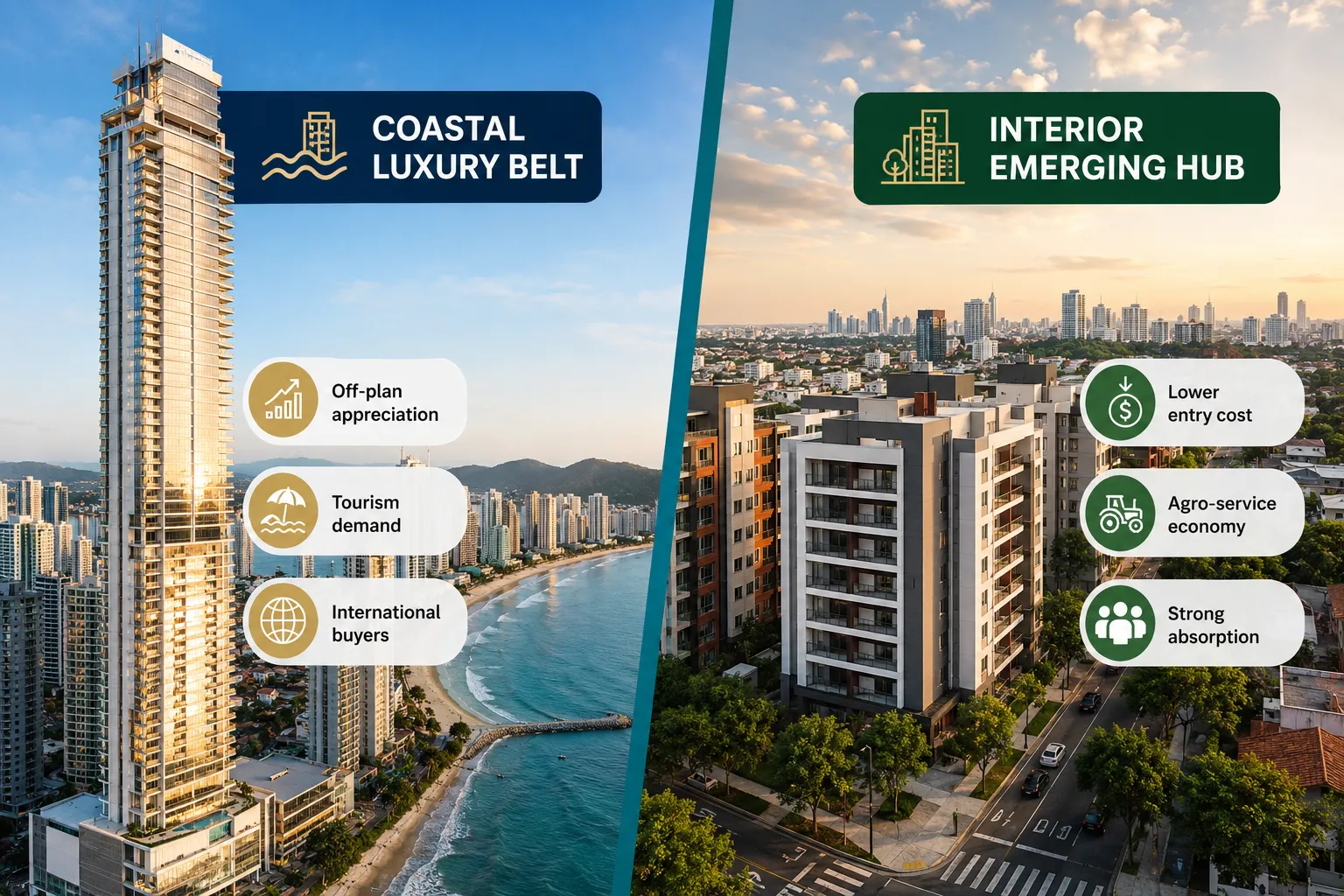
- Entry prices in emerging hubs can be 40-60% lower than in equivalent capital-city assets, allowing investors to capture comparable or superior yield with smaller initial capital outlays [11].
Why the Capital-Centric Model Is Breaking Down in 2026
For decades, Brazilian residential investment followed a simple rule: buy in São Paulo, Rio de Janeiro, or Brasília, and let urban density do the work. That model has not collapsed, São Paulo remains the most liquid and structurally sound anchor market [5][10], but it has been meaningfully disrupted by three converging forces.
First, affordability compression in capitals. São Paulo’s average square-meter price has risen sharply enough that yield compression is now a genuine concern for buy-to-let investors. Entry tickets that once delivered 7-8% gross rental yields now struggle to clear 5% in prime Paulistano neighborhoods.
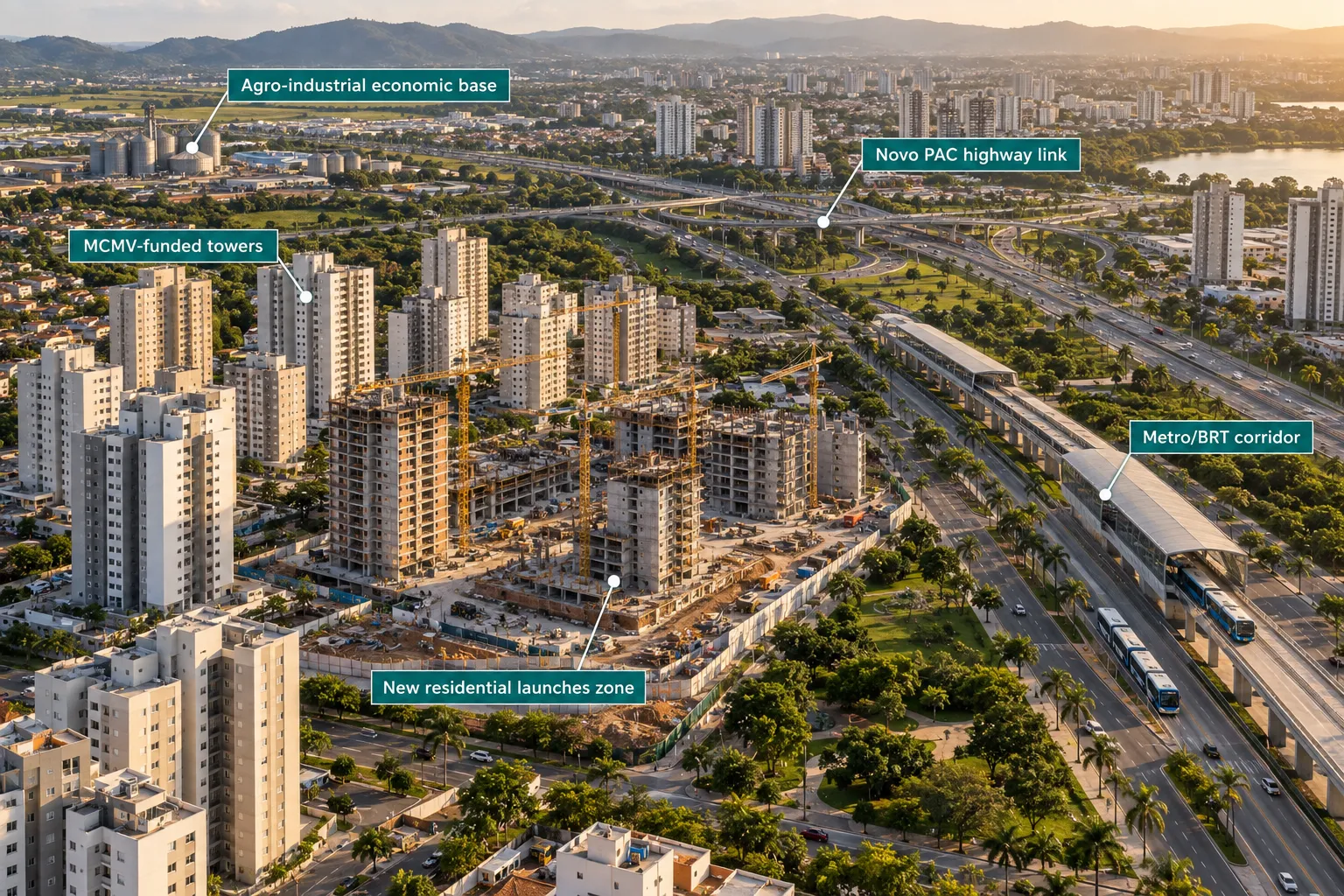
Second, infrastructure decentralization. The Novo PAC program has directed highway, railway, and urban mobility investment toward interior and secondary cities at a pace not seen since the 1970s. When a mid-sized city gains a new federal highway interchange or a BRT corridor, land values in adjacent zones reprice quickly, often before retail investors notice. For a detailed look at how infrastructure spending unlocks inland development sites, see the analysis of Novo PAC highway and railway projects unlocking inland development sites.
Third, demographic migration. Remote and hybrid work has freed a meaningful cohort of middle-class professionals from capital-city residency requirements. Cities with lower cost of living, better air quality, and improving amenity profiles, Campinas, Ribeirão Preto, Curitiba, Campo Grande, are absorbing this population shift and translating it into sustained housing demand.
The result is a market where the top cities for 2026 Brazilian real estate investments: beyond capitals to high-yield emerging hubs are no longer speculative bets. They are data-supported allocation targets with measurable absorption, rising VGV, and institutional developer presence [4][9].
The Methodology Behind the Rankings
Identifying genuine emerging hubs requires more than anecdotal evidence. The most rigorous 2026 analyses use a multi-variable framework that combines [3]:
| Metric | Why It Matters |
|---|---|
| 3-year annualized price appreciation | Confirms structural demand, not a one-cycle spike |
| Gross rental yield | Measures income-generation capacity |
| Average square-meter price | Gauges entry cost and upside room |
| New-launch absorption rate | Signals developer confidence and buyer depth |
| Economic base diversity | Reduces single-sector risk |
Cities that score well across all five metrics, rather than excelling on just one, are the most defensible 2026 targets.
Interior São Paulo: The Largest Non-Capital Real Estate Market in Brazil
The interior of São Paulo state has crossed a threshold in 2026: it is no longer an “emerging” market in the speculative sense but a mature secondary market with its own institutional ecosystem, established developer pipelines, and reliable data infrastructure [7][9].
New-build sales across 14 interior São Paulo cities grew 26% in H1 2025, with VGV advancing 22% over the same period, according to Abrainc/GeoBrain data compiled by Ademi [4]. Within that aggregate, three cities dominate:
- Ribeirão Preto, approximately 20% of total interior sales, driven by a diversified agro-industrial and healthcare services economy, strong university population, and rising luxury demand.
- Campinas, approximately 18% of sales, anchored by a technology corridor, multinational corporate presence, and direct highway connectivity to São Paulo city.
- São José do Rio Preto, approximately 13% of sales, with a growing medical hub and agricultural commodity economy generating consistent middle-class housing demand [9].
Together, these three cities concentrate more than half of all interior São Paulo transactions, a level of market depth that rivals several Brazilian state capitals outright.
Beyond the top three, cities such as Sorocaba, Jundiaí, Bauru, Piracicaba, and São José dos Campos round out a portfolio of investment-grade secondary markets. Notably, a mid-2026 luxury residential ranking using the IDI Brasil index placed Campinas, Ribeirão Preto, Jundiaí, and Sorocaba alongside São Paulo, Rio de Janeiro, and Brasília among the country’s 20 most attractive markets for high-end residential property [15]. That is a structural signal, not a cyclical one.
“Interior São Paulo is no longer a satellite of the capital’s market, it is generating its own investment cycle, its own developer competition, and its own price discovery.”
For investors focused on the São Paulo metro-adjacent opportunity, the corporate decentralization dynamic is equally important. Hybrid-work policies have accelerated the shift of back-office functions to lower-cost hubs, as detailed in this analysis of São Paulo corporate decentralization and office hubs in Alphaville and Curitiba.
São José dos Campos and the Tech-Industrial Edge
São José dos Campos deserves a separate mention. As the anchor of Brazil’s aerospace and defense corridor, home to Embraer, the Instituto Tecnológico de Aeronáutica (ITA), and a growing cluster of tech startups, the city combines industrial employment stability with a young, high-income demographic profile. Off-plan appreciation in the 17-20% annual range over 2019-2024 places it among the strongest performers in the MySide ranking [1][14], while its lower entry price relative to São Paulo city creates meaningful upside for capital-gain-oriented investors.
Coastal Santa Catarina and the Luxury Appreciation Belt
No cluster in Brazil has delivered more consistent high-yield appreciation outside major capitals than coastal Santa Catarina. The MySide “Melhores Cidades para Investir em Imóveis” ranking, covering the five-year period from October 2019 to September 2024, places this region at the top of every relevant metric [1][6]:
- Itapema (SC): 22.1% average annual off-plan appreciation, the highest in Brazil
- São José (SC): 19.7% average annual appreciation
- Itajaí (SC): 19.6% average annual appreciation
- Balneário Camboriú (SC): 19.1% average annual appreciation
These are not speculative outliers. They represent five consecutive years of above-20% annual gains in Itapema’s case, driven by a combination of luxury residential demand, domestic tourism, international buyer interest (particularly from Argentina and Paraguay), and constrained coastal land supply.
Balneário Camboriú, already Brazil’s most recognized luxury coastal brand, continues to attract mega-project development. The lessons from landmark high-rise developments there, and their implications for the broader luxury tower market, are explored in depth in the Senna Tower impact analysis for high-rise developments in Balneário Camboriú and beyond.
A mid-2026 luxury ranking using the IDI Brasil index further confirmed this cluster’s strength, placing Porto Belo, Itajaí, and Penha (SC) alongside major capitals as top-20 national markets for high-end residential property [15]. Porto Belo, in particular, represents the next frontier within the Santa Catarina coast, a smaller municipality where land prices remain below Balneário Camboriú levels but where the same demand drivers are beginning to take hold.
Vila Velha (ES) and Maceió (AL): The Coastal Overachievers Outside the South
The MySide ranking also highlights two non-Southern coastal cities that consistently outperform expectations [1][13][14]:
Vila Velha (ES) posted 20.3% average annual appreciation over the same five-year period, second only to Itapema nationally. Located in Espírito Santo, adjacent to Vitória, it combines port-city economic activity with beach residential demand and a lower entry price than any Santa Catarina equivalent.
Maceió (AL) rounds out the Northeast coastal opportunity, with strong rental demand indicators driven by domestic tourism and a growing remote-work population. For investors interested in the Northeast’s broader eco-resort and short-term rental potential, the Northeast Brazil eco-resort developments and Airbnb optimization strategies provide a detailed yield framework.
Center-West and Southern Emerging Hubs: The New Frontier
Analyst commentary across multiple 2026 sector reports identifies a group of mid-sized cities in the Center-West and South as the “nova fronteira”, the new frontier, of Brazilian real estate [4][11]. These cities combine diversified economic bases, ongoing population inflows, and established absorption capacity for new projects, yet their entry prices remain 40-60% below equivalent capital-city assets [11].
Campo Grande (MS): Center-West’s Fastest-Rising Market
Campo Grande has emerged as the standout Center-West story of 2025-2026. A Brain Inteligência Estratégica census covering 2025 data recorded [4]:
- Vertical residential sales up 20% year-on-year
- Two-bedroom apartment square-meter values up 36%
- VGV of residential lot developments up 55%
These are not incremental improvements, they represent a market repricing event. Campo Grande’s economy is anchored in agribusiness services, federal government employment, and a growing logistics sector tied to the Center-West’s commodity export corridor. The city’s population has grown steadily, and its housing stock has historically lagged demand, creating a structural supply deficit that new launches are only beginning to address.
Curitiba (PR): Smart City Infrastructure Meets Yield Opportunity
Curitiba occupies a unique position among Brazilian secondary cities: it is large enough to have institutional-grade infrastructure (metro system, organized urban planning, strong university base) yet priced well below São Paulo for comparable assets. The city’s smart-city initiatives and tech-integrated mid-tier condo market are generating a new wave of demand from young professionals and remote workers. For a detailed breakdown of Curitiba’s untapped potential and the 15-25% yield gains available through its southern infrastructure, see the Curitiba untapped property potential and southern infrastructure yield analysis.
Chapecó (SC) and Maringá (PR): Agro-Industrial Anchors
Both Chapecó and Maringá appear in 2026 “cidades médias” analyses as cities where price appreciation is matching or surpassing many state capitals while investment tickets remain significantly lower [11]. Chapecó’s food-processing and agro-industrial economy provides employment stability that translates directly into housing demand. Maringá, in northern Paraná, combines agricultural wealth with a strong university and healthcare services sector, a profile that reliably generates middle-class residential demand.
Interior Minas Gerais: Uberlândia and the Sul de Minas Region
The 2025 Censo do Mercado Imobiliário for Minas Gerais recorded 21,500 new apartments sold and VGV of R$14.5 billion, with interior cities, particularly Uberlândia and the Sul de Minas region, driving a meaningful share of that activity [4]. Uberlândia’s position as the logistics and distribution hub for Central Brazil, combined with its diversified service economy, makes it one of the most structurally sound secondary markets in the Southeast. Investors tracking metro-linked gentrification plays in Belo Horizonte itself should also monitor the Belo Horizonte Barreiro metro expansion and Linha 2 yield strategies as a complementary capital-city opportunity.
Building a Diversified Portfolio Across Emerging Hubs
The most effective 2026 allocation strategy treats these emerging hubs not as alternatives to capitals but as portfolio complements that reduce concentration risk while adding yield and appreciation potential.
A practical framework for diversification across the top cities for 2026 Brazilian real estate investments: beyond capitals to high-yield emerging hubs might look like this:
Tier 1, High-Liquidity Secondary Markets (core allocation): Ribeirão Preto, Campinas, Curitiba, Balneário Camboriú. These cities have proven absorption, institutional developer competition, and established resale markets.
Tier 2, High-Appreciation Emerging Hubs (growth allocation): Itapema, Vila Velha, São José dos Campos, Campo Grande. Strong appreciation metrics with moderate liquidity risk.
Tier 3, Value Entry Points (opportunistic allocation): Chapecó, Maringá, Uberlândia, Maceió. Lower entry prices, longer hold horizons, higher upside potential if economic base continues to expand.
For investors considering foreign-currency-denominated entry into any of these markets, the current BRL exchange rate environment creates an additional structural advantage. The foreign direct investment surge and weak Real strategy for coastal and urban acquisitions provides a framework for structuring that entry efficiently.
It is also worth noting that short-term rental regulations are evolving in many of these cities. Investors targeting Airbnb-optimized assets in secondary markets should consult the Airbnb-optimized holiday homes in Brazil’s secondary cities yield strategies before committing to a specific product type or municipality.
The Role of Small-Format Units in Secondary Markets
One cross-cutting theme across virtually all of these emerging hubs is the outperformance of studio and one-bedroom units. Compact apartments have delivered approximately 9% annual appreciation in 2026 amid high Selic rates, driven by affordability constraints and strong rental demand from young urban migrants. This dynamic is particularly pronounced in university cities (Ribeirão Preto, Campinas, Maringá) and tech-employment hubs (São José dos Campos, Curitiba). For a detailed analysis of why small apartments are outperforming larger properties, the data-driven case is laid out in the small apartment boom in Brazil 2026 and studio unit outperformance analysis.
Conclusion: Actionable Steps for 2026 Emerging Hub Investment
The data assembled across multiple 2026 market censuses, appreciation rankings, and sector analyses points to a clear and durable shift: Brazilian real estate alpha is increasingly generated outside state capitals, in a defined set of mid-sized cities with strong economic bases, infrastructure investment tailwinds, and growing populations [3][4][7][9][11].
Actionable next steps for investors in 2026:
Prioritize cities with multi-variable strength. Do not allocate based on a single metric (e.g., headline appreciation). Use the five-variable framework, appreciation, rental yield, entry price, absorption rate, economic diversity, to identify cities that score well across the board.
Enter Tier 1 markets first. Ribeirão Preto, Campinas, Curitiba, and Balneário Camboriú offer the best combination of proven liquidity and continued upside. These are the lowest-risk entry points into the emerging-hub thesis.
Size Tier 2 and Tier 3 positions appropriately. Itapema, Vila Velha, Campo Grande, and Chapecó offer higher potential returns but require longer hold periods and more careful developer due diligence.
Focus on small-format units in university and tech cities. Studios and one-bedrooms are delivering the strongest risk-adjusted returns in secondary markets with large student and young-professional populations.
Monitor infrastructure catalysts actively. Novo PAC highway completions, metro extensions, and BRT corridor openings are the most reliable leading indicators of land value repricing in secondary cities. Position before the infrastructure opens, not after.
Consult legal and regulatory frameworks before committing. Short-term rental regulations, zoning rules, and tax treatment vary significantly across municipalities. Professional legal review is essential before finalizing any acquisition in a new market.
The window for below-capital entry prices in many of these hubs is narrowing. The cities that were “emerging” in 2023 are becoming institutional-grade markets in 2026, and the next wave of emerging hubs is already forming behind them.
References
[1] Cidades Que Mais Valorizam Imoveis – https://myside.com.br/guia-imoveis/cidades-que-mais-valorizam-imoveis
[2] Webinar Do Secovi Sp Apresenta Dados Do Mercado Do 4o Trimestre Em 41 Cidades Paulistas – https://secovi.com.br/webinar-do-secovi-sp-apresenta-dados-do-mercado-do-4o-trimestre-em-41-cidades-paulistas/
[3] Melhores Cidades Investir Imoveis – https://casasvenda.com/melhores-cidades-investir-imoveis/
[4] Expansão Imobiliária Avança No Interior E O Desafio É – https://ademi.org.br/expansa%CC%83o-imobilia%CC%81ria-avanc%CC%A7a-no-interior-e-o-desafio-e%CC%81
[5] Melhor Cidade Investir Imoveis – https://housi.com/blog/cidades/melhor-cidade-investir-imoveis/
[6] Ranking Myside Melhores Cidades Para Investir Em Imoveis No Brasil Em 2025 – https://www.terracotta.ventures/hub/conteudo/ranking-myside-melhores-cidades-para-investir-em-imoveis-no-brasil-em-2025
[7] Mapa Real Estate Interior Sao Paulo 2026 Dados Precos Municipios – https://news.griinstitute.org/pt/mercado-imobiliario/mapa-real-estate-interior-sao-paulo-2026-dados-precos-municipios
[9] Mapa Real Estate Interior Sao Paulo 2026 Players Funding Municipios – https://news.griinstitute.org/pt/mercado-imobiliario/mapa-real-estate-interior-sao-paulo-2026-players-funding-municipios
[10] As Melhores Cidades Para Investimento Imobiliário Em 2026 – https://www.paolaroqueadvogados.com.br/post/as-melhores-cidades-para-investimento-imobili%C3%A1rio-em-2026