
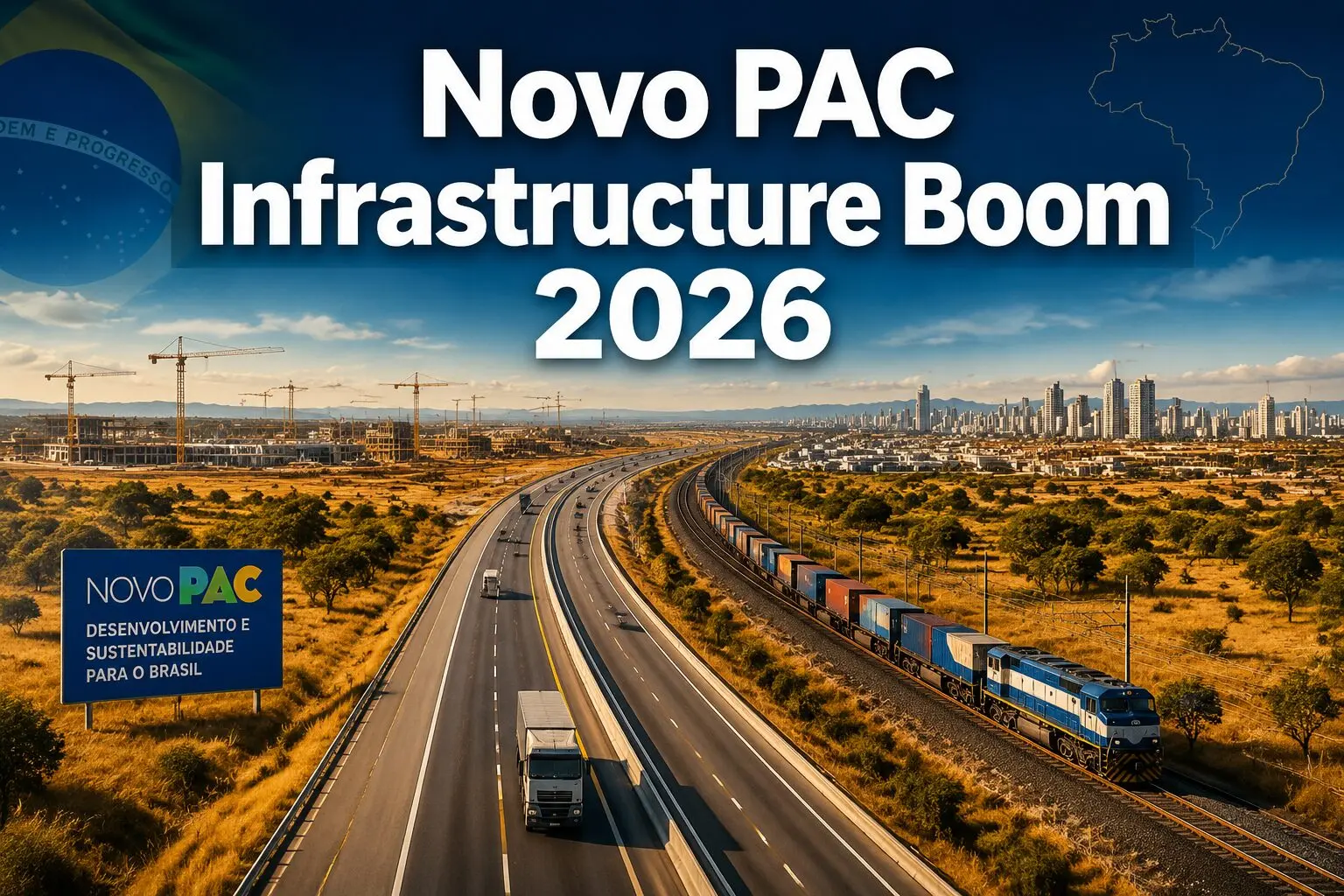
Brazil’s inland property market is being reshaped by one of the largest public investment programs in the country’s history — and most investors have not yet priced it in. The Novo PAC Infrastructure Boom 2026: Highway and Railway Projects Unlocking Inland Development Sites represents a structural shift in how capital, logistics, and land value flow across the Brazilian interior. With R$1.68 trillion in total planned investments through 2030 [9] and roughly R$148 billion in infrastructure concessions and auctions mapped specifically for 2026 [7], the program is not a political promise — it is an active construction and concession pipeline with measurable on-the-ground consequences for developers, investors, and landowners.
Key Takeaways 📌
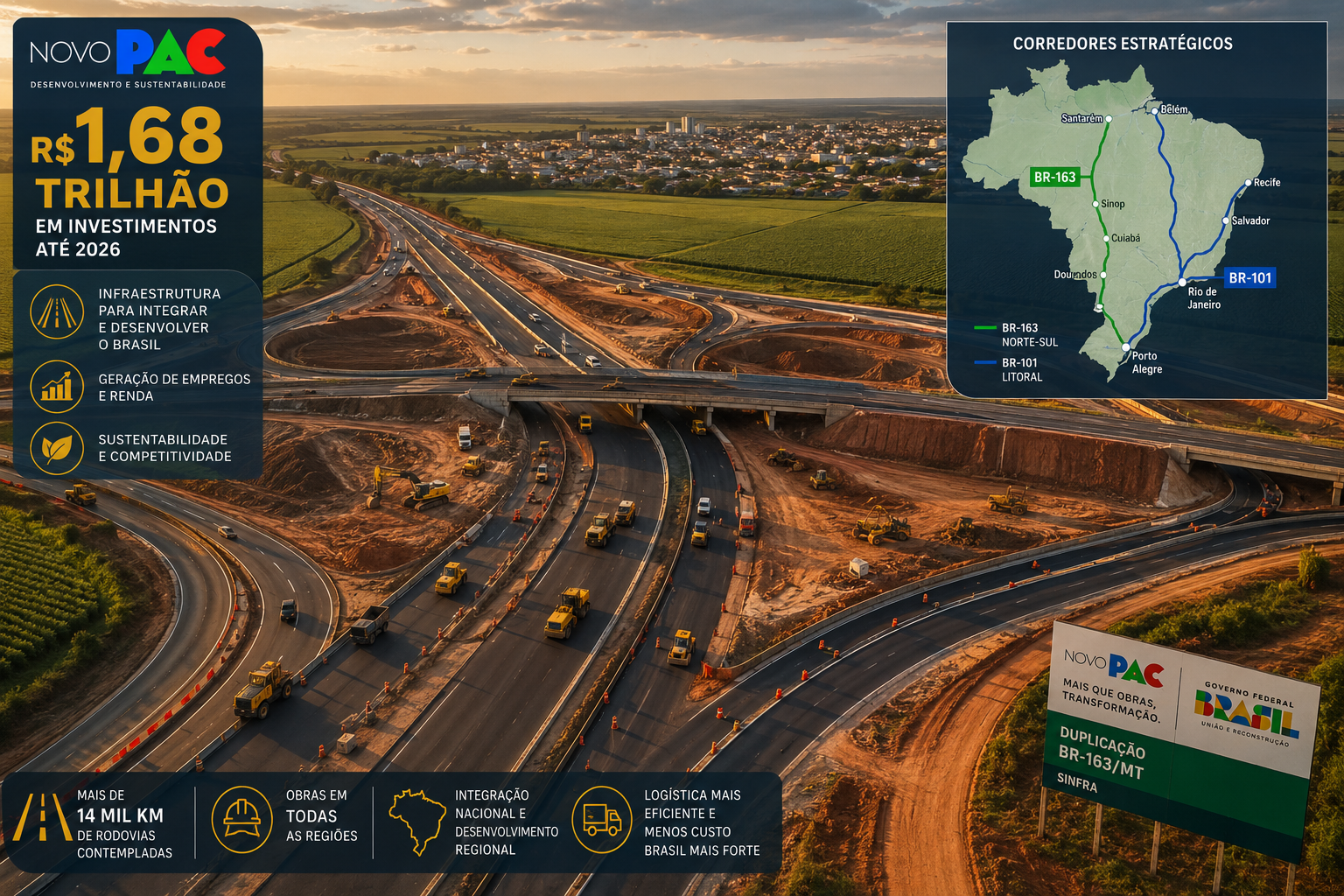
- R$1.68 trillion in total Novo PAC investments are planned through 2030, with a major portion front-loaded into 2026 [9].
- Highway and railway expansions are directly unlocking undervalued inland plots in secondary cities, with projected land value uplifts of 15–20% [4][2].
- Brazil has already added 5,200 km of new roads in recent years, with another 7,000 km under construction — a trajectory Novo PAC is accelerating [3][4].
- R$148 billion in infrastructure auctions are scheduled for 2026 alone, covering highways, railways, ports, and airports [7].
- Investors who map confirmed Novo PAC corridors and acquire land within 10 km of project sites before completion stand to capture the strongest capital appreciation [1][6].
What Is the Novo PAC and Why Does 2026 Matter?
The Novo PAC (Novo Programa de Aceleração do Crescimento) was formally launched on August 11, 2023, as the Lula administration’s reinvention of Brazil’s earlier Growth Acceleration Program. The program is structured around three core axes: social infrastructure, energy transition, and logistics [9]. Transport — including highways, railways, ports, airports, and urban mobility — is one of the largest spending categories within the package.
What makes 2026 a critical inflection point is the convergence of two forces:
- Budget-funded public works already under construction that are scheduled to reach completion or operational milestones.
- A record concession auction calendar worth R$148 billion that is designed to attract private capital into long-haul highways and freight rail [7].
💡 “The combination of Novo PAC budget spending and concessions is expected to significantly reduce Brazil’s historical infrastructure gap relative to peers by 2026, lowering logistics costs for inland agribusiness by several percentage points of delivered price.” [2]
This dual-track approach — public spending plus private concessions — gives the program unusual resilience. Even in an election year, the concession pipeline is expected to advance, providing continuity for investors focused on inland logistics corridors [7].
The Highway and Railway Pipeline: Scale, Corridors, and Key Numbers
Roads: From Coastal Trunk Routes to Inland Frontiers
Brazil’s transport ministry has outlined roughly R$80 billion (approximately US$16 billion) in road and rail investments over 2023–2026 [10]. The program explicitly targets a shift from coastal trunk routes toward inland and secondary-city corridors — a strategic reorientation that directly affects land values in previously overlooked regions.
Key highway metrics under the Novo PAC framework include:
| Metric | Figure |
|---|---|
| New roads added (recent 4 years) | ~5,200 km [3][4] |
| Roads currently under construction | ~7,000 km [4] |
| Total highway investment (recent cycle) | ~US$24.4 billion [3] |
| Roads built under long-term concessions | ~1,400 km [4] |
| Federal road network target (“good” condition) | 80% by end-2024 [2] |
| Road projects targeted in near-term pipeline | ~60 projects [2] |
| Highway auctions targeted (near-term) | ~13 auctions [2] |
The corridors drawing the most institutional attention in 2026 are BR-163 (connecting Mato Grosso soy-producing regions to the Port of Miritituba and onward to Itaqui), BR-101 (coastal and inland expansion segments along the southeast and northeast), and key duplications in Goiás and the Cerrado that reduce travel time between farm frontiers and export ports [1][10].
Railways: Freight Corridors as Value Catalysts
Railway investment under the Novo PAC is specifically designed to address Brazil’s chronic over-dependence on road freight. The program prioritizes freight rail concessions that connect inland farm frontiers in Mato Grosso, Goiás, and the Cerrado to ports such as Santos and Itaqui [10].
Policy analysts note that this iteration of PAC places stronger emphasis than prior cycles on integrating highways and railways with agribusiness and mining logistics — moving soy, corn, and iron ore from central and northern interiors to export ports by 2026–2030 [10]. Right-of-way works and tender announcements along these corridors have already shifted market expectations for logistics parks and industrial subdivisions in secondary cities [1].
How Infrastructure Unlocks Inland Development Sites
The 10 km Rule: Where Land Value Appreciation Concentrates
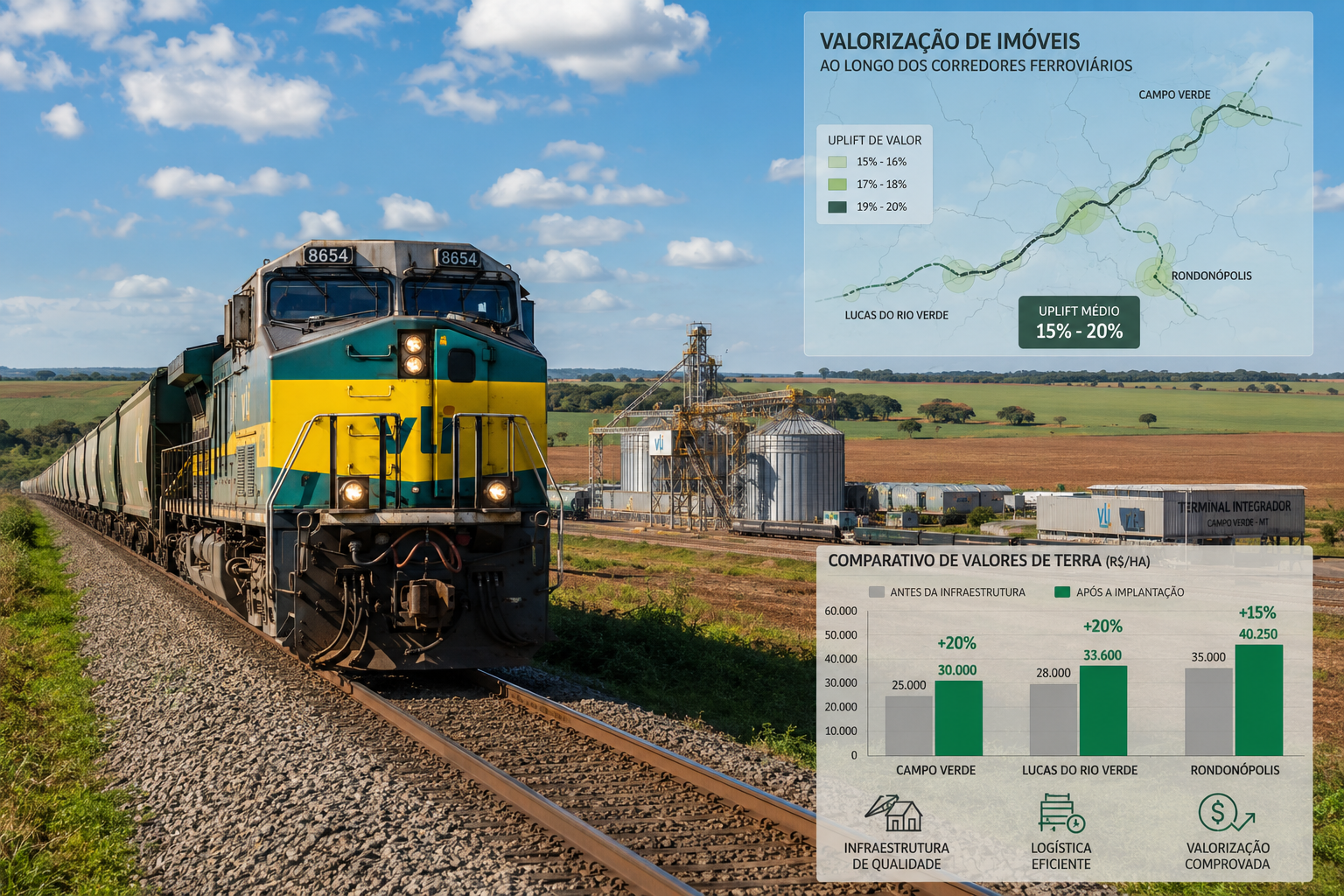
A strategy paper on infrastructure-led property booms in secondary cities identifies a clear spatial pattern: land parcels within 10 km of confirmed Novo PAC highway and railway projects slated for completion by 2028 are the primary beneficiaries of value uplift [1]. The mechanism is straightforward — reduced logistics costs, improved access, and rising investor confidence compress capitalization rates and push land prices upward before a single building is constructed.
The 15–20% property value uplift projected for secondary cities along these corridors [4][2] reflects:
- 🚛 Lower freight costs — reducing the price penalty for businesses located inland vs. coastal hubs.
- 🏭 Industrial park and dry port development — logistics operators acquiring land near highway-rail junctions for warehousing and distribution.
- 🌾 Agri-logistics real estate — grain storage, processing facilities, and cold-chain infrastructure clustering near upgraded corridors.
- 🏘️ Residential and mixed-use demand — population growth in secondary cities as employment follows infrastructure.
For investors already exploring the best places to invest in Brazilian property, understanding which inland corridors are confirmed (vs. merely proposed) is the critical differentiator between capturing genuine uplift and speculating on political timelines.
Inland Logistics Hubs: The Strongest Capitalization Rate Compression
The Novo PAC Infrastructure Investment Playbook 2026 identifies inland logistics hubs at junctions between upgraded highways and new or revived freight rail lines as the assets most likely to see the strongest capitalization rate compression [6]. The playbook recommends timing acquisitions to precede project completion — the window between confirmed tender award and operational opening is historically when the largest share of value appreciation occurs [6].
📊 Investors who enter after a project is completed typically capture only 20–30% of the total value uplift. The bulk accrues to those who act during the construction phase. [1][6]
Specific asset classes flagged as priority opportunities include:
- BR-101 highway expansion segments — particularly in the south and northeast where duplication works are advancing.
- Airport modernization projects — secondary-city airports receiving Novo PAC upgrades that stimulate business travel and logistics.
- Coastal road improvements — creating new connectivity between port cities and inland secondary markets.
- Digital connectivity upgrades — broadband infrastructure bundled into Novo PAC that raises the attractiveness of inland locations for technology-enabled businesses [6].
Risks, Sustainability, and the Lessons of Prior PAC Cycles
Execution Risk Is Real — and Historically Significant
No honest analysis of the Novo PAC Infrastructure Boom 2026 can ignore the program’s track record. Prior PAC cycles (PAC 1 launched 2007, PAC 2 launched 2010) were marked by delays, cost overruns, and incomplete stretches of highway and rail that limited their development impact [5]. Think-tank commentary and World Bank reviews of the earlier programs stress the need for better project selection, environmental licensing, and concession structuring to ensure delivery [5].
The key risk factors for 2026 investors to monitor include:
- Environmental licensing delays — particularly for projects in or near the Legal Amazon, where federal agencies face complex approval processes.
- Concession structuring quality — poorly designed concession contracts have historically led to renegotiations that delay construction timelines.
- Political continuity — while the 2026 concession pipeline is expected to advance regardless of election outcomes, budget-funded works are more exposed to fiscal policy shifts.
- Land governance — the Climate Policy Initiative has specifically flagged that poorly governed road expansion in frontier regions historically correlates with land grabbing and unsustainable development booms [8].
The Amazon Sustainability Filter
The federal Novo PAC presentation and subsequent policy briefs introduce a new sustainability filter for Amazon and northern-region logistics projects [9]. Infrastructure in the Legal Amazon must favor “green corridors” and modal shifts from roads to rail and waterways where possible [8].
The Climate Policy Initiative recommends that Novo PAC highway and railway projects in the Amazon be paired with strict land-use governance and deforestation controls [8]. For investors, this means that Amazon-adjacent infrastructure plays carry additional regulatory risk — and that the most defensible inland development opportunities are in the Cerrado, southern Brazil, and established secondary cities where governance frameworks are more mature.
Strategic Implications for Property Investors in 2026
Mapping the Opportunity: A Practical Framework
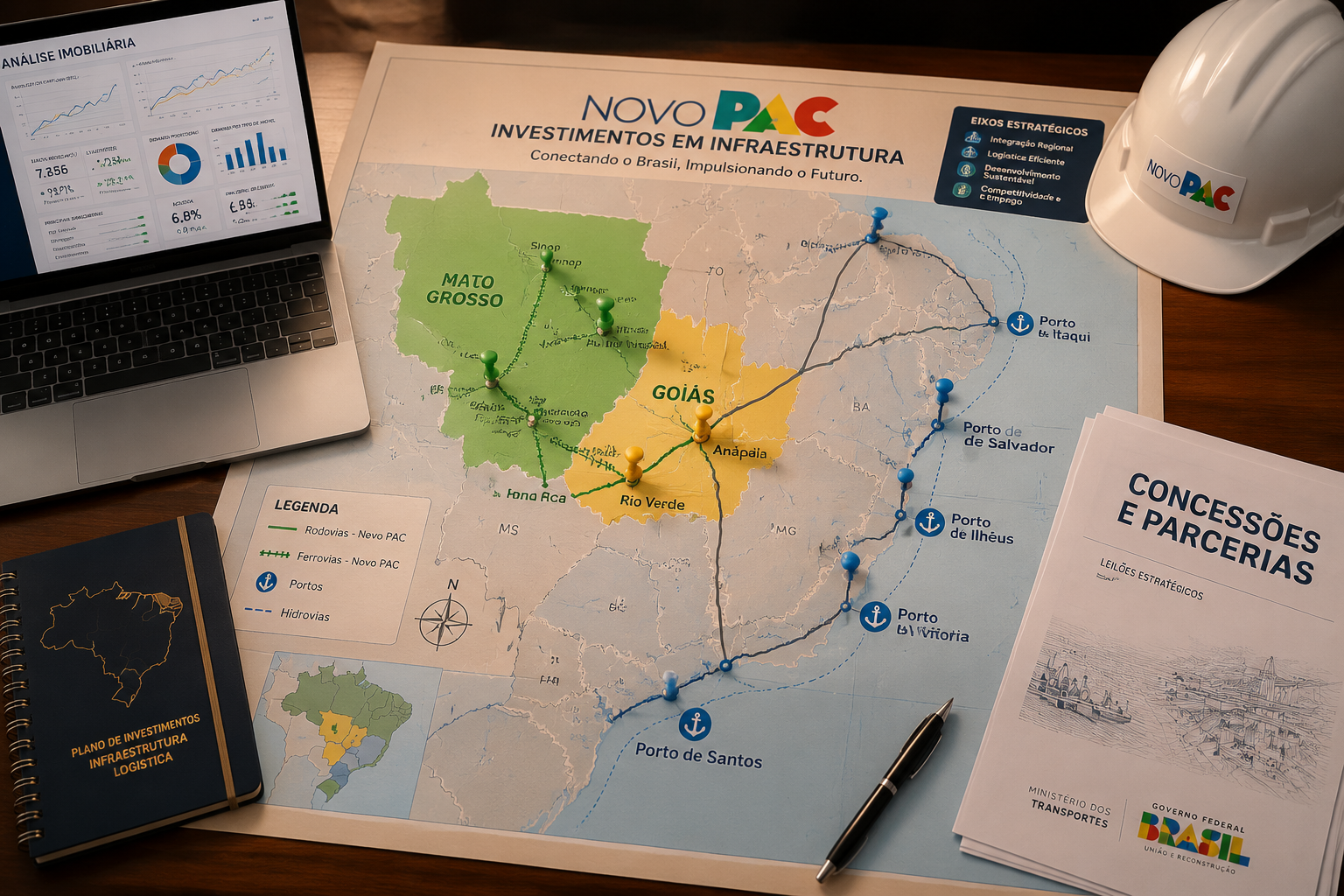
For developers and investors looking to capitalize on the Novo PAC Infrastructure Boom 2026 — highway and railway projects unlocking inland development sites — a structured approach is essential. The following framework draws on the investment playbook and infrastructure analysis reviewed above [1][6]:
Step 1: Identify Confirmed Projects (Not Proposals) Focus only on Novo PAC projects that have reached tender award, environmental license approval, or active construction stage. Preliminary announcements carry significant execution risk.
Step 2: Map the 10 km Acquisition Zone Prioritize land parcels within 10 km of highway-rail junctions, interchange points, and planned logistics park zones. Secondary cities with populations between 50,000 and 300,000 offer the best balance of affordability and growth potential [1].
Step 3: Time Entry to the Construction Phase Acquire before operational opening. The construction phase — typically 2–4 years for major highway segments — is the optimal entry window for maximizing value uplift [6].
Step 4: Monitor the 2026 Concession Auction Calendar The R$148 billion auction pipeline [7] will generate new confirmed projects throughout 2026. Each auction award creates a fresh acquisition window in the surrounding land market.
Step 5: Assess Sustainability and Governance Risk For any project near the Legal Amazon or in frontier agricultural zones, verify compliance with the Novo PAC sustainability filter and check for active deforestation monitoring [8].
Connecting Infrastructure Plays to Coastal Markets
It is worth noting that infrastructure-driven value appreciation is not limited to purely inland plays. Coastal markets that serve as logistics endpoints for Novo PAC corridors also benefit. For example, improvements to BR-101 and coastal port connectivity have direct positive effects on markets like Greater Florianópolis, where the real estate market has been showing strong momentum.
Investors interested in how infrastructure investment translates into property premiums at the project level can also examine active developments that have benefited from regional infrastructure improvements — such as the Tramonto development, where foundation works and accelerated construction timelines reflect the broader confidence in infrastructure-backed regional growth.
For investors exploring off-plan opportunities that capture pre-completion value uplift, understanding why buying at the plant stage can amplify returns is directly relevant to the Novo PAC corridor strategy — the same timing principle that applies to infrastructure-adjacent land applies to pre-launch residential and commercial developments in growth corridors.
Conclusion: Acting Before the Infrastructure Discount Disappears
The Novo PAC Infrastructure Boom 2026: Highway and Railway Projects Unlocking Inland Development Sites is not a future scenario — it is an active, funded, and partially constructed reality. With R$1.68 trillion in total planned investment [9], R$148 billion in 2026 auctions alone [7], and confirmed highway and railway corridors already reshaping logistics costs across the Brazilian interior, the window for capturing pre-completion land value appreciation is open now — but it will not remain open indefinitely.
The 15–20% property value uplift projected for secondary cities along confirmed corridors [4][2] is not speculative. It reflects the same mechanism that has played out along every major infrastructure corridor in Brazil’s history: reduced logistics costs attract business investment, business investment drives employment, employment drives population growth, and population growth drives demand for every category of real estate.
Actionable Next Steps for Investors in 2026:
✅ Download and map the official Novo PAC project list — cross-reference with the 2026 concession auction calendar to identify the highest-confidence corridors.
✅ Target secondary cities (50,000–300,000 population) within 10 km of confirmed highway-rail junctions for land acquisition during the construction phase.
✅ Prioritize Cerrado and southern Brazil corridors over Amazon-adjacent projects to minimize environmental licensing and governance risk.
✅ Monitor the R$148 billion auction pipeline throughout 2026 — each new award creates a fresh entry window in the surrounding land market.
✅ Consult with regional developers and infrastructure specialists who have on-the-ground visibility into project timelines and local land markets.
✅ Explore current development opportunities across active projects in growth corridors to understand how infrastructure-backed demand is already being priced into new developments.
The infrastructure discount on Brazil’s inland development sites is real — but it has an expiration date tied to construction progress. The investors who act during the build phase, not after the ribbon-cutting, will capture the full value of the Novo PAC Infrastructure Boom 2026.
References
[1] Infrastructure Led Property Booms In Secondary Cities 2026 Highway And Railway Impacts On Inland Development Values – Infrastructure led property booms in secondary cities 2026 highway and railway impacts on inland development values
[2] Brazils Strategic Road And Rail Development By 2026 – riotimesonline.com
[3] Brazils Pac 2 Us18 Billion Highway Investment – itsinternational.com
[4] Brazil Phase 2 Pac Infrastructure Programme Shows Results – globalhighways.com
[5] Programa De Aceleração Do Crescimento – en.wikipedia.org
[6] Novo Pac Infrastructure Investment Playbook 2026 Capturing 10 25 Property Premiums Through Strategic Project Timing – Novo pac infrastructure investment playbook 2026 capturing 10 25 property premiums through strategic project timing
[7] Brazil Maps R148bn In Infrastructure Auctions For 2026 – valorinternacional.globo.com
[8] The Amazon In The New Pac Recommendations To Promote Sustainable Infrastructure – climatepolicyinitiative.org
[9] Presentation Pac English – gov.br
[10] Brasil Forecasts Us80 Billion In Investments In Highways And Railways By 2030 – bnamericas.com