
Municipalities that cracked down hardest on short-term rentals saw average host revenue drop by 31% within 12 months of enforcement — yet savvy developers who repositioned to compliant, purpose-built models in lenient coastal zones reported net yields of 8–12% post-fees. That gap is the entire opportunity. Navigating Short-Term Rental Regulations 2026: Zoning and Tax Hacks for Airbnb-Optimized Developments in Resort Towns is no longer optional for real estate investors — it is the core competency that separates profitable portfolios from stranded assets.

Key Takeaways 🎯
- Regulatory arbitrage is real: Stricter STR rules in major metros (São Paulo, Rio de Janeiro) are pushing smart capital toward lenient Northeast and Southern Brazilian beach communities.
- Zoning determines viability: Hosted vs. unhosted STR distinctions, Conditional Use Permits (CUPs), and zone-specific allowances can make or break a development’s return.
- Tax structure is a multiplier: Registering under the correct business entity and lodging-tax framework can legally reduce effective tax burden by 15–25%.
- Purpose-built beats retrofitted: Developments designed from the ground up for STR compliance consistently outperform converted residential units on both yield and regulatory longevity.
- 8–12% net yields are achievable in well-chosen resort markets when condo fees, occupancy rates, and tax optimization are engineered into the project from day one.
Why 2026 Is a Regulatory Inflection Point for Short-Term Rentals
The global STR landscape entered a new phase in 2025–2026. Platforms like Airbnb and Booking.com now face pressure from local governments to share host data, enforce registration requirements, and delist non-compliant properties. In Brazil, the pattern mirrors what happened in the United States: dense urban centers tighten rules first, while resort towns and secondary markets lag behind — creating a window for informed investors.
“The smartest move in 2026 is not to fight regulation — it’s to build ahead of it.”
In the U.S., Washington State defines short-term rentals as any lodging provided for fewer than 30 consecutive days [4]. This definition is now the model many Brazilian municipalities are studying as they draft their own frameworks. Hosts in Washington who earn $12,000 or more annually must register a state business license (UBI) with the Department of Revenue [4] — a compliance threshold that virtually every active STR host crosses.
The lesson for Brazilian investors: compliance infrastructure that feels burdensome today becomes a competitive moat tomorrow, once less-prepared operators are forced out of the market.
Understanding the Zoning Landscape: Where STRs Are Allowed (and Where They Are Not)
The Hosted vs. Unhosted Distinction
One of the most consequential zoning variables is whether a municipality distinguishes between hosted and unhosted rentals:
- Hosted STR: The owner or a long-term resident is present during the guest’s stay. Generally permitted in more zones, including residential.
- Unhosted STR (entire home): The property is rented without the owner present. Subject to stricter zoning controls, density caps, and often requires a Conditional Use Permit (CUP).
In Kittitas County, Washington, for example, Ellensburg allows hosted STRs in most zones but restricts unhosted rentals to specific areas and may require CUPs [2]. This two-tier system is becoming the global standard — and Brazilian resort municipalities are moving in the same direction.
Zone-by-Zone Risk Assessment
| Zone Type | STR Likelihood (2026) | Key Risk | Opportunity Level |
|---|---|---|---|
| Pure Residential (R1/R2) | Low–Medium | Density caps, neighbor complaints | ⚠️ Moderate |
| Mixed-Use Commercial | Medium–High | Licensing requirements | ✅ High |
| Tourist/Resort Designated | High | Seasonal demand volatility | ✅✅ Very High |
| Historic/Conservation | Very Low | Preservation restrictions | ❌ Low |
| Coastal/Beach Overlay | High (if compliant) | Environmental permits | ✅✅ Very High |
The Anacortes Warning: Blanket Prohibitions Are Real
Not every coastal town is STR-friendly. Anacortes, Washington, prohibits short-term rental of dwelling units across residential, mixed-use, and commercial zones — with only grandfathered, previously licensed units allowed to continue operating [1]. This is the regulatory trap that destroys uninformed investment theses.
Due diligence checklist before acquiring any resort-town property:
- ✅ Confirm current zoning classification
- ✅ Review municipal STR ordinance (check for sunset clauses)
- ✅ Verify whether the property qualifies as hosted or unhosted
- ✅ Check for pending zoning amendments (public comment periods)
- ✅ Confirm platform data-sharing agreements with local government
For investors evaluating the best places to invest in Brazil for high returns, the Northeast coast (Ceará, Rio Grande do Norte, Alagoas) and Southern beach communities (Santa Catarina) currently offer the most favorable STR zoning environments — with Florianópolis standing out as a particularly dynamic market.
The São Paulo/Rio de Janeiro Squeeze: Why Capital Is Migrating South and Northeast
Brazil’s two largest cities are following the global metro playbook: tighten STR rules, increase licensing fees, mandate owner-occupancy requirements, and enforce platform delisting of non-compliant listings [8]. For developers who built their STR thesis around SP and RJ urban apartments, 2026 is a reckoning year.
The strategic response is regulatory arbitrage — moving development capital to municipalities where:
- STR ordinances are still permissive or non-existent
- Tourism demand is growing (not just stable)
- Infrastructure investment is accelerating
- Land acquisition costs remain below replacement value
Florianópolis’s real estate market checks all four boxes. The city’s 42 beaches, growing tech sector, and international airport expansion have driven consistent demand growth, while its municipal STR framework remains more accommodating than SP or RJ equivalents.
The growth of the Ingleses region in Florianópolis — with its improving infrastructure, quality of life metrics, and rising property values — exemplifies exactly the kind of secondary-within-primary market that outperforms in a tightening regulatory environment.
Tax Hacks for Airbnb-Optimized Developments: Legal Optimization Strategies

The Registration Imperative
In Washington State, hosts earning $12,000+ annually must register a Unified Business Identifier (UBI) with the Department of Revenue [4]. Bainbridge Island additionally requires STR certificates, $1 million in liability insurance, annual registration, and compliance with a 4% lodging tax plus Business & Occupation (B&O) tax [5].
Brazil’s equivalent framework — CNPJ registration under Simples Nacional or Lucro Presumido — offers similar structure with significant optimization potential. The key variables:
- Simples Nacional: Best for operators with gross revenue under R$4.8M/year. Unified tax rate of 6–15.5% depending on revenue bracket.
- Lucro Presumido: Advantageous for higher-revenue operations with controlled expenses. Presumed profit margin of 32% on service revenue.
- MEI (Individual Microentrepreneur): Only viable for very small-scale operators; caps at R$81,000/year gross revenue.
The Lodging Tax Layer
Most resort municipalities impose lodging or tourism taxes (equivalent to the U.S. transient occupancy tax). These are typically:
- Collected by platforms (Airbnb, Booking.com) in jurisdictions with platform-level agreements
- Passed through to hosts in municipalities without platform agreements — creating compliance risk for uninformed operators
Pro tip 💡: In municipalities where platforms do not collect lodging tax automatically, failure to remit creates compounding liability. Always confirm the collection mechanism before listing.
Depreciation and Cost Segregation
For purpose-built STR developments, depreciation is a powerful yield enhancer:
- Furniture and fixtures: 5–7 year depreciation schedule
- Appliances and technology: 5-year schedule
- Building structure: 27.5 years (U.S.) / 25 years (Brazil)
- Cost segregation study: Can accelerate 20–30% of building cost into shorter depreciation schedules, dramatically reducing taxable income in years 1–5
For investors exploring the advantages of investing in studio units in Florianópolis, the combination of lower acquisition cost, higher occupancy rates (studios fill faster), and accelerated depreciation creates a particularly compelling tax-adjusted return profile.
The Property Management Blueprint: Engineering 8–12% Net Yields
Achieving 8–12% net yields post-condo fees in resort STR markets is not accidental — it requires deliberate engineering at every stage of the investment lifecycle.
Stage 1: Development Selection Criteria
The yield is largely determined before a single guest books. Key selection filters:
| Factor | Target Benchmark | Why It Matters |
|---|---|---|
| Occupancy Rate (annual avg.) | ≥ 70% | Below 65%, most markets don’t pencil |
| Average Daily Rate (ADR) | Market P75 or above | Positioning determines revenue ceiling |
| Condo Fee as % of Revenue | ≤ 20% | Fees above 25% compress yields severely |
| Distance to Beach/Attraction | ≤ 800m | Primary demand driver in resort markets |
| Platform Visibility Score | Top 15% of market | Algorithm positioning = organic bookings |
Stage 2: Compliance-First Design
Purpose-built STR developments outperform retrofitted units because they are designed around guest experience AND regulatory requirements simultaneously:
- Separate entrances (eliminates hosted/unhosted ambiguity in mixed-use zones)
- Fire safety systems built to commercial standards (required in Lewis County, WA and increasingly in Brazilian resort municipalities) [6]
- Guest safety postings (emergency contacts, evacuation routes, local regulations) — mandatory in Kitsap County [5]
- Soundproofing between units (reduces neighbor complaints, the #1 trigger for STR ordinance tightening)
Projects like Tramonto and Solis in the Florianópolis region represent this compliance-first development philosophy — where construction quality and regulatory alignment are built into the project from the foundation stage.
Stage 3: Revenue Management
Dynamic pricing is table stakes in 2026. The revenue management stack for a high-performing STR includes:
- Dynamic pricing tool (PriceLabs, Wheelhouse, or Beyond): Adjusts nightly rates based on local demand signals, competitor pricing, and event calendars
- Channel manager: Synchronizes availability across Airbnb, Booking.com, VRBO, and direct booking site
- Direct booking website: Eliminates platform fees (typically 3% host fee) on repeat guests — can add 2–3% to net yield over time
- Minimum stay rules: Longer minimums during peak season reduce turnover costs; shorter minimums during shoulder season maximize occupancy
Stage 4: Operational Cost Control
The difference between gross yield and net yield is almost entirely operational discipline:
- Condo fees: Non-negotiable, but developments with shared amenities (pool, gym, co-working) command higher ADRs that more than offset fees
- Cleaning costs: Standardize unit layouts to reduce cleaning time; build cleaning fees into guest pricing
- Maintenance reserves: Budget 8–10% of gross revenue for maintenance; purpose-built units with commercial-grade fixtures reduce this materially
- Property management fee: Full-service management typically costs 20–25% of gross revenue; self-management or hybrid models can reduce this to 10–15%
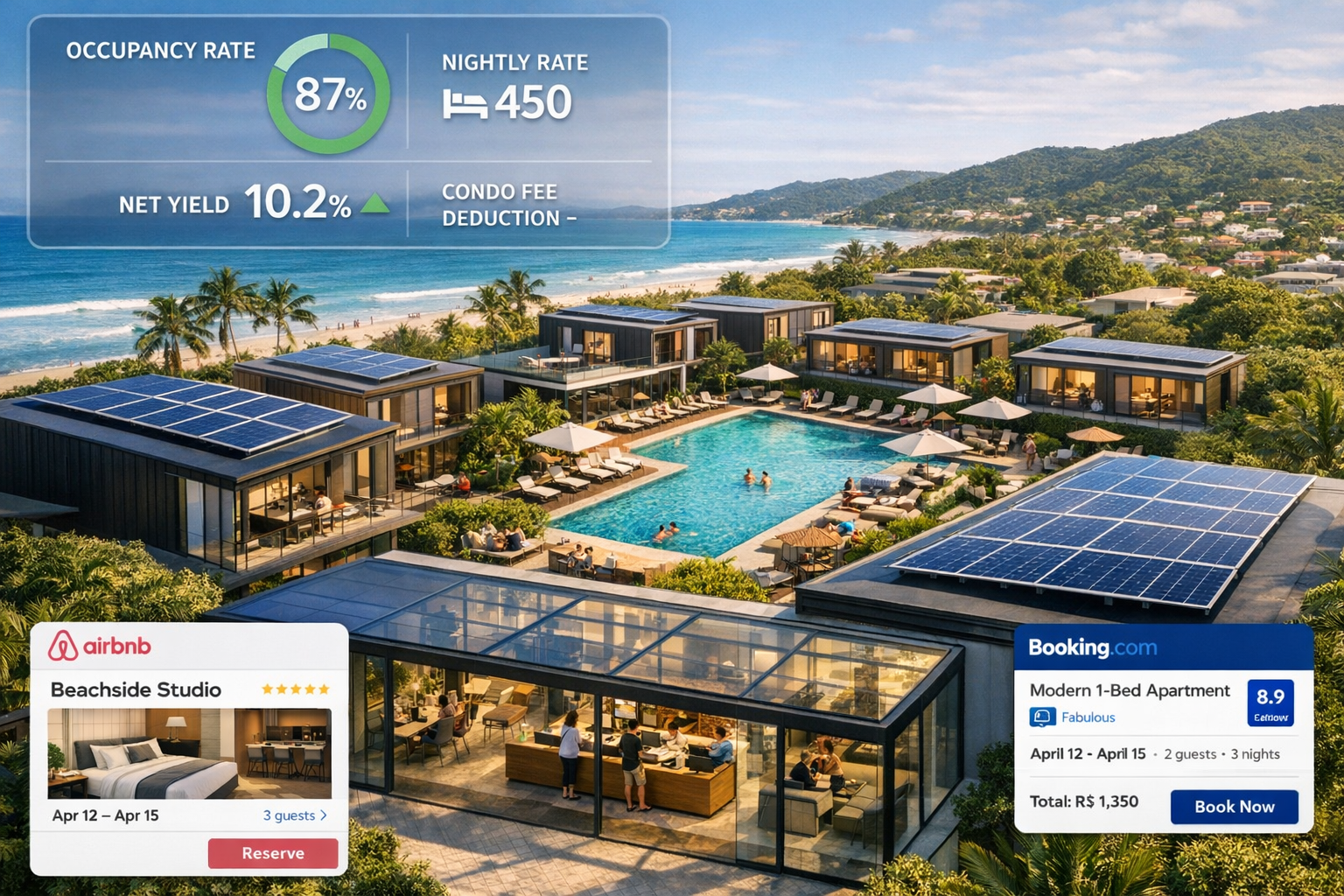
A realistic net yield model for a R$500,000 studio in a Florianópolis resort zone: Gross annual revenue: R$72,000 (R$450 ADR × 160 nights) Less: Management (22%) = R$15,840 | Condo fees = R$9,600 | Taxes (Simples 8%) = R$5,760 | Maintenance (8%) = R$5,760 Net yield: R$35,040 = ~7.0% (conservative) → up to 10.5% with direct bookings and optimized management
For investors tracking the broader Florianópolis real estate market trajectory, the combination of capital appreciation (historically 8–12% annually in prime zones) and STR income creates a total return profile that is difficult to match in any other Brazilian market.
Anticipating the Next Wave of Regulation: Future-Proofing Your STR Portfolio
The most dangerous assumption in STR investing is that today’s permissive environment will persist. Cancún is already signaling what comes next: municipal authorities are moving toward stricter registration requirements, platform data-sharing mandates, and zone-specific density caps that will fundamentally reshape the STR market there by 2026–2027 [8].
Future-proofing strategies:
- Register early, register properly. Grandfathered status (like Anacortes’s existing licensed units [1]) is the most valuable regulatory asset an STR can hold.
- Engage in local governance. STR host associations that participate in municipal planning processes consistently achieve more favorable ordinance outcomes than those that ignore them.
- Diversify across municipalities. A portfolio spread across 2–3 resort towns with different regulatory timelines reduces concentration risk.
- Build to commercial standards. Properties that meet or exceed commercial lodging requirements are almost never targeted by new STR ordinances — those ordinances are written to address non-compliant operators.
- Monitor platform policy changes. Airbnb’s compliance partnerships with municipalities are expanding rapidly; hosts who are not registered on the platform’s compliance portal face automatic delisting in covered jurisdictions.
For those interested in innovative financing structures for STR development, cryptocurrency and real estate development intersections are creating new capital-raising mechanisms that can accelerate portfolio construction in high-opportunity markets.
Conclusion: Build Compliant, Build Early, Build in the Right Markets
The central thesis of Short-Term Rental Regulations 2026: Zoning and Tax Hacks for Airbnb-Optimized Developments in Resort Towns is straightforward: regulation is not the enemy of STR investment — non-compliance is. The developers and investors who will dominate the next decade of resort-town STR markets are those who treat regulatory frameworks as design inputs, not afterthoughts.
Actionable Next Steps ✅
- Audit your current or target portfolio against the zoning checklist above — identify any hosted/unhosted ambiguity or missing permits immediately.
- Consult a tax professional familiar with both platform-economy taxation and local lodging tax requirements before acquiring any new STR property.
- Target Northeast and Southern Brazilian beach communities where STR frameworks remain permissive and tourism demand is structurally growing.
- Evaluate purpose-built developments over residential conversions — the compliance, operational, and yield advantages compound over time.
- Model net yield conservatively (use 65% occupancy, full management fees, and realistic condo costs) before committing capital — if the deal works at conservative assumptions, it works.
- Engage with local STR host associations in your target market to stay ahead of regulatory changes before they affect property values.
The window for acquiring compliant, high-yield STR assets in Brazil’s best resort markets at current prices will not stay open indefinitely. Explore current development opportunities that are purpose-built for the 2026 STR regulatory environment and beyond.
References
[1] Skagit County Airbnb And Short Term Rental Regulations – https://househackseattle.com/blog/skagit-county-airbnb-and-short-term-rental-regulations
[2] Navigating Short Term Rental Rules In Kittitas County Including Cle Elum Roslyn And Ellensburg – https://househackseattle.com/blog/navigating-short-term-rental-rules-in-kittitas-county-including-cle-elum-roslyn-and-ellensburg
[3] 2025 Guide To Thurston County Short Term Rentals Rules Zoning And Legal Requirements – https://househackseattle.com/blog/2025-guide-to-thurston-county-short-term-rentals-rules-zoning-and-legal-requirements
[4] Washington State Short Term Rental Rules What Hosts Need To Know In 2024 – https://househackseattle.com/blog/washington-state-short-term-rental-rules-what-hosts-need-to-know-in-2024
[5] Hosting In Kitsap County From Bainbridge To Bremerton Heres What You Need To Know About Strs – https://househackseattle.com/blog/hosting-in-kitsap-county-from-bainbridge-to-bremerton-heres-what-you-need-to-know-about-strs
[6] Packwood Randle And Rural Lewis County The Updated Str Rules Every Host Must Follow – https://househackseattle.com/blog/packwood-randle-and-rural-lewis-county-the-updated-str-rules-every-host-must-follow
[7] Airbnb Markets Where You Should Think Twice About Before Investing In – https://www.biggerpockets.com/blog/airbnb-markets-where-you-should-think-twice-about-before-investing-in
[8] Why Booking A Cancun Airbnb Might Look Very Different In 2026 – https://thecancunsun.com/why-booking-a-cancun-airbnb-might-look-very-different-in-2026/