

Short-term rental occupancy rates in small coastal destinations are consistently outpacing major metro markets in 2026, with select secondary beach cities recording occupancy above 80% while primary coastal hubs stagnate below 65% [9]. That gap is not a coincidence. It is the product of constrained housing supply, surging foreign demand, and a structural shift in how remote workers and lifestyle-driven travelers choose where to stay.
For investors and developers willing to look beyond the obvious, niche lifestyle properties in secondary coastal cities: high-yield strategies for 2026 rental market shifts represent one of the most compelling opportunities in the current rental landscape. Low acquisition costs, rising rents, and an underserved tenant base hungry for amenity-rich spaces are converging at exactly the right moment.
Key Takeaways
- Secondary coastal cities offer acquisition costs far below primary markets while delivering short-term rental yields that frequently exceed 10-18%.
- Supply constraints in select beach submarkets are driving above-average rent growth and historically low vacancy rates in 2026.
- Foreign digital nomads and lifestyle travelers are the highest-value tenant segment, prioritizing remote workspaces, wellness amenities, and long-stay flexibility.
- STR regulatory risk is real but manageable, investors who audit zoning before acquisition gain a durable competitive advantage.
- Amenity differentiation (fiber internet, co-working lounges, yoga spaces) is the single most effective lever for commanding premium nightly rates in secondary coastal markets.
Why Secondary Coastal Cities Are Outperforming in 2026
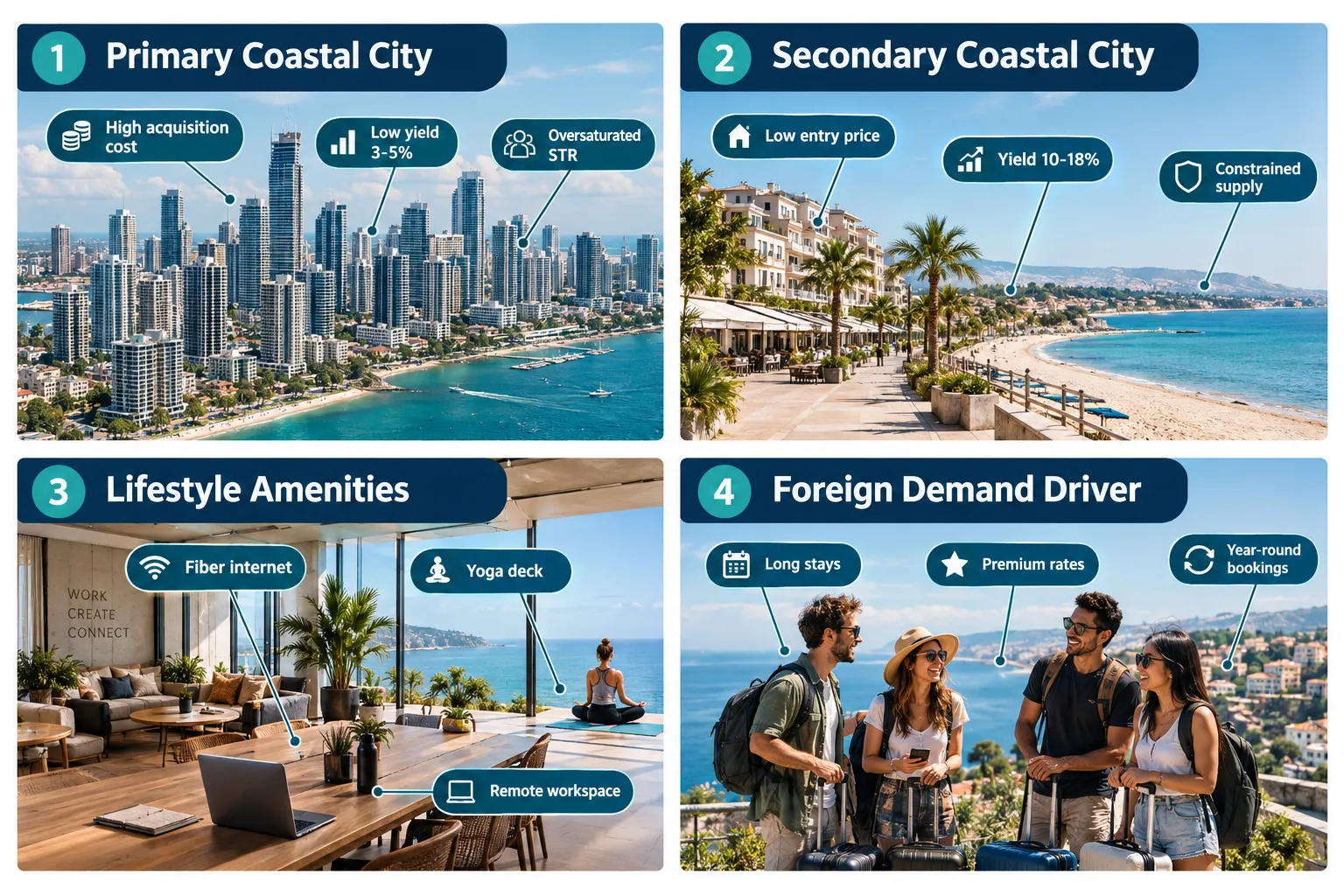
The national apartment market in 2026 is best described as “steady, not explosive.” Rent growth has moderated from the post-pandemic surge, with broad forecasts pointing to gains in the 2-4% range for most U.S. metros [2]. That baseline, however, masks a sharp divergence between oversupplied primary markets and structurally constrained secondary coastal cities.
Markets like Providence, Rhode Island and Virginia Beach, Virginia have emerged as what analysts are calling “stealth” high-growth rental destinations [5]. These cities share a common profile: limited developable land near the waterfront, growing remote-worker populations, and tourism infrastructure that was built for visitors but is increasingly serving longer-stay residents.
Why does supply constraint matter so much? In coastal submarkets where permitting is slow and geography limits new construction, even modest demand increases translate directly into rent growth and low vacancy. The California coastal market illustrates this clearly, despite modest statewide rent gains, supply-constrained beachfront submarkets continue to see reliable appreciation [4].
“In coastal markets where you cannot build more land, every new unit of demand is a pricing event.”
For investors focused on niche lifestyle properties in secondary coastal cities, this supply dynamic is the foundational thesis. The strategy is not about chasing the hottest market, it is about identifying the markets where structural barriers protect yield over time.
The Global Analog: Affordable Lifestyle Markets Lead Rent Growth
This pattern is not unique to the United States. Global research on “affordable lifestyle” regional markets, secondary cities with strong quality-of-life attributes but lower costs than capital cities, consistently shows that these markets outperform in rent growth during periods of broader market normalization [6]. The mechanism is the same: demand from mobile, income-earning workers flows toward value, and secondary coastal cities offer exactly that combination of lifestyle quality and relative affordability.
For Brazil-focused investors, this global pattern maps directly onto markets like João Pessoa, Florianópolis, and Fortaleza, where Airbnb-optimized coastal developments are already generating 20% rental yields in secondary beach cities. The underlying logic, constrained supply, foreign demand, lifestyle positioning, is identical.
The Foreign Nomad Tenant: The Highest-Value Guest in Secondary Coastal Markets
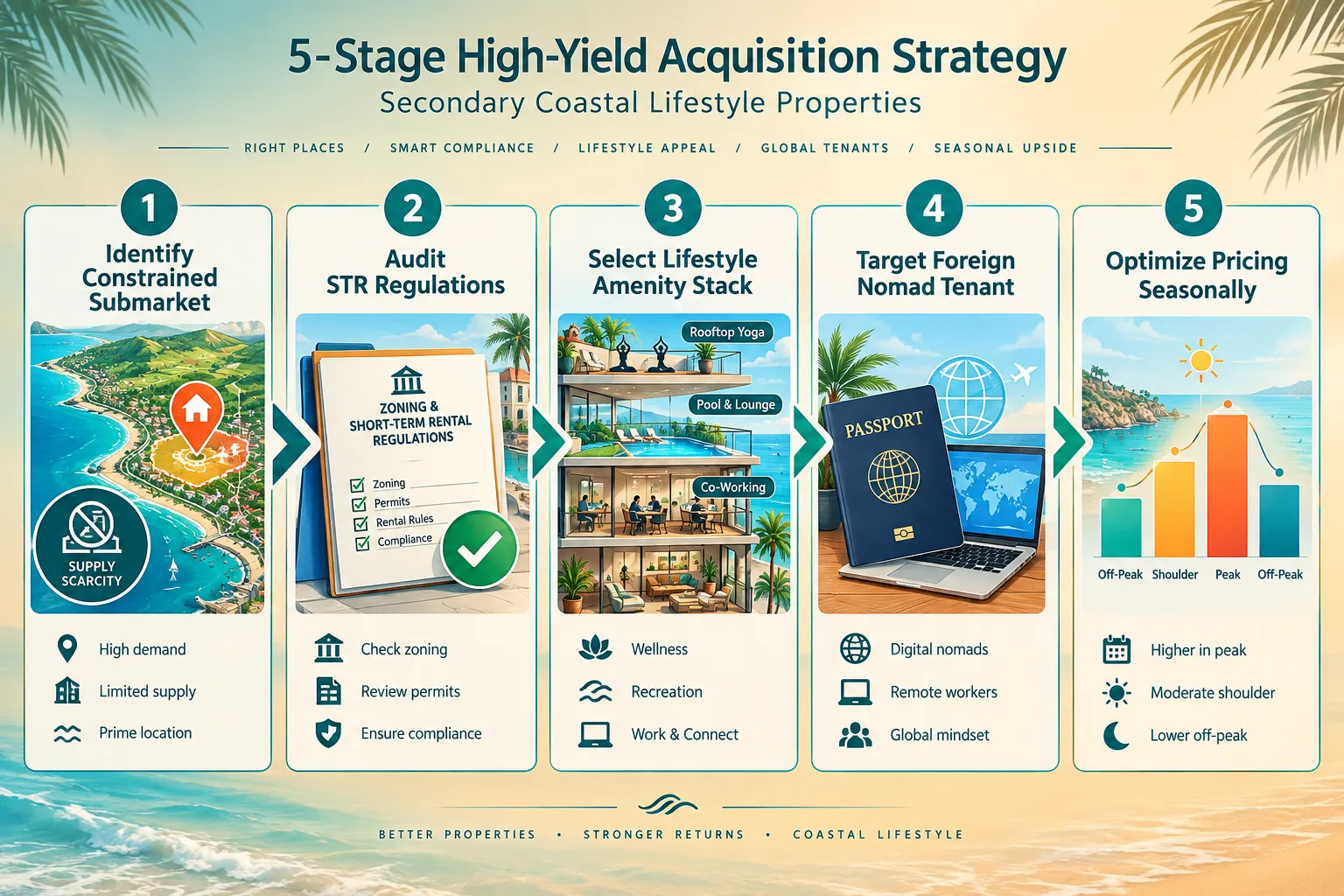
The single most important demand driver reshaping secondary coastal rental markets in 2026 is the growth of the international digital nomad segment. These are not traditional tourists booking three-night weekend stays. They are income-earning remote workers seeking stays of two weeks to three months, willing to pay a significant premium for properties that support both productivity and lifestyle.
What does this tenant segment actually want? Research on STR market performance points to a consistent amenity hierarchy:
| Amenity | Impact on Booking Rate | Impact on Nightly Rate |
|---|---|---|
| High-speed fiber internet | Very High | High |
| Dedicated co-working space | High | High |
| Wellness facilities (yoga, gym) | Medium-High | Medium-High |
| Outdoor living / ocean views | High | Very High |
| Flexible check-in / long-stay pricing | High | Medium |
Properties that deliver on the top three amenities in this list consistently outperform standard vacation rentals in both occupancy and revenue per available night [9]. The Charleston and Santa Barbara markets in the U.S. provide strong evidence for this “experience-driven” positioning, STR occupancies in those lifestyle coastal cities have remained robust even as broader STR supply has grown [9].
Building the Right Amenity Stack
The most effective approach is to treat the amenity stack as a deliberate product decision, not an afterthought. For secondary coastal properties targeting foreign nomads, the minimum viable amenity package in 2026 includes:
- Fiber internet with guaranteed speeds (not just “WiFi available”)
- A dedicated work zone separate from sleeping and living areas
- Outdoor space with ocean or nature views
- Wellness access, either on-site or within a short walk
- Flexible booking terms that reward longer stays with meaningful discounts
This is precisely the model being deployed in digital nomad residential developments in João Pessoa and Fortaleza, where fiber-enabled coastal condos are capturing a growing share of the international long-stay market. The same framework applies equally to secondary coastal cities in North America, Southeast Asia, and Southern Europe.
For investors interested in the wellness dimension of this amenity stack, the broader trend toward wellness-certified high-end residences with gyms, yoga spaces, and lifestyle amenities confirms that these features are now demand-table stakes, not luxury differentiators.
High-Yield Strategies for 2026 Rental Market Shifts: Execution Playbook
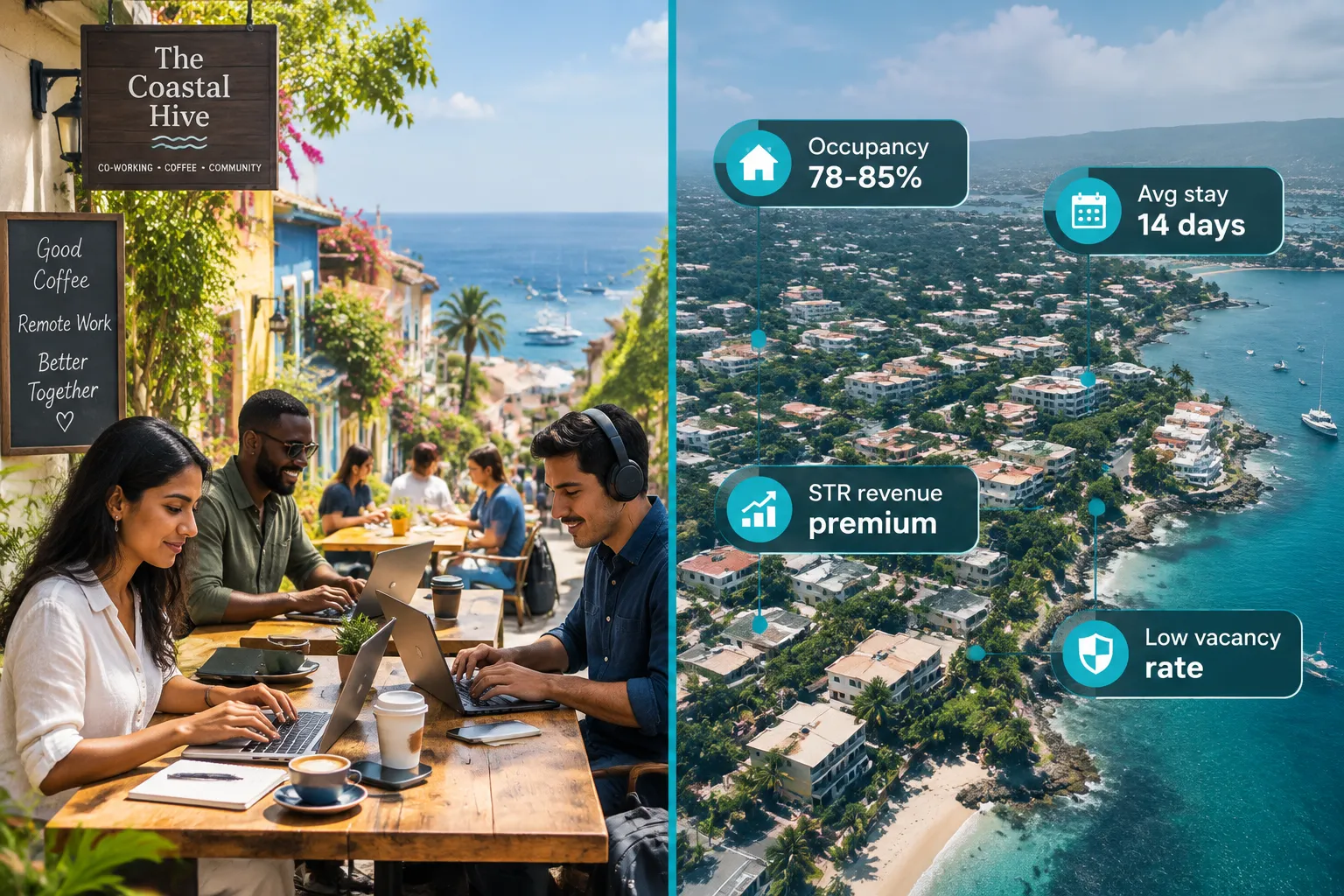
Understanding the market thesis is one thing. Executing a high-yield strategy in secondary coastal cities requires a specific operational playbook that addresses acquisition, regulation, pricing, and management.
Step 1: Submarket Selection Using Supply Constraint Metrics
Not every secondary coastal city qualifies. The screening criteria that matter most in 2026 are:
- Vacancy rate below 5% in the target submarket [3]
- Permitting restrictions that limit new STR-eligible construction near the waterfront
- Growing inbound flight or transit connectivity that signals rising visitor demand
- Existing STR regulatory framework that is stable or investor-friendly
The January 2026 Zillow Rent Report confirms that markets with low vacancy are sustaining rent growth even as broader national trends moderate [3]. Investors who screen for vacancy first, before looking at yield figures, are identifying the most durable opportunities.
Step 2: STR Regulatory Due Diligence
The 2026 STR outlook carries a clear warning: supply is reaccelerating in resort and suburban markets, partly driven by new entrants who underestimate regulatory risk [10]. Cities that have not yet imposed STR restrictions may do so quickly if political pressure builds. The correct approach is to acquire in markets where the regulatory framework is already established and understood.
For coastal markets in Brazil specifically, Airbnb regulation shifts and compliance strategies for high-yield coastal developments in cities like Florianópolis and João Pessoa provide a detailed framework for navigating this risk. The core principle, audit zoning and licensing requirements before signing a purchase agreement, applies universally.
Investors should also review short-term rental regulations, zoning, and tax strategies for Airbnb-optimized developments in resort towns to understand how to structure acquisitions for maximum compliance and yield.
Step 3: Pricing Strategy for the Foreign Nomad Segment
Standard STR pricing tools optimize for weekend leisure travelers. The foreign nomad segment requires a different pricing architecture:
- Base nightly rate set at a 15-25% premium to the local STR average, justified by the amenity stack
- Long-stay discount tiers: 10% off for 7+ nights, 20% off for 28+ nights
- Seasonal floor pricing that prevents deep discounting in shoulder seasons by targeting the nomad segment, which is less season-sensitive than leisure tourists
- Dynamic pricing calibration that accounts for local events, international school calendars, and nomad community gathering periods
This pricing structure is what separates high-yield operators from average performers in secondary coastal markets. The data from top STR markets in 2026 consistently shows that properties with a defined guest persona and matching pricing strategy outperform generalist listings by 20-35% on revenue per available night [9].
Step 4: Technology-Driven Management for Scale
Managing a portfolio of niche lifestyle properties across secondary coastal cities requires operational infrastructure that most individual investors underestimate. The good news is that proptech tools have matured significantly. AI-driven pricing engines, automated guest communication platforms, and remote property management systems now make it feasible to operate properties in multiple markets from a single management hub.
For investors building scale in this segment, rental yield optimization through tech-driven management for Brazil’s suburban apartment surge offers a detailed look at how technology is being deployed to maximize returns across distributed coastal portfolios.
Risk Management: What Can Go Wrong in Secondary Coastal Markets
Every high-yield strategy carries risk, and niche lifestyle properties in secondary coastal cities: high-yield strategies for 2026 rental market shifts are no exception. The primary risks in 2026 fall into three categories:
Regulatory reversal. A city that is STR-friendly today may not be in three years. Mitigation: diversify across multiple markets and maintain long-term rental capability in every property.
Supply surge. The 2026 STR outlook explicitly warns that reaccelerating supply in resort markets could compress yields [10]. Mitigation: focus on submarkets with genuine geographic constraints on new construction.
Currency and macro risk (international markets). For foreign investors in markets like Brazil, currency fluctuation is a real factor. The current weak BRL environment is favorable for USD or EUR-denominated investors, but that can change. Mitigation: structure returns in local currency with repatriation flexibility.
Demand concentration. Over-reliance on a single tenant segment (e.g., only digital nomads) creates vulnerability if that segment’s travel patterns shift. Mitigation: design properties that appeal to both nomads and premium leisure travelers.
For investors exploring the broader opportunity set in Brazil’s secondary cities, secondary city shifts for foreign investors with low-cost, high-yield opportunities beyond São Paulo provides a comprehensive market overview that addresses many of these risk factors in detail.
Market Spotlight: Where the Opportunity Is Concentrated in 2026
The following secondary coastal markets stand out based on the convergence of supply constraint, foreign demand growth, and amenity-driven STR performance:
Northeast Brazil (João Pessoa, Fortaleza, Maceió): Low acquisition costs, growing international connectivity, and a rapidly maturing STR ecosystem. Northeast Brazil Airbnb hotspots with high-yield short-term rental strategies beyond Trancoso and Florianópolis documents the specific submarkets within this region delivering the strongest 2026 performance.
Southern Brazil (Florianópolis): A more mature market with stronger regulatory clarity and a proven track record of attracting high-income domestic and international visitors. See the Florianópolis real estate investment guide for 2026 for current yield benchmarks and neighborhood-level analysis.
U.S. Mid-Atlantic Secondary Coasts (Providence, Virginia Beach): Emerging as stealth high-growth markets driven by remote worker migration from New York and Washington D.C. [5]. Lower acquisition costs than primary coastal metros, with improving transit connectivity.
Southern California Coastal-Adjacent Markets: Modest but reliable rent growth supported by chronic supply constraints and persistent lifestyle demand [4]. Best suited for long-term hold strategies rather than aggressive STR plays.
Conclusion
The case for niche lifestyle properties in secondary coastal cities as a high-yield strategy in 2026 is built on durable structural foundations: supply-constrained submarkets, a growing foreign nomad tenant base, and a clear amenity differentiation playbook that commands premium pricing. The rental market is shifting away from broad-based appreciation toward segmented outperformance, and secondary coastal cities with the right property profile are positioned to capture the best of that shift.
Actionable next steps for investors:
- Screen three to five target secondary coastal cities using vacancy rate, STR regulatory stability, and inbound connectivity as primary filters.
- Define the amenity stack for each target property before acquisition, fiber internet, co-working space, and wellness access are non-negotiable for the nomad segment.
- Complete STR regulatory due diligence in each target market before committing capital.
- Build a long-stay pricing architecture that rewards the foreign nomad segment and reduces dependence on peak-season leisure demand.
- Invest in proptech management infrastructure early, the operational leverage it provides is essential for portfolio scale.
The investors who act on this framework in 2026, rather than waiting for the opportunity to become obvious, will be the ones who capture the yield premium before supply catches up.
References
[1] Market Trends – https://ocrentaldata.com/market-trends/ [2] 2026 Apartment Housing Outlook – https://naahq.org/news/2026-apartment-housing-outlook [3] January 2026 Rent Report 36091 – https://www.zillow.com/research/january-2026-rent-report-36091/ [4] California Rental Market Report – https://managecasa.com/articles/california-rental-market-report [5] Coastal City Rent Growth Trends – https://www.linkedin.com/top-content/real-estate/multifamily-housing-trends/coastal-city-rent-growth-trends/ [6] Will Uk Rents Keep Rising In 2026 Full Rental Market Forecast North West Analysis – https://www.farrellheyworth.co.uk/blog/will-uk-rents-keep-rising-in-2026-full-rental-market-forecast-north-west-analysis/ [7] Upcoming Rental Trends For 2026 – https://smartscreen.clearscreening.com/upcoming-rental-trends-for-2026/ [8] Matrix Multifamily National Report December 2025 – https://www.urbancatalyst.com/hubfs/Matrix%20Multifamily%20National%20Report-December%202025.pdf [9] Best Str Markets 2026 – https://staystra.com/best-str-markets-2026/ [10] Short Term Rental Market Trends 2026 Data – https://magicbnb.io/blog/short-term-rental-market-trends-2026-data