
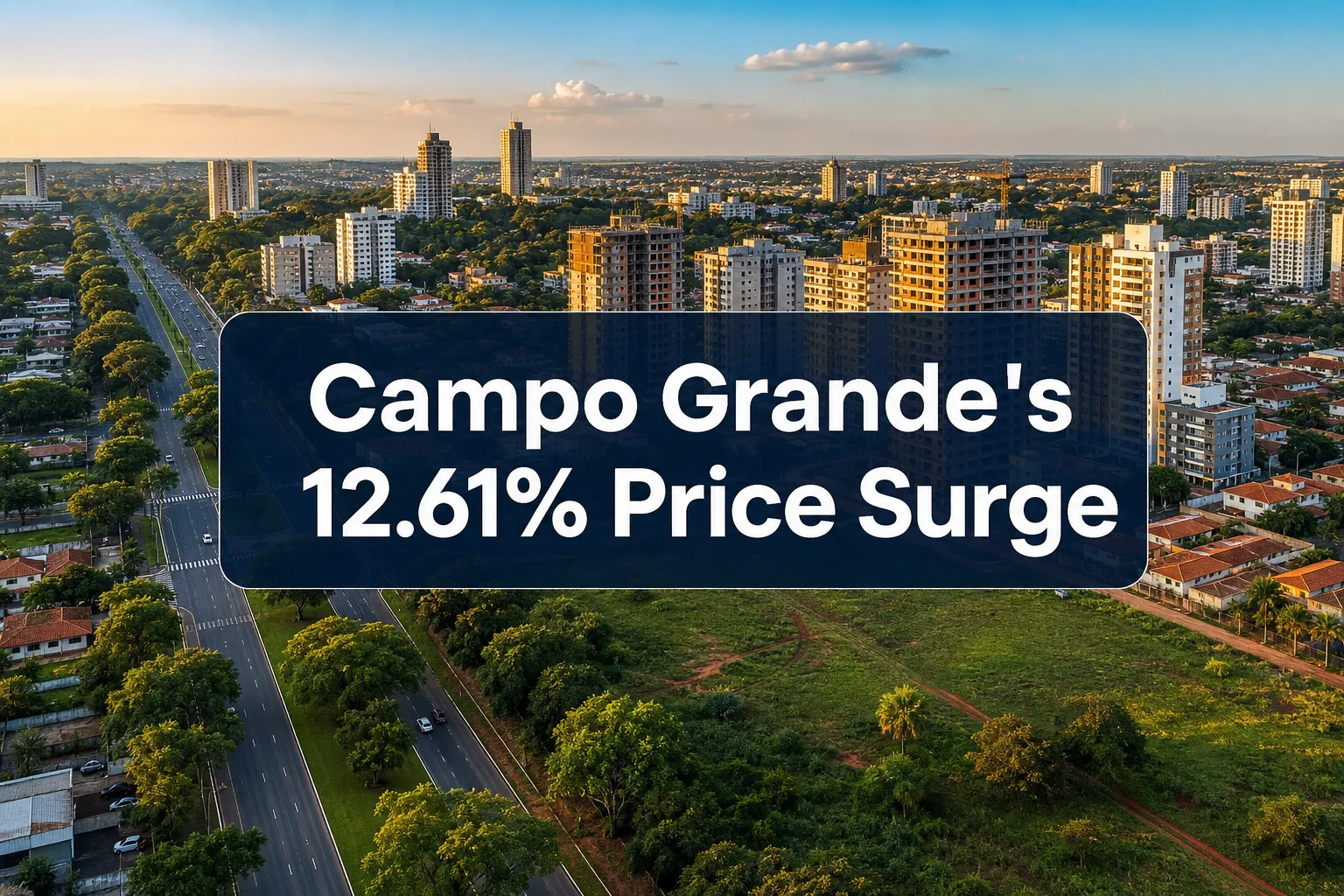
A 12.61% annual price gain in a landlocked Brazilian capital that most coastal investors still overlook, that is the story the FipeZAP index told at the start of 2026, and the data behind it is compelling enough to rewrite development pipelines [5]. Campo Grande’s 12.61% Price Surge: Suburban Development Goldmine for 2026 Midwestern Expansion is not a headline built on speculation. It rests on R$1.7 billion in property transactions over 12 months, a cost-per-square-metre that now outpaces Brasília and Maceió, and a suburban land bank that remains largely untapped [8][4]. For developers and investors searching for yield beyond the coastal hotspots, Mato Grosso do Sul’s capital is emerging as one of the most structurally sound opportunities in Brazil’s interior.
Key Takeaways
- Campo Grande posted a 12.61% annual price increase in early 2026, ranking it among Brazil’s top three capitals for residential appreciation [5].
- Total property sales reached R$1.7 billion over 12 months, driven primarily by the mid-market segment (R$350,000, R$700,000) [8][3].
- The cost per square metre in Campo Grande now exceeds that of Brasília and Maceió, signalling a structural repricing rather than a speculative spike [4].
- Noble districts command above R$7,500, R$10,000/m², while popular neighbourhoods offer entry points at R$3,500, R$4,500/m², creating a tiered opportunity map for developers [6].
- Agribusiness-linked financing, Novo PAC infrastructure investment, and suburban gated-community demand are the three structural drivers most likely to sustain 10-15% appreciation through the mid-2026 cycle.
Understanding the Price Surge: What the Data Actually Shows
The FipeZAP residential sales index for January and February 2026 placed Campo Grande third among Brazilian state capitals for annual price growth, with a 12.61% gain that outperformed the national average by a significant margin [5][7]. That figure is not a one-month anomaly. The trajectory had been building through 2025, and by early 2026 the market had reached a point where the official Censo Imobiliário confirmed that Campo Grande’s average cost per square metre had surpassed both Brasília and Maceió, cities with far larger federal budgets and established real estate markets [4].
What is driving this repricing?
Several structural factors converge in Campo Grande that are absent in many other interior cities:
- Agribusiness wealth concentration: Mato Grosso do Sul is one of Brazil’s leading soy, beef, and sugarcane states. Landowner and agribusiness entrepreneur wealth flows into Campo Grande’s residential market as a store of value, creating demand that is largely insulated from urban employment cycles.
- Limited quality supply: The city’s formal residential stock in the mid-to-high segment has not kept pace with income growth. New launches in gated communities and mid-rise condominiums are absorbed quickly.
- Infrastructure investment: Federal Novo PAC commitments to sanitation, road upgrades, and urban mobility in Mato Grosso do Sul are reducing the risk premium on suburban development. Developers tracking Novo PAC sanitation investments unlocking residential development in Brazil’s underserved urban peripheries will find Campo Grande’s suburban ring a direct beneficiary.
- Migration from smaller municipalities: Campo Grande functions as the regional service hub for a vast interior. Healthcare, education, and corporate employment continue to attract families from smaller Mato Grosso do Sul towns.
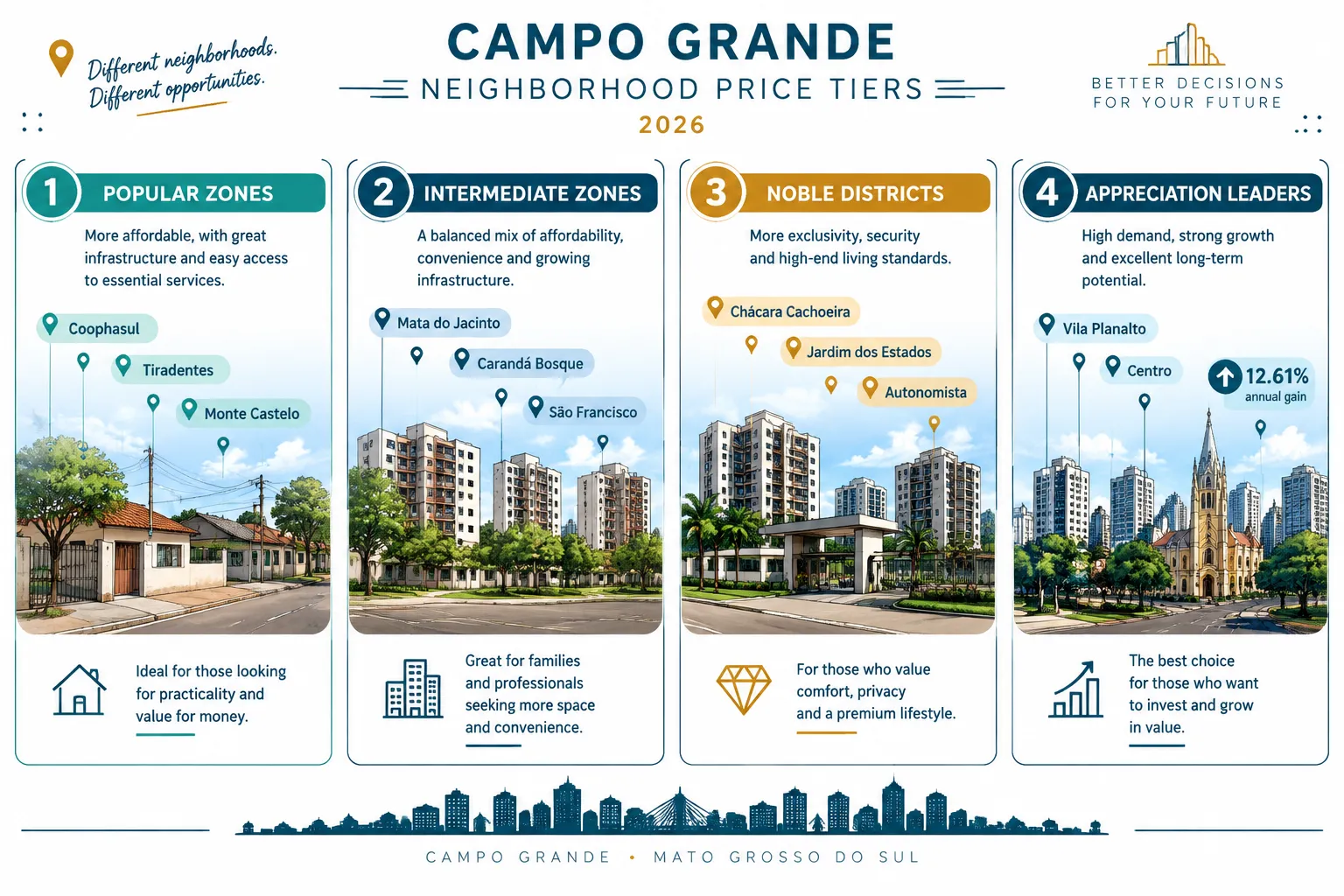
The neighbourhood-level data reinforces the macro picture. Vila Planalto and Centro recorded the highest annual price increases per square metre in the city over the 12-month period ending in mid-2026, with both areas benefiting from urban renewal investment and proximity to commercial corridors [9].
“Campo Grande’s repricing is structural, not cyclical. The convergence of agribusiness capital, infrastructure spending, and constrained quality supply creates a durable appreciation floor.”
The Tiered Price Map: Where Campo Grande’s 12.61% Price Surge Creates Entry Points
The market is not monolithic. Campo Grande’s 12.61% Price Surge: Suburban Development Goldmine for 2026 Midwestern Expansion plays out differently across three distinct price tiers, and understanding this structure is essential for positioning a development project correctly.
Popular Neighbourhoods: High Volume, Lower Barriers
Areas such as Coophasul, Tiradentes, and Monte Castelo currently trade at approximately R$3,500, R$4,500/m² [6]. These neighbourhoods serve the working and lower-middle-class buyer, with strong overlap with Minha Casa Minha Vida (MCMV) programme eligibility. Transaction velocity is high, but margin compression is a real risk for developers who underestimate infrastructure costs.
Intermediate Zones: The Sweet Spot for Mid-Market Development
Mata do Jacinto, Carandá Bosque, and São Francisco sit in the R$5,000, R$7,000/m² range [6]. This tier aligns almost perfectly with the market segment that Campo Grande News identified as the dominant demand engine: properties priced between R$350,000 and R$700,000, generating 5-7% annual appreciation even in years without a headline surge [3]. Buyers in this tier are typically dual-income families, agribusiness professionals, and civil servants seeking quality over location prestige.
Noble Districts: Premium Positioning with Strong Absorption
Chácara Cachoeira, Jardim dos Estados, and Autonomista command prices above R$7,500, R$10,000/m², with some premium units exceeding R$8,000/m² [6]. The R$1.7 billion in 12-month transaction volume is heavily concentrated here and in the upper intermediate tier [8]. For developers with the capital to access these land plots, the margin profile is compelling, particularly in gated horizontal condominium formats.
Tiered Price Reference (2026)| Tier | Example Neighbourhoods | Approx. R$/m² |
|---|---|---|
| Popular | Coophasul, Tiradentes, Monte Castelo | R$3,500, R$4,500 |
| Intermediate | Mata do Jacinto, Carandá Bosque, São Francisco | R$5,000, R$7,000 |
| Noble | Chácara Cachoeira, Jardim dos Estados, Autonomista | R$7,500, R$10,000+ |
The appreciation leaders, Vila Planalto and Centro, cut across tiers, demonstrating that location-specific factors (urban renewal, commercial density, transit access) can generate outsized returns independent of the base price level [9][2].
Suburban Development Strategies for the 2026 Midwestern Expansion
The most underexplored dimension of Campo Grande’s 12.61% Price Surge: Suburban Development Goldmine for 2026 Midwestern Expansion is the suburban land bank. The city’s urban footprint expands along several axes, notably toward Água Limpa Park, Alphaville Campo Grande, and rural tracts on the western and northern perimeters, where land acquisition costs remain significantly below the per-unit value of a completed gated condominium.

Agribusiness-Tied Financing: A Structural Advantage
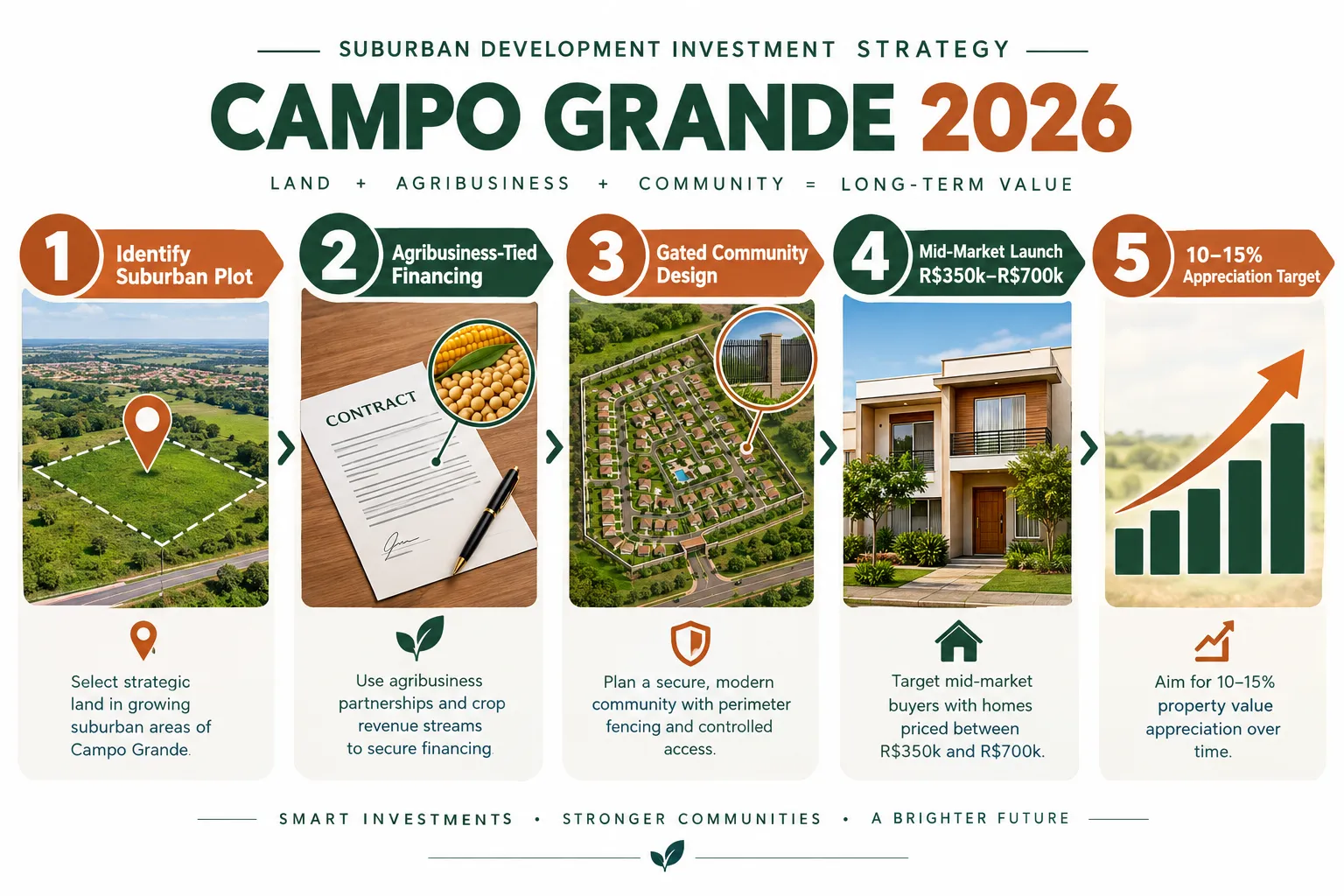
One of Campo Grande’s most distinctive features as a development market is the availability of agribusiness-linked capital structures. Local developers and landowners with ties to the soy and beef sectors have access to rural credit lines (notably PRONAF and PRONAMP derivatives) that can be structured to partially finance suburban residential development on land transitioning from agricultural to urban use. This mechanism can reduce the effective cost of capital by 3-5 percentage points compared to standard real estate development financing, directly supporting the 10-15% appreciation target that makes suburban projects viable even in a high-Selic environment.
For context on how Brazil’s current interest rate environment affects development feasibility, the analysis of how Brazil’s high Selic rate is reshaping development feasibility for mid-market projects is directly applicable to Campo Grande’s suburban pipeline.
Gated Horizontal Condominiums: The Format That Sells
The demand profile in Campo Grande’s suburban ring is dominated by families seeking larger floor areas, private outdoor space, and security, a combination that horizontal gated condominiums deliver more efficiently than vertical mid-rise towers. Key design and commercial considerations include:
- Unit mix: 3-4 bedroom houses of 120-180m² targeting the R$450,000, R$750,000 bracket
- Amenity package: Shared pool, sports courts, and green corridors, which align with buyer expectations in this income segment
- Phase sizing: Phases of 80-150 units allow developers to manage absorption risk while maintaining construction efficiency
- Infrastructure pre-investment: Buyers in this tier expect paved internal roads, full sanitation, and fibre connectivity from delivery
The Novo PAC infrastructure investment playbook for capturing 10-25% property premiums through strategic project timing provides a replicable framework for timing suburban launches around confirmed public infrastructure commitments, a strategy that is directly applicable to Campo Grande’s western expansion corridors.
Rental Yield Considerations
While the primary driver in Campo Grande is capital appreciation rather than rental yield, the mid-market segment does generate meaningful rental returns. The city’s growing population of corporate professionals, federal agency employees, and university staff creates a stable rental demand base. Developers targeting the intermediate tier (R$5,000, R$7,000/m²) should model rental yields of 5-7% per annum alongside the appreciation upside. For a broader framework on optimising rental returns in Brazil’s suburban apartment market, the rental yield optimization guide for Brazil’s suburban apartment surge offers applicable strategies.
Foreign and Institutional Capital Positioning
Campo Grande is beginning to appear on the radar of foreign investors seeking inland Brazilian exposure beyond the coastal hotspots. The combination of a weak Brazilian real, above-average appreciation rates, and agribusiness-backed economic stability creates a compelling entry thesis. The broader analysis of foreign buyer surge in inland markets and yield optimization beyond coastal hotspots documents this trend and provides a useful benchmark for Campo Grande’s positioning within the national inland investment landscape.
For institutional capital considering Brazilian real estate funds, the FII market expansion and high-yield opportunities in Brazilian property funds for international developers outlines the structural vehicles through which exposure to markets like Campo Grande can be accessed with liquidity and regulatory clarity.
Risk Factors and Market Constraints
No investment thesis is complete without an honest assessment of the constraints. Campo Grande’s suburban development opportunity carries several risks that developers must price into their feasibility models.
Demand concentration risk: The R$1.7 billion in annual transaction volume, while impressive for a city of this size, is concentrated in a relatively narrow buyer segment [8]. A significant deterioration in agribusiness commodity prices, particularly soy or beef, could reduce discretionary property investment from the landowning class that underpins much of the noble district demand.
Infrastructure sequencing: Suburban plots beyond the established urban perimeter depend on public infrastructure delivery (roads, sanitation, electricity) that is subject to federal and state budget cycles. Developers who acquire land ahead of confirmed Novo PAC commitments carry timing risk that can extend project cycles by 18-36 months. Tracking infrastructure-led suburban expansions and Novo PAC’s role in unlocking viable residential projects beyond major metros is essential for managing this risk.
Selic rate sensitivity: Mid-market buyers in the R$350,000, R$700,000 range are mortgage-dependent. The current high-Selic environment compresses affordability and can slow absorption velocity. Developers should model scenarios in which the Selic remains above 12% through late 2026 and structure payment plans accordingly.
Supply pipeline acceleration: The visibility of Campo Grande’s appreciation figures will attract new entrants. A rapid expansion of the launch pipeline in 2026-2027 could compress margins in the intermediate tier if demand does not scale proportionally.
Comparative Context: How Campo Grande Stacks Up Against Other Brazilian Growth Markets
Campo Grande’s 12.61% annual gain places it in a select group of Brazilian cities delivering double-digit residential appreciation in 2026. For comparison:
- Fortaleza has generated 15-25% gains in specific coastal micro-markets tied to port infrastructure upgrades, as documented in the analysis of Fortaleza’s coastal property surge from Novo PAC port upgrades and international rental demand.
- Porto Alegre is recovering from flood-related disruption, with yield strategies emerging in specific resilient corridors.
- Belo Horizonte is seeing transit-led appreciation along Metro Line 2 expansion zones.
What distinguishes Campo Grande is the combination of appreciation rate, transaction volume depth, and the availability of suburban land at prices that still allow viable development margins. Cities like Fortaleza offer higher peak yields but in narrower coastal micro-markets with significant competition. Campo Grande’s suburban ring offers scale, hundreds of hectares of developable land within 15-25 km of the city centre, that coastal markets simply cannot match.
Conclusion: Actionable Steps for Developers Targeting Campo Grande in 2026
Campo Grande’s 12.61% price surge is not a temporary headline. It reflects a structural repricing driven by agribusiness wealth, constrained quality supply, and accelerating infrastructure investment. For developers and investors prepared to act in 2026, the following steps represent the clearest path to capturing this opportunity.
1. Conduct a suburban land audit now. The window for acquiring peripheral plots at pre-appreciation prices is narrowing. Focus on the western and northern expansion corridors where Novo PAC sanitation investments are confirmed or in procurement.
2. Structure financing around agribusiness credit lines. Engage local agricultural credit specialists to explore hybrid financing structures that reduce the effective cost of capital for land transitioning from rural to urban use.
3. Target the intermediate tier for volume, the noble tier for margin. The R$350,000, R$700,000 mid-market segment offers the most reliable absorption velocity [3]. Noble district projects in Chácara Cachoeira and Jardim dos Estados offer higher margins but require stronger pre-sales programmes.
4. Design for the suburban buyer’s actual priorities. Larger floor areas, private outdoor space, security infrastructure, and high-speed connectivity are non-negotiable for the target demographic. Amenity packages that reflect these priorities reduce time-to-sell.
5. Monitor the FipeZAP index monthly. The 12.61% figure represents a 12-month trailing average [5][7]. Quarterly updates will signal whether appreciation is accelerating into the second half of 2026 or beginning to moderate, a critical input for launch timing decisions.
6. Evaluate FII structures for capital access. For developers without a local balance sheet, Brazilian real estate investment funds offer a structured path to deploying capital in Campo Grande’s residential market with defined exit mechanisms.
The midwestern expansion story in Brazilian real estate is still in its early chapters. Campo Grande’s price surge is the clearest signal yet that the interior’s time has arrived.
References
[1] Campo Grande – https://tulugar.com/en/market/paraguay/luque/campo-grande
[2] Lista Confira Bairros Lideram Valorizacao Imobiliaria Anual Campo Grande – https://midiamax.com.br/cotidiano/2026/lista-confira-bairros-lideram-valorizacao-imobiliaria-anual-campo-grande/
[3] Imoveis De Classe Media Lideram Mercado Na Capital De R 350 Mil A R 700 Mil – https://www.campograndenews.com.br/economia/imoveis-de-classe-media-lideram-mercado-na-capital-de-r-350-mil-a-r-700-mil
[4] Censo Campo Grande Tem O M² Mais Caro Que Brasilia E Maceio – https://primeirapagina.com.br/economia/censo-campo-grande-tem-o-m%C2%B2-mais-caro-que-brasilia-e-maceio/
[5] Fipezap 202601 Residencial Venda – https://downloads.fipe.org.br/indices/fipezap/fipezap-202601-residencial-venda.pdf
[6] Valor Metro Quadrado Campo Grande Ms – https://myside.com.br/guia-imoveis/valor-metro-quadrado-campo-grande-ms
[7] Fipezap 202602 Residencial Venda – https://downloads.fipe.org.br/indices/fipezap/fipezap-202602-residencial-venda.pdf
[8] Venda De Imoveis Em Campo Grande Movimentou R 1 7 Bilhao Em 12 Meses – https://www.campograndenews.com.br/economia/venda-de-imoveis-em-campo-grande-movimentou-r-1-7-bilhao-em-12-meses
[9] Vila Planalto E Centro Registram As Maiores Altas No Preco Do M Em 1 Ano – https://www.campograndenews.com.br/cidades/capital/vila-planalto-e-centro-registram-as-maiores-altas-no-preco-do-m-em-1-ano
[10] Campo Grande Ms – https://www.gurudosimoveis.com.br/dados/campo-grande-ms.csv