
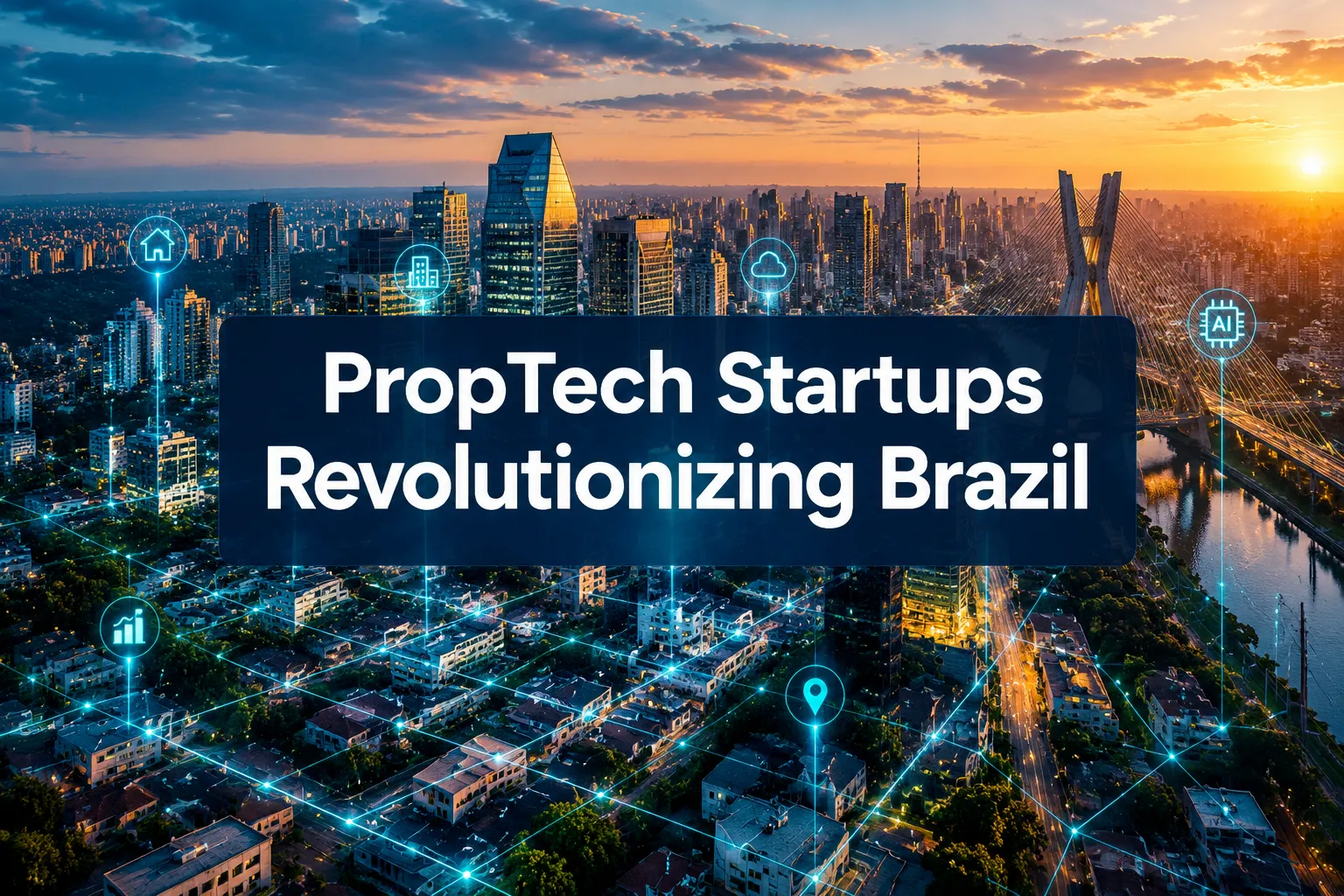
Developers who identified plots near Brazil’s Linha 4 metro extension in Sao Paulo before construction broke ground captured land appreciation of 30 to 45 percent within three years. In 2026, waiting for that kind of signal to become obvious is already too late. The new competitive edge belongs to PropTech startups revolutionizing Brazil site selection through AI tools for 2026 high-yield development pipelines, firms that can process thousands of geo-spatial variables, infrastructure timelines, and demand signals in the time it takes a traditional analyst to pull a zoning report.
Brazil’s property technology sector is no longer a niche experiment. QuintoAndar has committed approximately 2 billion reais (roughly US$395 million) to AI investment over two years, embedding machine learning into valuation, credit scoring, and pipeline planning at national scale. Morada.ai, Lastro, and a growing cohort of startups are building generative-AI stacks that feed directly into the decisions developers make about where to build, what to build, and when to launch.
Key Takeaways
- AI-driven site selection tools are compressing developer decision timelines by up to 20 percent, with early movers capturing undervalued plots near Novo PAC infrastructure corridors before price signals become public.
- Brazil’s leading PropTech firms, including QuintoAndar, Morada.ai, and Lastro, are deploying large-scale AI investments that reshape how demand data flows into development pipelines.
- Geo-spatial intelligence platforms, including open-source tools like UrbanPy, are maturing rapidly, giving private developers access to the same analytical depth previously reserved for public-sector urban planners.
- Smart-city initiatives such as Rio AI City and the SENSEable Rio Lab are generating high-resolution urban data that anchors next-generation site-selection algorithms.
- The 2026 to 2028 window represents a critical adoption period: developers who integrate AI site-selection tools now will hold a structural advantage as Brazil’s infrastructure spending accelerates under Novo PAC.
How AI Is Reshaping the Site Selection Process in Brazil
Site selection in Brazilian real estate has historically relied on a combination of broker relationships, municipal zoning maps, and the intuition of experienced land analysts. That approach worked when information asymmetry was the norm. Today, the same asymmetry that once protected local knowledge is being dismantled by data.
The core shift is from reactive to predictive. Traditional site selection asks: “What is this plot worth today?” AI-powered site selection asks: “What will this plot be worth in 36 months, given infrastructure commitments, demographic flows, and credit availability?”
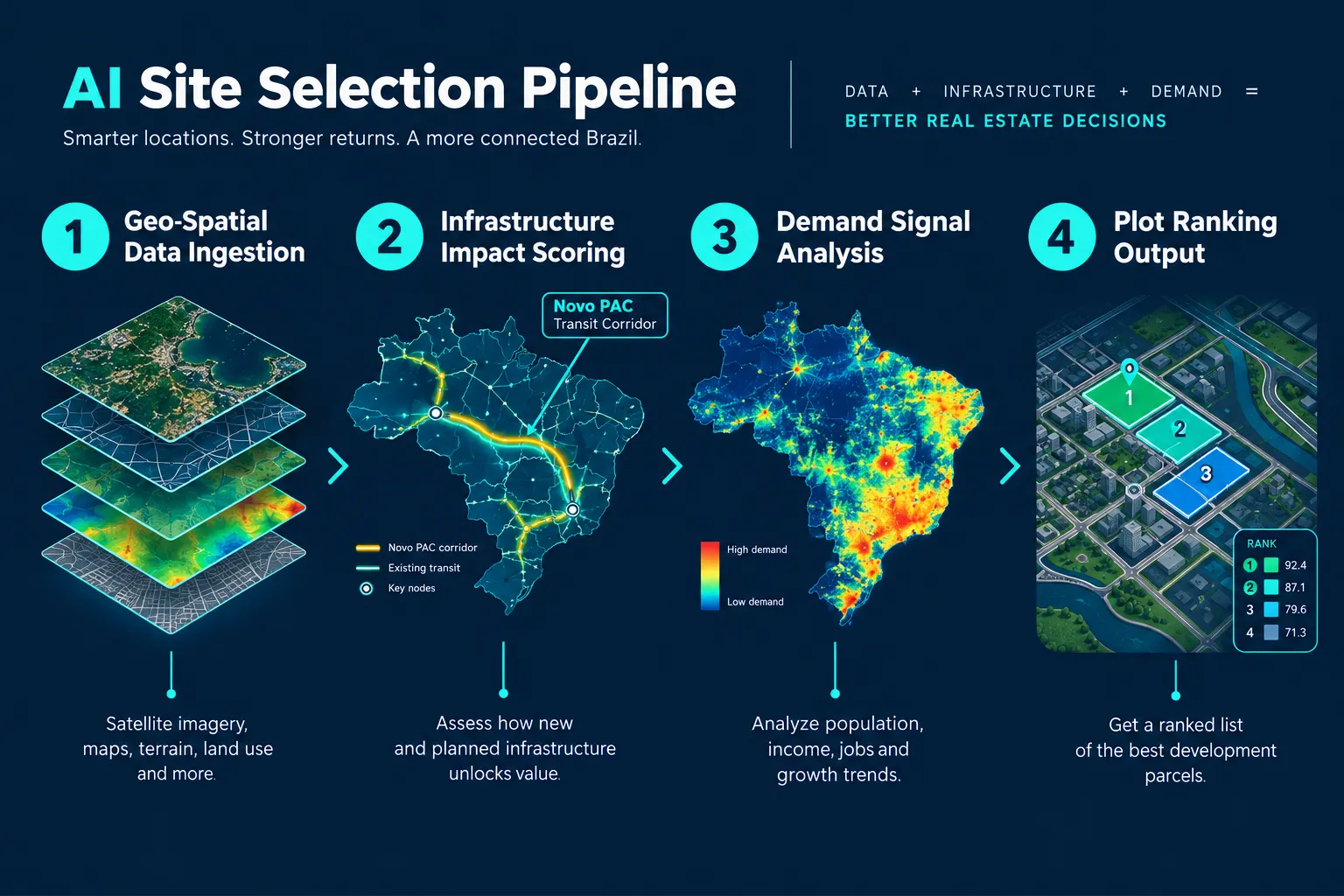
The technical stack driving this shift combines three layers:
- Geo-spatial data ingestion, satellite imagery, cadastral records, flood-risk layers, and transit corridor shapefiles are aggregated into a single analytical environment.
- Predictive scoring models, machine learning algorithms weight each variable against historical price appreciation data, identifying plots where the gap between current pricing and future value is widest.
- Demand signal integration, rental search volumes, mortgage application density, and population mobility data are fed into the model to validate that end-user demand will materialize.
Open-source tools like UrbanPy, already used in public-sector urban planning across Latin America, provide a blueprint for how private PropTech firms are building proprietary versions of this stack [5]. The Inter-American Development Bank has highlighted how open-source technology and AI-powered data are strengthening urban planning decisions across the region, a methodology now being commercialized by Brazil’s startup ecosystem [5].
Academic research at Brazilian institutions is converging on the same technical architecture. Studies from USP and affiliated research centers point to AI combined with geoprocessing and big data as the foundational stack for urban site selection and scenario modeling [7]. What was a research agenda two years ago is now a product roadmap.
For developers building 2026 high-yield development pipelines, the implication is direct: the firms that integrate these tools earliest will consistently identify undervalued land before the broader market prices in infrastructure impacts.
The Novo PAC Effect: Infrastructure Intelligence as a Competitive Weapon

Brazil’s Novo PAC program represents one of the largest infrastructure investment cycles in the country’s recent history, covering transit, sanitation, housing, and logistics across every major region. For developers, each announced corridor is a potential value-creation event. The challenge is that the gap between announcement and price reaction in the land market is shrinking, and AI tools are the reason.
PropTech startups are now building infrastructure-impact models that ingest Novo PAC project data, cross-reference it with existing transit density and employment catchment maps, and output a ranked list of plots where appreciation potential is highest relative to current asking prices. Developers using these tools are reporting launch timelines that are approximately 20 percent faster than traditional processes, because land acquisition decisions that previously required months of manual due diligence can now be validated in days.
“The developer who waits for a metro station to open before buying land nearby has already missed the trade. The AI advantage is knowing which corridor gets funded next.”
This dynamic is particularly relevant for secondary cities, where Novo PAC investment is flowing into markets that lack the deep broker networks of Sao Paulo or Rio. Cities like Salvador, Belo Horizonte, and Belem are receiving significant infrastructure commitments, and AI site-selection tools are among the few ways developers can build analytical coverage of these markets at scale.
The Salvador Novo PAC transit yield strategies for residential projects illustrate exactly this dynamic: transit-oriented development near new urban mobility lines is generating measurable rental and resale premiums that AI models can now identify months before they appear in comparable sales data.
Similarly, the Belo Horizonte Barreiro metro expansion yield strategies near Linha 2 stations demonstrate how infrastructure timelines, when fed into predictive models, generate actionable site rankings that traditional analysis simply cannot produce at the same speed or scale.
Key infrastructure variables that AI site-selection models are tracking in 2026:
| Variable | Data Source | Impact on Site Score |
|---|---|---|
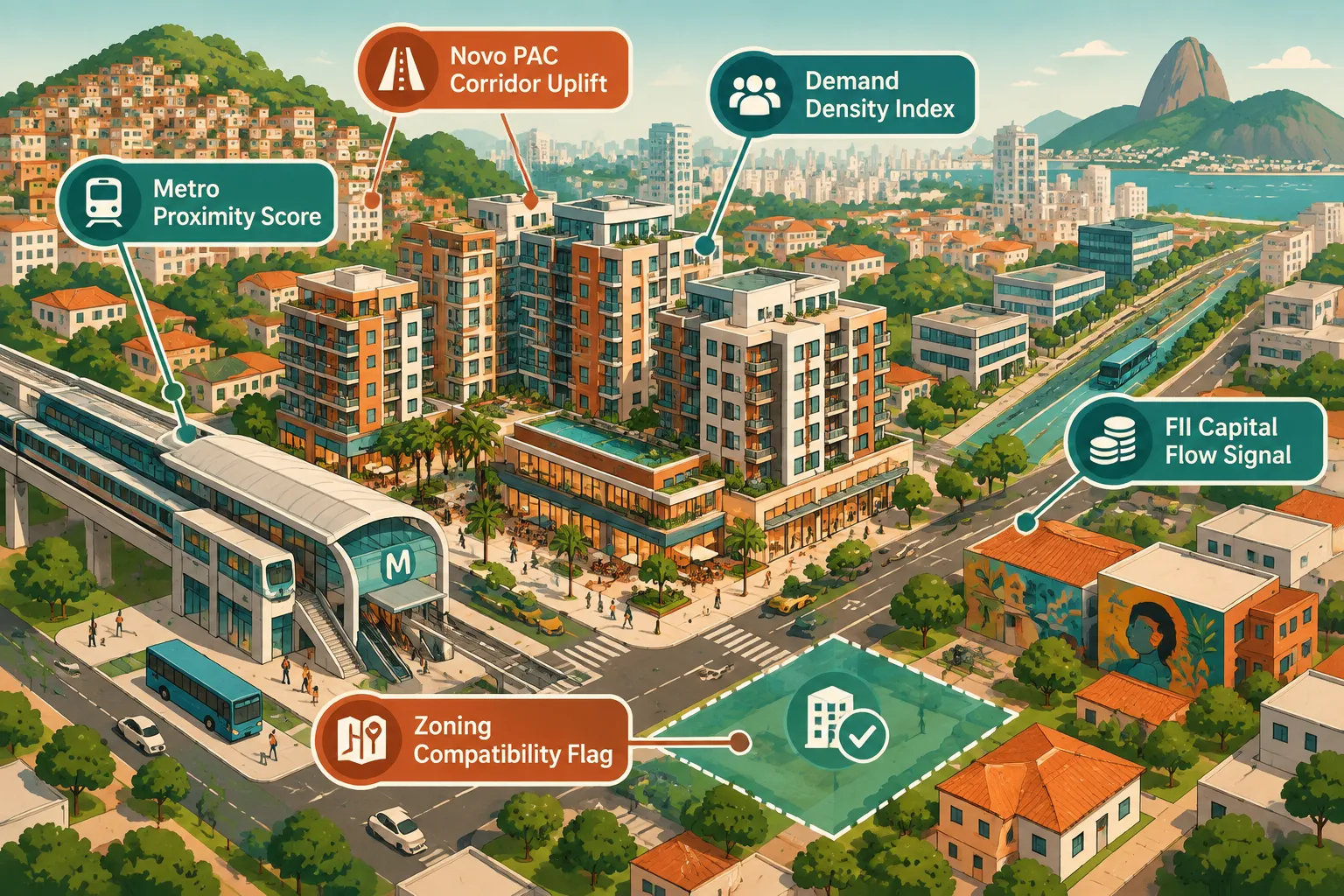
| Novo PAC transit corridor distance | Federal project registry | High positive within 800m |
| Sanitation upgrade zones | Municipal concession maps | Moderate positive |
| Flood risk reclassification | INPE satellite data | High negative if elevated |
| Employment density growth | RAIS labor market data | High positive |
| MCMV eligibility boundary | Caixa Economica registers | Moderate positive for mid-market |
The secondary cities property boom driven by MCMV development tactics is another area where AI infrastructure scoring is proving its value, helping developers identify which inland markets have the combination of program eligibility, infrastructure investment, and demand density to support high-velocity launches.
The PropTech Startup Landscape Driving Brazil’s AI Site-Selection Revolution
Understanding which startups are building the tools that matter requires separating the broader PropTech ecosystem from the specific segment focused on developer-side intelligence. Most consumer-facing PropTech addresses the buyer or renter journey. The more strategically significant layer for developers is the data and analytics infrastructure being built underneath.
QuintoAndar is the most capitalized player, with its 2-billion-real AI commitment funding not just consumer features but the underlying valuation and credit models that influence how demand data is structured and distributed. Its integration of conversational property search inside ChatGPT signals that AI-generated demand signals will increasingly be available in structured, API-accessible formats, exactly the kind of feed that site-selection models need.
Morada.ai is building a generative-AI stack focused on the home-buying journey for developers, with tools that help development teams understand buyer intent signals at the neighborhood level. As its capital base and geographic reach expand, the granularity of its demand data becomes a direct input for site-selection scoring.
Lastro’s “Lais” AI agent transforms lead qualification and brokerage operations, generating a continuous stream of structured demand data that, in aggregate, reveals which micro-markets are absorbing product fastest. For developers, this is an indirect but powerful signal about where to build next.
Plaza’s “Maya” and Kzas’s matching engine push toward always-on, data-rich demand pipelines that reduce the lag between market shifts and developer awareness. These tools are part of a broader ecosystem that, taken together, constitutes a real-time demand intelligence layer for the Brazilian property market.
Smart-city infrastructure is reinforcing this data layer from the physical side. Rio AI City is creating urban hubs where physical sensors, mobility data, and AI processing converge [8]. The SENSEable Rio Lab is generating high-resolution urban data, pedestrian flows, noise maps, visual density indices, that future PropTech site-selection tools can incorporate as additional scoring variables [3]. Brazil’s participation in BRICS smart-city frameworks is accelerating South-South knowledge transfer in AI urban applications, bringing global GeoAI methodologies into the Brazilian context [8].
Academic and policy literature is reinforcing the same direction. Research published through Brazilian urban planning journals identifies AI combined with geoprocessing as the core technical framework for scenario modeling in site selection [6]. The practical implication for developers is that the analytical tools being built by startups in 2026 have a deep research foundation, not just a commercial one.
For developers evaluating how PropTech tools fit into a broader investment thesis, the FII market surge fueling logistics and mixed-use property developments provides important context: institutional capital is increasingly flowing toward assets that can demonstrate data-driven site selection as part of their underwriting.
The data centers, AI infrastructure, and power availability as Brazil’s next commercial development hotspots analysis is also directly relevant: the same AI infrastructure driving PropTech tools is itself generating new demand for commercial real estate, creating a feedback loop between the technology and the asset class it serves.
Emerging PropTech capabilities by development stage:
- Land acquisition: Geo-spatial scoring, infrastructure impact modeling, comparable transaction analysis
- Feasibility: AI-generated demand projections, absorption rate modeling, competitor pipeline mapping
- Design: Generative layout optimization, unit-mix recommendations based on buyer profile data
- Sales and marketing: Conversational AI search, personalized buyer matching, VR tour integration
- Asset management: Predictive maintenance scoring, rental yield optimization, refinancing signal alerts
The Proptech revolution in Brazil covering AI valuation tools and VR tours driving development efficiency provides a detailed look at how these capabilities are being deployed across the full development lifecycle, not just at the site-selection stage.
Practical Integration: Building an AI-Augmented Development Pipeline in 2026
PropTech startups revolutionizing Brazil site selection through AI tools for 2026 high-yield development pipelines are not replacing development expertise, they are amplifying it. The developers capturing the most value from these tools share a common approach: they treat AI outputs as structured hypotheses to be validated by local knowledge, not as final decisions.
A practical integration framework looks like this:
Step 1, Define the target market parameters. Before any AI tool is deployed, the development team specifies the asset class, price band, target buyer profile, and geographic boundaries. This constrains the model and prevents spurious recommendations.
Step 2, Run infrastructure impact scoring. Feed Novo PAC corridor data, municipal zoning updates, and transport concession timelines into the geo-spatial model. Output is a ranked list of micro-markets by infrastructure-driven appreciation potential.
Step 3, Overlay demand signal validation. Cross-reference the ranked list against rental search volume data, mortgage application density from Caixa Economica Federal registers, and population mobility indices. Markets where infrastructure scoring and demand signals align move to the shortlist.
Step 4, Conduct rapid field validation. AI-shortlisted plots are visited by local analysts who assess qualitative factors, neighborhood trajectory, broker sentiment, visible construction activity, that quantitative models cannot fully capture.
Step 5, Run financial scenario modeling. AI-generated absorption rate projections and comparable pricing data feed into the financial model, stress-testing the development against a range of launch timing and pricing scenarios.
This workflow is why developers using AI site-selection tools are achieving faster launches. Steps 1 through 3, which traditionally consumed weeks of analyst time, can now be completed in hours. The human expertise is concentrated where it adds the most value: field validation and financial judgment.
Credit conditions in 2026 are also making speed a competitive advantage. The Selic rate environment and fixed-rate mortgage credit expansion boosting Brazil residential launches means that well-located, correctly priced product is being absorbed faster than in previous cycles. Developers who can identify and acquire the right sites quickly are capturing disproportionate returns.
Foreign capital is also flowing into this dynamic. The foreign direct investment boom in Brazil properties driven by tax incentives and weak BRL is creating additional demand for AI-validated site selection, as international investors require the kind of structured, data-backed underwriting that manual processes cannot efficiently produce.
Barriers to adoption that developers should anticipate:
- Data fragmentation: Brazil’s cadastral and zoning databases vary significantly in quality across municipalities. AI tools are only as good as the underlying data, and secondary cities often have less structured inputs.
- Model interpretability: Development teams need to understand why an AI model ranks a site highly, not just that it does. Startups offering explainable AI outputs are more useful than black-box scoring systems.
- Integration with existing workflows: The most common failure mode is purchasing an AI tool and running it in parallel with existing processes rather than integrating it. The efficiency gains come from replacing manual steps, not adding a new layer.
- Talent gaps: Using these tools effectively requires at least one team member who understands both real estate fundamentals and data interpretation. This profile is scarce in Brazil’s current talent market.
Conclusion
The convergence of AI, geo-spatial intelligence, and Brazil’s Novo PAC infrastructure cycle is creating a structural advantage for developers who adopt data-driven site selection now. PropTech startups revolutionizing Brazil site selection through AI tools for 2026 high-yield development pipelines are not a future trend, they are an operational reality for the country’s most competitive development firms today.
Actionable next steps for developers and investors:
- Audit your current site-selection process against the five-step AI integration framework above. Identify which steps are consuming the most time and where structured data inputs could replace manual research.
- Engage directly with Brazil’s leading PropTech data providers, QuintoAndar’s API ecosystem, Morada.ai’s developer tools, and Lastro’s demand signal feeds, to understand what structured data is already available for your target markets.
- Map your pipeline against Novo PAC corridors using publicly available project registries combined with any geo-spatial tool that can calculate distance-weighted infrastructure impact scores.
- Prioritize secondary cities where AI tools provide the greatest information advantage, because broker networks are thinner and public data is less efficiently priced into land values.
- Build explainability requirements into any AI tool procurement. The ability to explain a site-selection decision to investors, partners, and regulators is as important as the decision itself.
The developers who treat AI site selection as a core competency in 2026 will be the ones defining Brazil’s next generation of high-yield development pipelines.
References
[1] colab.com.br – https://www.colab.com.br/en/
[2] 22rdt.riodetransportes.org.br – https://22rdt.riodetransportes.org.br/trabalhos/trabalhos/1303475.pdf
[3] visualcompublications.es – https://visualcompublications.es/SAUC/article/download/5995/4431/27464
[5] Open Source Technology And Ai Powered Data Strengthen Urban Planning – https://www.iadb.org/en/blog/open-knowledge/open-source-technology-and-ai-powered-data-strengthen-urban-planning
[6] periodicos.famig.edu.br – https://www.periodicos.famig.edu.br/index.php/parametrica/article/download/566/468
[7] repositorio.usp.br – https://repositorio.usp.br/directbitstream/cc73036c-30d9-4163-b6db-6598f6d106ab/3250590.pdf
[8] Smart Cities In The Brics Artificial Intelligence South South Cooperation And The Future Of Sustainable Urban Development – https://brics.br/en/news/articles/smart-cities-in-the-brics-artificial-intelligence-south-south-cooperation-and-the-future-of-sustainable-urban-development