
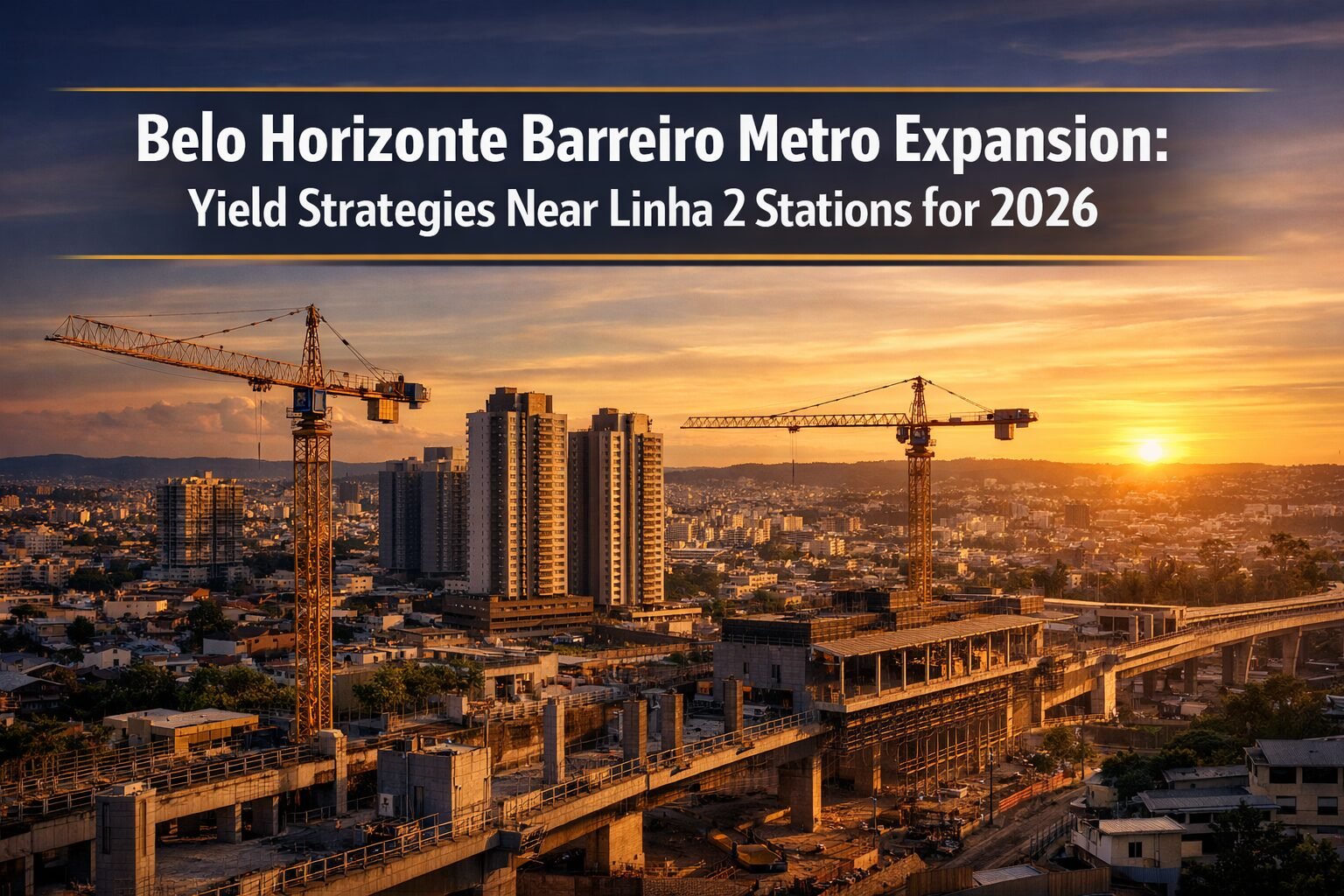
A district long overlooked by institutional capital is about to become one of Brazil’s most compelling transit-oriented investment corridors. The Barreiro neighborhood in southwest Belo Horizonte — historically underserved by rapid transit — sits at the center of the Belo Horizonte Barreiro Metro Expansion: Yield Strategies Near Linha 2 Stations for 2026, a story that blends a USD 706 million infrastructure commitment with a rare window for early-mover real estate returns [2]. With the first operational segment of Linha 2 expected to launch in 2026 and the full 10.5 km route connecting Nova Suíça to Barreiro by 2028, the clock is ticking for developers and investors who understand how transit transforms urban land values [1].
Key Takeaways 📌
- Linha 2 opens its first segment in 2026, connecting Barreiro to Nova Suíça across 7 stations and 10.5 km, backed by a BRL 3.7 billion (USD 706 million) concession [1][2].
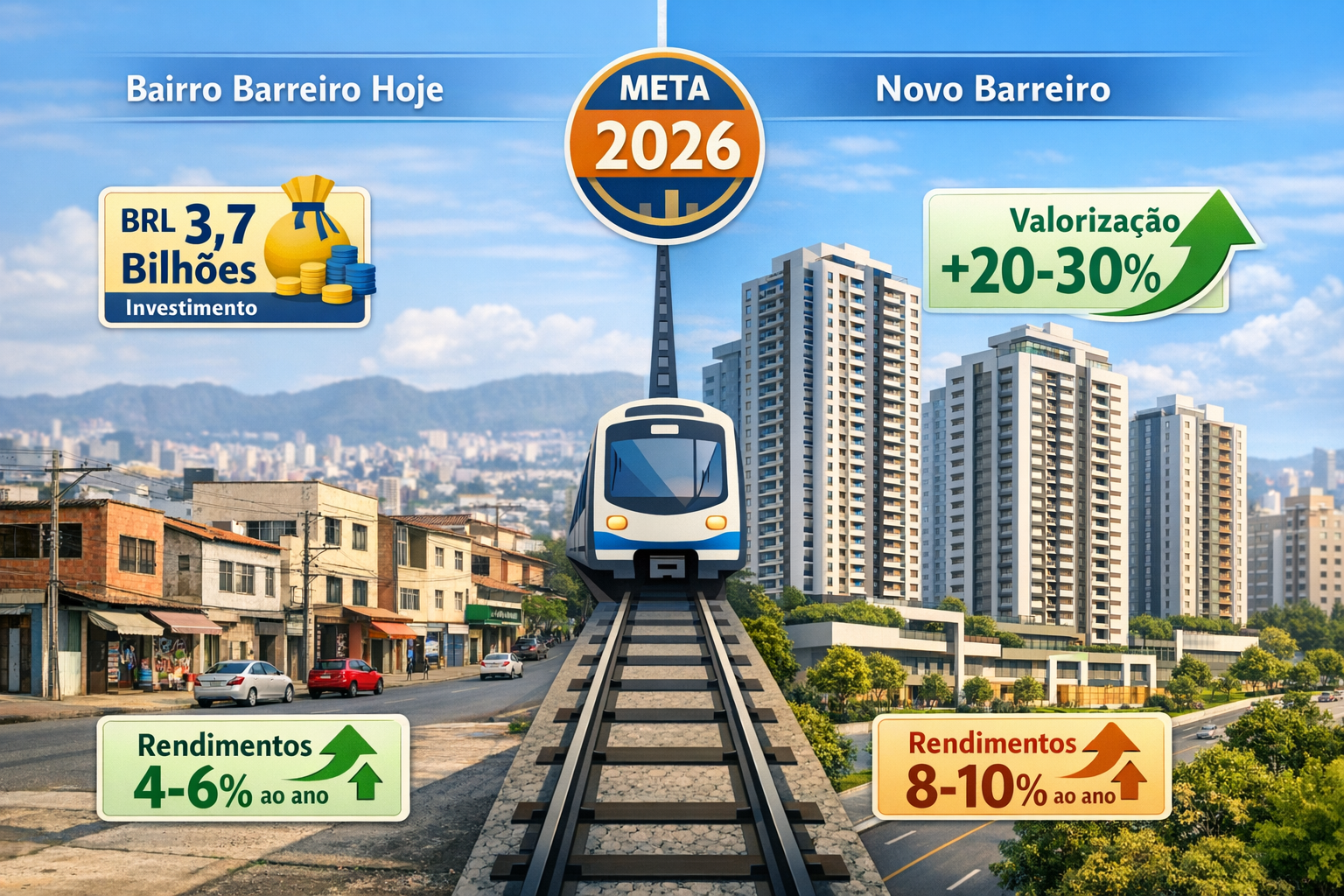
- Property appreciation of 20–30% is a realistic projection for assets within 800 meters of new metro stations, based on comparable Brazilian transit-led urban transformations.
- Multi-family and studio units near transit nodes represent the highest-yield play in an underserved rental market hungry for connectivity.
- Early-stage acquisition — before station openings — historically delivers the strongest capital gains, making 2026 a critical entry window.
- Transit-Oriented Development (TOD) principles, combined with Belo Horizonte’s housing deficit, create durable demand fundamentals for long-term yield strategies.
Understanding the Linha 2 Infrastructure: Scale, Timeline, and Investment Backbone
The Route and What It Means for Barreiro
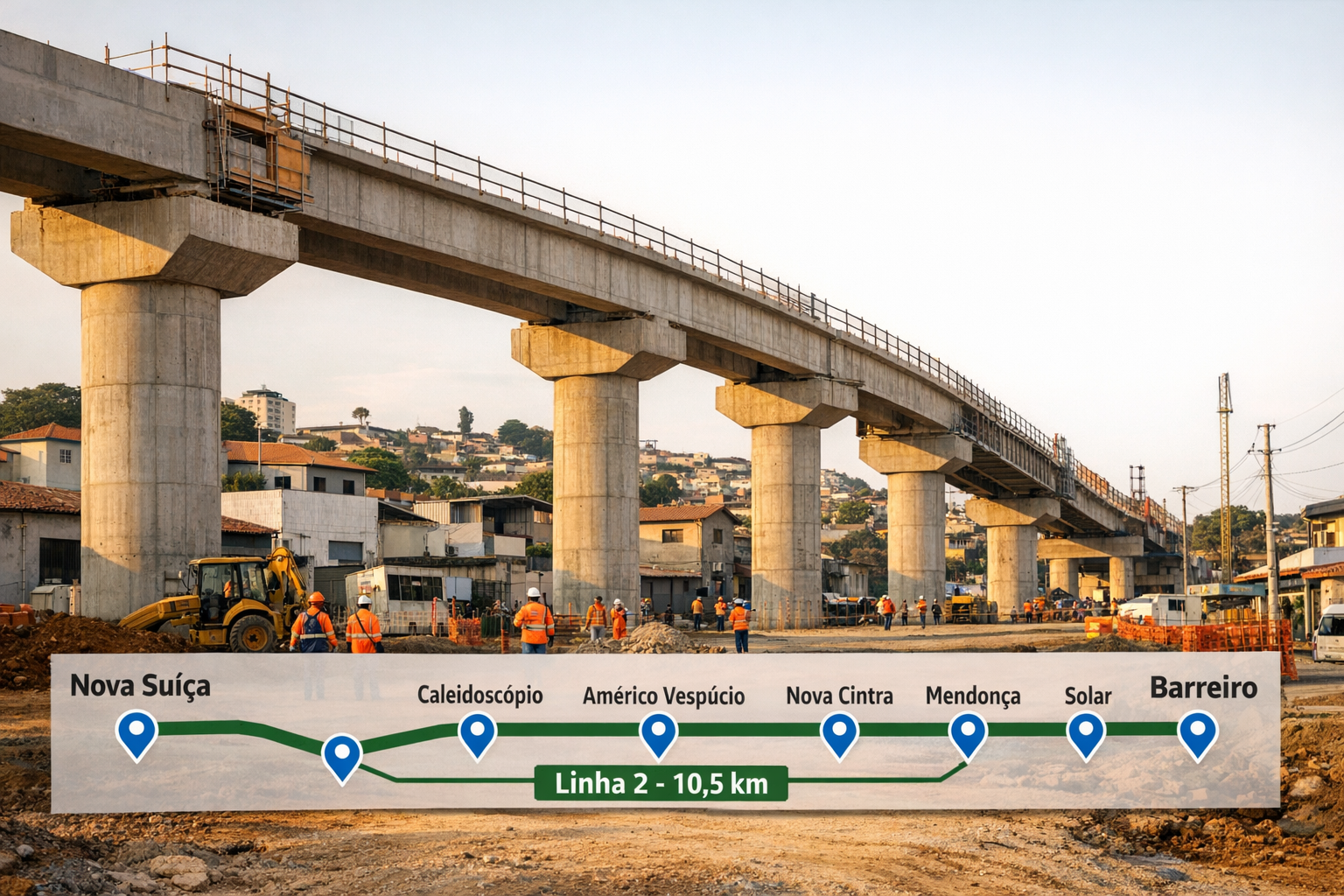
The Linha 2 project is not a minor urban upgrade — it is a structural reshaping of how southwest Belo Horizonte connects to the rest of the metropolitan area. The line will span 10.5 km and serve 7 stations, threading through the Nova Suíça, Nova Gameleira, and Barreiro districts [1][2]. For decades, Barreiro’s residents have relied on surface bus networks prone to congestion. A metro link changes the district’s commute calculus entirely, compressing travel times and expanding job market access for roughly 260,000 projected beneficiaries across the expanded network [3].
The concessionaire, Metrô BH (operated by the Comporte Participações consortium), assumed operations in March 2023 under a 30-year agreement [1][4]. The first segment is anticipated to begin operations in 2026, with the complete route scheduled for delivery by 2028 [2]. This phased rollout is critical for investors: it means station-adjacent land values will experience multiple appreciation events — one at the 2026 partial opening and another at full network completion.
The Financial Muscle Behind the Project
The numbers behind this expansion are significant. The Minas Gerais state expansion programme totals approximately USD 1.8 billion [9], while the specific metro concession contract is valued at USD 706 million over 30 years [2]. Funding breaks down as follows:
| Funding Source | BRL Amount | USD Equivalent |
|---|---|---|
| Federal Government | BRL 2.8 billion | ~USD 534 million |
| Minas Gerais State | BRL 440 million | ~USD 83 million |
| Total Public Funding | BRL 3.2 billion | ~USD 610 million |
| Full Concession Value | BRL 3.7 billion | ~USD 706 million |
Source: [2]
The broader urban mobility package, which includes modernization of 19 existing stations, fleet acquisition, and Line 2 construction, reaches approximately BRL 4 billion (USD 750 million) [5]. This is not speculative infrastructure — it is a fully funded, actively progressing programme confirmed by the state government as recently as March 29, 2026 [1].
New Trains and Signaling: Operational Credibility
Skeptics of Brazilian infrastructure timelines have legitimate historical reasons for caution. However, several concrete milestones distinguish this project. 24 four-car trains built by CRRC Changchun have been ordered, with 10 trains expected to be operating by end of 2026 [1][7]. The first train arrived in Brazil in January 2026, with two additional units arriving on March 22, 2026, and further units in transit from China [1].
On the signaling side, Alstom is implementing modern systems across both lines, with Line 1 signaling (including the new Novo Eldorado extension) scheduled for completion in 2026 [3]. In February 2026, the 1.7 km Novo Eldorado extension of Line 1 opened — the network’s first expansion in 20 years — demonstrating that Metrô BH is delivering on its commitments [1][5]. Line 1 now stretches 29.7 km across 20 stations [1].
💬 “The arrival of physical rolling stock and the opening of the Novo Eldorado extension in early 2026 are the clearest signals yet that this expansion programme is real, funded, and moving.”
Why Barreiro? The Case for 20–30% Appreciation Near Linha 2 Stations
A District Priced for the Past, Not the Future
Barreiro is one of Belo Horizonte’s most populous administrative districts, home to a dense working-class and lower-middle-class population with strong latent demand for quality housing. Yet property prices in Barreiro have historically lagged behind better-connected neighborhoods by a significant margin. That discount exists precisely because of the transit gap — a gap that Linha 2 is about to close.
The Belo Horizonte Barreiro Metro Expansion: Yield Strategies Near Linha 2 Stations for 2026 thesis rests on a well-documented global pattern: when rapid transit reaches a previously disconnected urban area, land values within a 500–800 meter radius of new stations appreciate substantially. In comparable Brazilian contexts — São Paulo’s metro expansions, Rio de Janeiro’s BRT corridors — appreciation in the 20–30% range over a 3–5 year window around station openings has been observed repeatedly.
Several factors amplify this dynamic specifically for Barreiro:
- 🏘️ Housing deficit: Belo Horizonte’s metropolitan region has a structural housing shortage, particularly for affordable and mid-market units.
- 🚇 First-mover advantage: Barreiro has never had metro access. The demand shock from connectivity will be larger than in areas upgrading existing transit.
- 📈 Low baseline prices: Lower entry prices mean higher percentage gains are achievable even with moderate absolute price increases.
- 🏗️ Underdeveloped supply: The district has limited modern multi-family stock, creating a supply vacuum that new development can fill at premium rents.
The Nova Suíça and Nova Gameleira Nodes
While Barreiro is the terminal anchor of Linha 2, the Nova Suíça and Nova Gameleira stations deserve equal investor attention. Nova Suíça connects Linha 2 to the existing Linha 1 network, making it a critical interchange node — historically the highest-value station typology in any metro system. Properties within walking distance of interchange stations benefit from compounded demand: commuters from multiple directions, commercial activity, and retail foot traffic.
Nova Gameleira sits between the two anchors and represents a mid-corridor opportunity — often overlooked by investors focused on endpoints, but frequently delivering strong yields as the surrounding neighborhood densifies in response to transit access.
Comparing Belo Horizonte to Brazil’s Best Investment Markets
For context on how transit-driven appreciation fits into Brazil’s broader property investment landscape, it is worth noting that markets like Florianópolis have demonstrated strong returns driven by infrastructure and lifestyle investment. Exploring the best places to invest in Brazil for high property returns reveals that transit connectivity consistently ranks among the top value drivers across Brazilian urban markets.
Understanding why buying off-plan can amplify gains in real estate development is also directly applicable here: acquiring units near Linha 2 stations during the construction phase — before the 2026 partial opening — mirrors the off-plan dynamic, capturing appreciation before the market fully prices in the transit premium.
Yield Strategies for Developers and Investors Near Linha 2 Stations
Strategy 1: Transit-Oriented Development (TOD) Multi-Family Projects
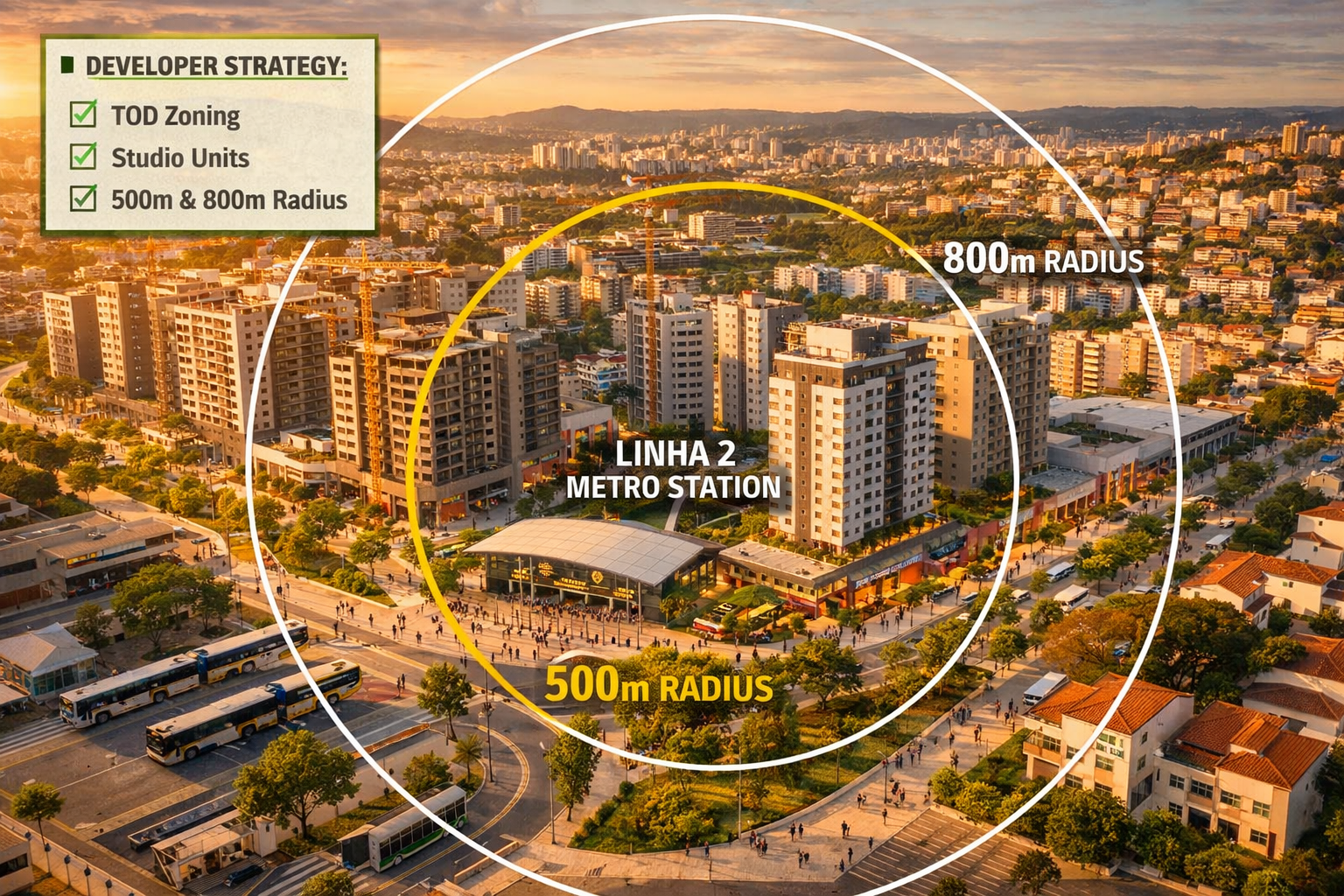
The most direct yield play in the Belo Horizonte Barreiro Metro Expansion: Yield Strategies Near Linha 2 Stations for 2026 context is purpose-built multi-family residential development within the 500–800 meter station catchment zone. TOD principles — mixing residential density with ground-floor commercial uses and pedestrian connectivity to transit — are well-established in global markets and increasingly recognized in Brazilian urban planning frameworks.
Key TOD development parameters for Barreiro:
- Unit mix: Prioritize 1-bedroom and studio configurations (35–55 sqm), which align with the demographic profile of transit-dependent renters — young professionals, students, and service workers.
- Ground floor activation: Retail, food service, and convenience uses on the ground floor improve project economics and neighborhood vitality.
- Parking optimization: Near metro stations, parking requirements can often be reduced, lowering construction costs and increasing buildable area.
- Amenity package: Co-working spaces, laundry facilities, and social areas command rental premiums among younger tenants who prioritize connectivity over square footage.
For investors interested in how studio and compact unit strategies perform in Brazilian urban markets, the analysis of the advantages of investing in studio apartments from a real estate development perspective provides directly transferable insights on yield optimization.
Strategy 2: Land Banking in the Station Catchment Zone
For investors with a longer horizon, acquiring land or older low-rise properties within the Linha 2 catchment zone before the 2026 partial opening represents a classic land banking play. The logic is straightforward: once the station opens and the transit premium becomes visible to the broader market, land prices will adjust upward rapidly. Early acquirers capture the full appreciation curve.
Practical land banking considerations:
| Factor | Optimal Profile |
|---|---|
| Distance from station | 300–700 meters (walking distance) |
| Current land use | Low-density residential or commercial |
| Zoning | Check for upzoning potential near transit corridors |
| Lot size | 500–2,000 sqm for mid-scale development |
| Acquisition timing | Pre-2026 opening for maximum upside |
Strategy 3: Renovation and Repositioning of Existing Stock
Not every yield strategy requires ground-up development. Acquiring and renovating existing multi-family buildings in Barreiro — particularly older apartment blocks built in the 1970s–1990s — and repositioning them as transit-connected, modern rental stock is a capital-efficient approach. This strategy works because:
- Older stock trades at significant discounts to replacement cost.
- Renovation timelines (12–18 months) can align with the 2026 station opening.
- Repositioned assets benefit from the transit premium without bearing full development risk.
Strategy 4: Commercial and Mixed-Use Positioning
Metro stations generate pedestrian traffic — and pedestrian traffic generates commercial demand. Ground-floor retail, food and beverage, and service businesses within 200 meters of Linha 2 stations will benefit from captive daily commuter flows. For developers, incorporating commercial ground floors into residential projects improves overall project yield and reduces vacancy risk.
Financing and Capital Stack Considerations
Brazil’s real estate financing landscape has evolved significantly. The intersection of cryptocurrency and real estate development as a new investment frontier reflects how developers are increasingly exploring alternative capital sources. For Barreiro-focused projects, a blended capital stack — combining traditional bank financing (Caixa Econômica Federal’s housing programmes are particularly relevant for affordable units), equity from real estate investment funds (FIIs), and potentially tokenized real estate instruments — can optimize returns while managing risk.
Risk Factors and Due Diligence Checklist
No investment thesis is complete without an honest risk assessment. The Linha 2 expansion, while well-funded and progressing, carries execution risks that investors must evaluate:
⚠️ Key Risks to Monitor:
- Construction delays: Brazilian infrastructure projects have a documented history of timeline slippage. The 2026 partial opening is the current official target, but investors should stress-test scenarios with 12–18 month delays.
- Ridership ramp-up: Even after opening, ridership may take 2–3 years to reach projected levels, delaying the full commercial impact on surrounding property values.
- Zoning and permitting: Local municipal regulations in Belo Horizonte may constrain density near stations. Pre-acquisition zoning analysis is essential.
- Macroeconomic environment: Brazil’s interest rate environment (Selic rate) directly affects mortgage affordability and real estate demand. Monitor COPOM decisions closely.
- Displacement and gentrification pressure: Rapid appreciation can trigger community resistance and regulatory responses. Developers should engage proactively with local stakeholders.
✅ Due Diligence Checklist:
- Confirm station location coordinates and exact catchment radius
- Review Belo Horizonte municipal master plan (Plano Diretor) for transit corridor zoning
- Assess current rental yields in Barreiro vs. metro-connected neighborhoods
- Evaluate infrastructure readiness (water, sewage, electricity capacity) for increased density
- Analyze demographic trends: population growth, income levels, employment base
- Review Metrô BH’s latest construction progress reports
For investors seeking broader context on Brazilian real estate market dynamics and developer performance metrics, reviewing current news and market analysis from experienced real estate developers provides useful benchmarking data.
Positioning Your Portfolio: Practical Next Steps for 2026
The window for pre-opening positioning in the Barreiro metro corridor is measured in months, not years. The Belo Horizonte Barreiro Metro Expansion: Yield Strategies Near Linha 2 Stations for 2026 represents a convergence of infrastructure spending, demographic demand, and pricing inefficiency that is rare in any market.
Immediate action priorities:
- Map the catchment zones: Use confirmed station locations to draw 500m and 800m radius circles. Prioritize acquisition targets within these zones.
- Engage local brokers and developers: Barreiro-based real estate professionals have ground-level intelligence on off-market opportunities that national platforms miss.
- Model the yield scenarios: Build conservative (15% appreciation), base (25%), and optimistic (35%) scenarios for assets at different distances from stations.
- Explore established developer partnerships: Working with experienced real estate developers who understand Brazilian market dynamics — such as those offering innovative real estate developments — can reduce execution risk for investors new to the Belo Horizonte market.
- Monitor construction milestones: Track Metrô BH’s progress reports and CRRC train delivery schedules as leading indicators of timeline confidence.
Conclusion: Barreiro’s Transit Moment Is Now
The Belo Horizonte Barreiro Metro Expansion: Yield Strategies Near Linha 2 Stations for 2026 is not a future hypothesis — it is an active, funded, and physically progressing transformation of one of Brazil’s most populous metropolitan areas. With BRL 3.7 billion committed, Chinese-built trains already arriving on Brazilian soil, and the first segment targeting a 2026 launch, the infrastructure foundation is real [1][2][7].
Barreiro’s combination of low baseline property prices, structural housing deficit, zero prior metro access, and confirmed transit investment creates a textbook conditions for 20–30% appreciation over the 2026–2029 window. The investors and developers who act before the market fully prices in the Linha 2 premium — particularly those deploying TOD multi-family strategies in the 500–800 meter station catchment zones — stand to capture the strongest risk-adjusted returns.
Actionable next steps:
- 🗺️ Commission a station-by-station catchment analysis for Linha 2’s 7 stops
- 🏗️ Identify land banking or renovation targets in Barreiro and Nova Gameleira before the 2026 partial opening
- 📊 Build a yield model incorporating rental demand from the 260,000+ projected metro beneficiaries [3]
- 🤝 Partner with developers who have demonstrated execution capability in Brazilian urban markets
- 📰 Stay current with the latest real estate market developments and investment insights as the Linha 2 construction advances
The transit transformation of Barreiro is underway. The question is whether investors will be positioned ahead of it — or watching from the outside as the appreciation curve moves without them.
References
[1] Belo Horizonte Metro Expansion Centres On Line 2 Works – https://www.railway.supply/belo-horizonte-metro-expansion-centres-on-line-2-works/
[2] Usd706 Million Contract Awarded For Metro Expansion Ppp Project In Brazil – https://www.infrapppworld.com/news/usd706-million-contract-awarded-for-metro-expansion-ppp-project-in-brazil
[3] 20231010 Pr Sig Bh En – https://www.alstom.com/sites/alstom.com/files/2023/10/10/20231010_PR_Sig_BH_EN.pdf
[4] Belo Horizonte Metro – https://en.wikipedia.org/wiki/Belo_Horizonte_Metro
[5] Metro Bh Recebe Novos Trens Para Ampliar Mobilidade Urbana Sima00 – https://en.clickpetroleoegas.com.br/metro-bh-recebe-novos-trens-para-ampliar-mobilidade-urbana-sima00/
[6] Belo Horizonte Metro Expansion Confirmed – https://www.railjournal.com/regions/central-south-america/belo-horizonte-metro-expansion-confirmed/
[7] railwaygazette – https://www.railwaygazette.com/metro/crrc-changchun-unveils-belo-horizonte-metro-trainset/69054.article
[9] Brazils Minas Gerais State Plans To Expand Metro Network In A Us18 Billion Initiative – https://www.bnamericas.com/en/news/brazils-minas-gerais-state-plans-to-expand-metro-network-in-a-us18-billion-initiative