
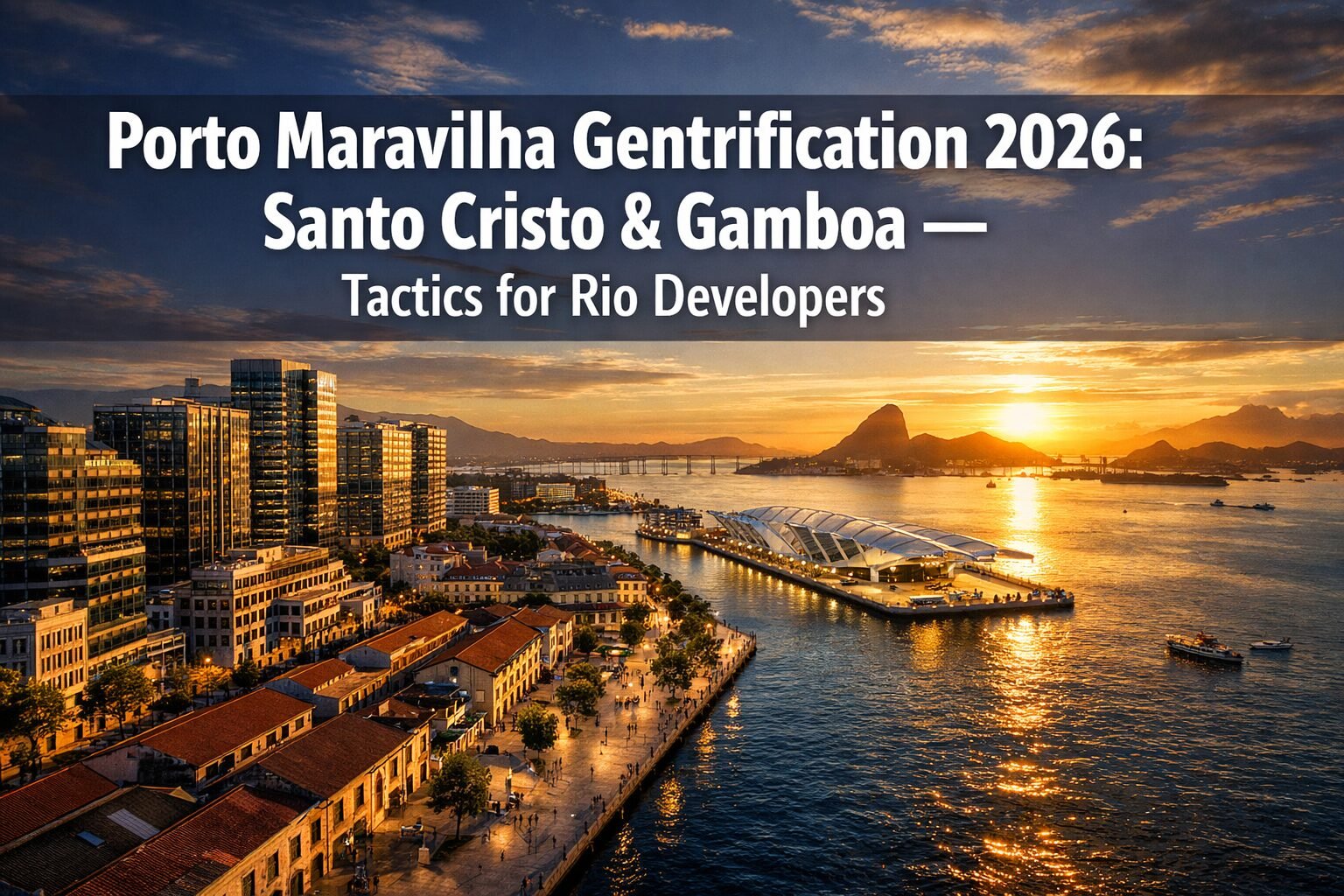
Over 6,000 apartments launched in Porto Maravilha between 2021 and 2026 have achieved an 80 percent sell-through rate — a figure that outpaces Rio de Janeiro’s citywide averages and signals something far more durable than a speculative bubble. [1] This is the story of a deliberate, decade-long urban transformation reshaping two of Rio’s most historically layered neighborhoods: Santo Cristo and Gamboa.
For real estate developers operating in 2026, understanding Porto Maravilha Gentrification 2026: Santo Cristo and Gamboa Tactics for Rio Developers is no longer optional — it is a competitive necessity. The district has evolved from an abandoned industrial waterfront into one of Latin America’s most closely watched urban regeneration case studies, with property values climbing 60 to 80 percent over just three years. [1]
This article unpacks the gentrification waves reshaping these neighborhoods, examines the financing instruments and infrastructure investments driving demand, and delivers actionable development strategies for capturing rising rental and sales opportunities in 2026 and beyond.
Key Takeaways 📌
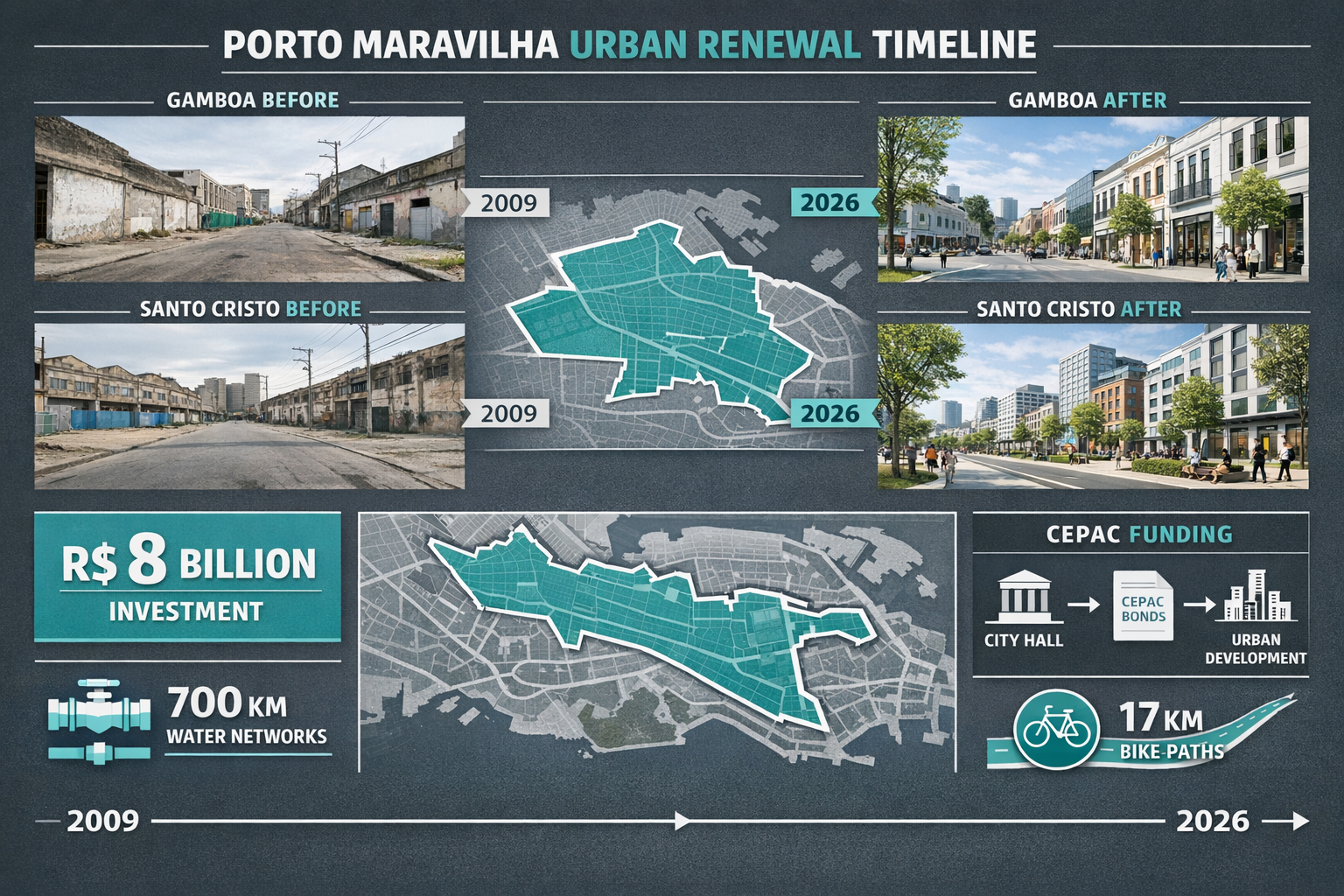
- R$8 billion has been invested in Porto Maravilha — Rio’s largest modern urban renewal project — spanning 5 million square meters across Gamboa, Santo Cristo, and Caju. [1]
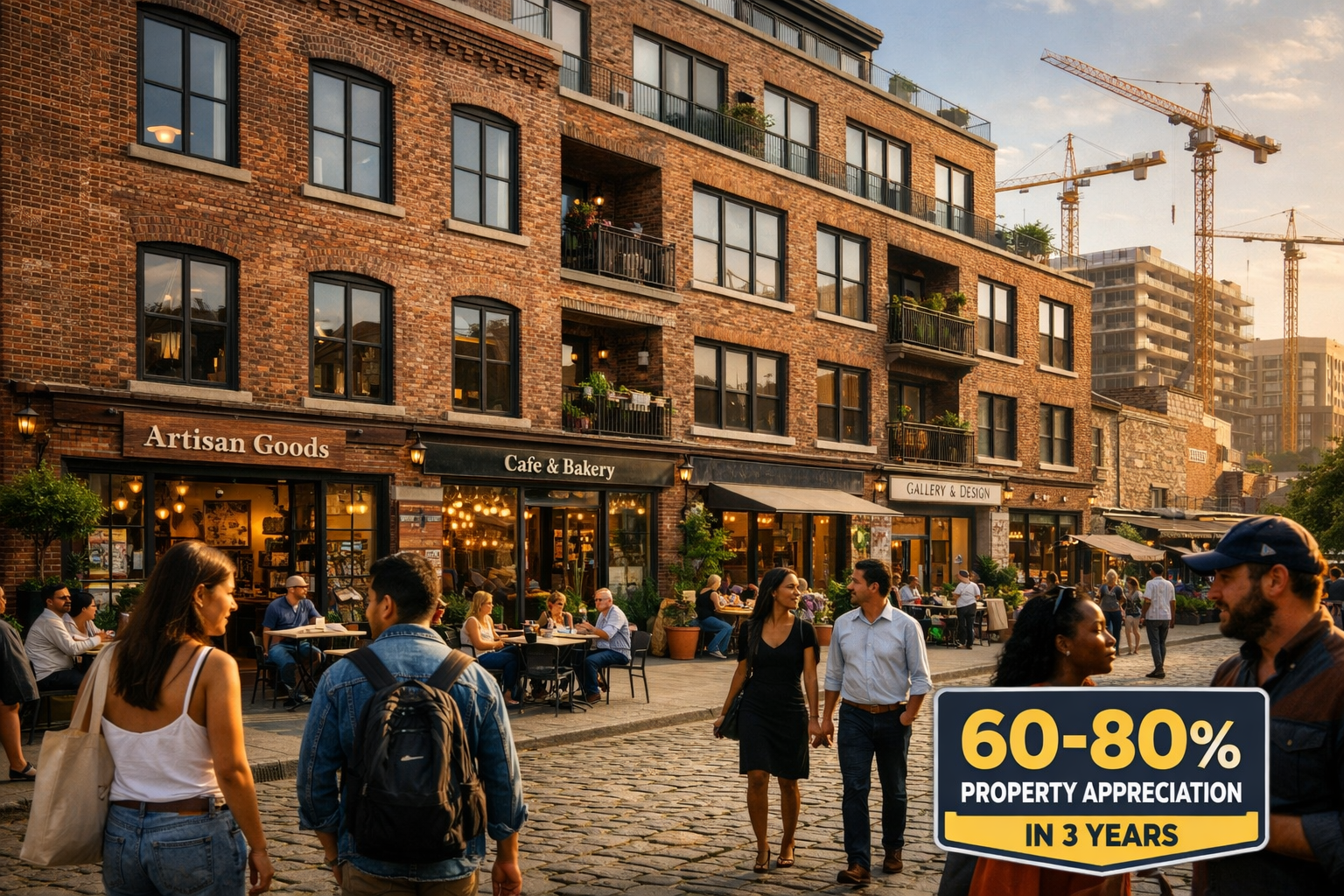
- Property appreciation of 60–80% over three years makes the port zone one of Rio’s fastest-growing real estate markets. [1]
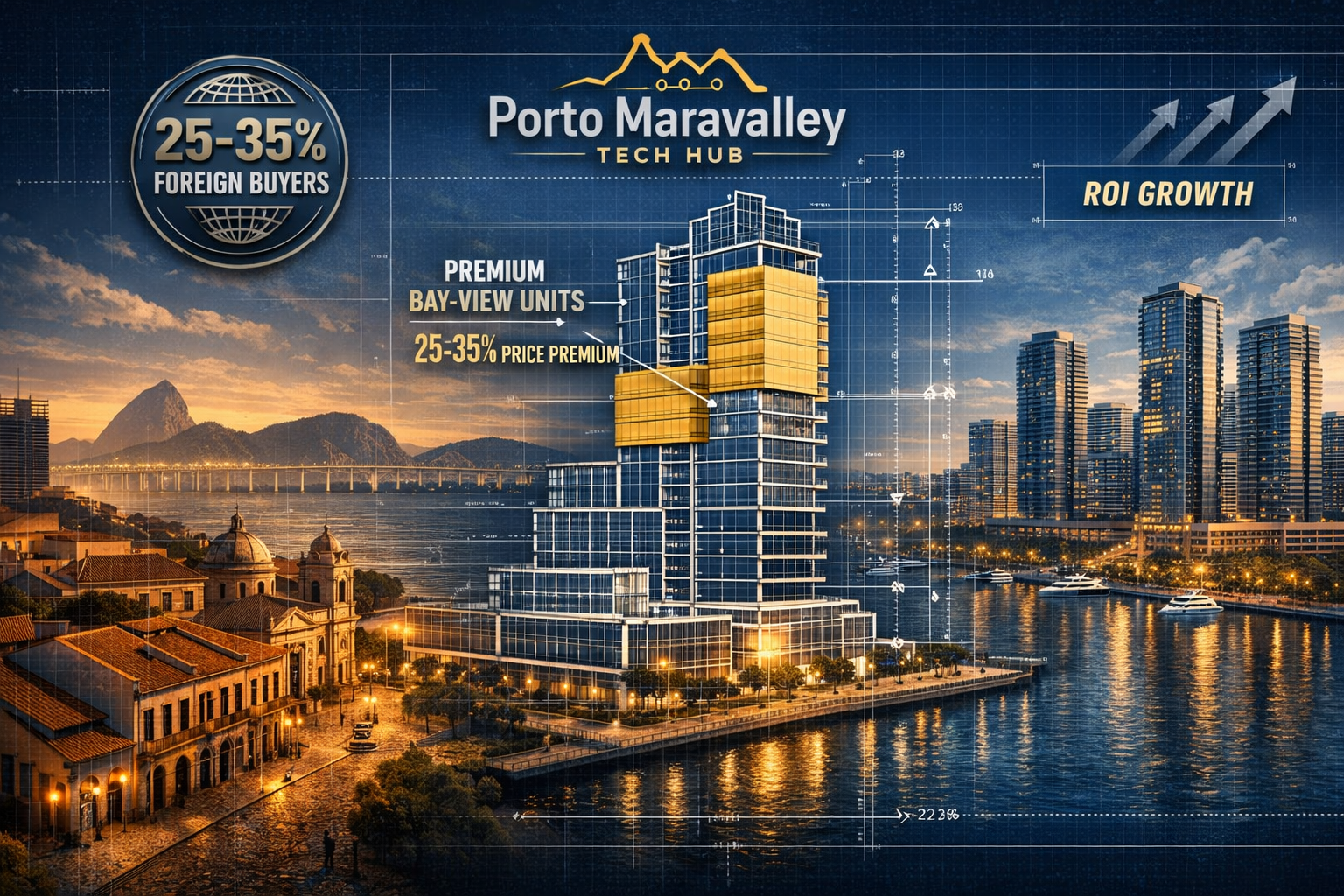
- Bay-view and landmark-adjacent units command 25–35% premiums over comparable interior apartments. [1]
- Gentrification in Gamboa is described as “strategic” — driven by symbolic revaluation and investor expectations rather than purely organic demand. [2]
- International buyers represent 25–35% of premium transactions, creating a foreign-demand layer that developers can specifically target. [1]
The R$8 Billion Foundation: How Porto Maravilha Was Built to Gentrify
The Legislative and Financial Architecture
Porto Maravilha did not happen by accident. Authorized under Municipal Law 101 of 2009, the project was engineered from the start to transfer financial risk away from public coffers and toward private capital markets. [1]
The central instrument was the CEPAC — Certificado de Potencial Adicional de Construção, or Certificate of Additional Construction Potential. These certificates, initially valued at R$3.5 billion, plus R$400 million in direct land value, allowed developers to purchase the right to build beyond standard zoning limits. [1] The result: a self-financing regeneration engine where private investors essentially paid for public infrastructure.
💡 Pull Quote: “Porto Maravilha’s CEPAC model transferred financial risk from public coffers to private markets — a blueprint now studied by urban planners across Latin America.”
This mechanism is critical for developers to understand in 2026. The CEPAC system shaped where density was permitted, what typologies were incentivized, and how land values were anchored to symbolic as much as physical improvements. [2]
Infrastructure That Moved Markets
The physical transformation of Santo Cristo and Gamboa was underpinned by infrastructure at a scale rarely seen in Brazilian urban renewal:
| Infrastructure Component | Scale Delivered |
|---|---|
| Water & sanitation networks | 700 km of new pipes |
| Rebuilt sidewalks | 650 km² |
| Dedicated bike paths | 17 km |
| Sanitation treatment plants | 3 new facilities |
| Total project area | 5 million m² |
Source: [1]
This is not cosmetic regeneration. The laying of 700 kilometers of new water and sanitation infrastructure fundamentally changed the risk profile of developing in Gamboa and Santo Cristo — neighborhoods that had long suffered from inadequate utilities. [1] For developers, this means that the hard infrastructure work has already been absorbed by public and quasi-public investment, reducing development risk substantially.
The Stigma Reversal Strategy
Academic research confirms that Porto Maravilha’s primary objective extends beyond physical renewal. The project was explicitly designed to reverse the territorial stigma attached to the port area — transforming perceptions from “abandoned and dangerous” to “Rio’s cultural and residential gateway.” [2]
This rebranding strategy, anchored by landmark cultural institutions like the Museum of Tomorrow and the AquaRio aquarium, is precisely what drives the 25–35% price premium for units with proximity to these anchors. [1] Developers who understand this symbolic economy — not just the physical one — are better positioned to price, market, and sell in this district.
For a broader perspective on how Brazilian cities are leveraging urban transformation to attract real estate investment, explore best places to invest in Brazil property for comparative market intelligence.
Santo Cristo and Gamboa: Reading the Gentrification Wave in 2026
Two Neighborhoods, Two Gentrification Speeds
While Porto Maravilha covers a broad swath of Rio’s port zone, Santo Cristo and Gamboa are experiencing gentrification at different velocities and through different mechanisms — a distinction that matters enormously for development strategy.
Santo Cristo sits closer to the Praça Mauá cultural anchor and has absorbed the first and most intense wave of residential conversion. Former warehouses and light-industrial buildings have been repurposed into loft apartments, creative offices, and ground-floor retail — a classic mixed-use gentrification pattern. The neighborhood’s proximity to the Museum of Tomorrow and the VLT (light rail) network has made it the preferred address for young professionals and early-adopter buyers.
Gamboa, by contrast, has experienced what researchers describe as “strategic” gentrification — a process driven primarily by investor expectations and real estate profitability rather than organic residential demand. [2] Land values in Gamboa have been largely shaped by symbolic revaluation: the anticipation of future cultural and commercial investment rather than its current presence.
⚠️ Developer Alert: Strategic gentrification creates opportunity — but also timing risk. Gamboa’s appreciation curve is steeper and more volatile than Santo Cristo’s more established trajectory.
The Numbers Behind the Demand
The residential acceleration in Porto Maravilha tells a compelling story:
- 9,129 total apartments launched across the district [1]
- 6,000+ units entered the market between 2021 and 2026 [1]
- 80%+ sell-through rate on those units, exceeding citywide benchmarks [1]
- 60–80% appreciation achieved over a three-year window [1]
These are not speculative projections — they are recorded transaction outcomes. The sustained absorption rate indicates genuine end-user demand rather than investor flipping, which historically supports more durable price floors.
The Foreign Buyer Layer 🌍
International buyers account for 25–35% of premium transactions across Rio’s high-end market, drawn in part by favorable exchange rates. [1] For Porto Maravilha developers, this creates a distinct marketing and product design opportunity:
- Compact, high-finish units with strong rental yield profiles appeal to foreign investors seeking passive income
- Bay-view and landmark-adjacent positioning commands the 25–35% premium that international buyers are most willing to pay [1]
- English and Spanish-language marketing materials and international broker partnerships become competitive differentiators
Understanding how to price and position for appreciation is critical in this context. Developers can learn from strategies detailed in why buying off-plan can maximize your gains — a principle that applies directly to Porto Maravilha’s pre-launch market dynamics.
Tactical Playbook: Porto Maravilha Gentrification 2026 Strategies for Rio Developers
Tactic 1: Lead with Mixed-Use Ground Floors
The most successful developments in Santo Cristo and Gamboa in 2026 share a common design logic: activated ground floors. Retail, food and beverage, co-working, and cultural programming at street level do three things simultaneously:
- Generate rental income from day one of occupancy
- Accelerate neighborhood perception shift — the single most important driver of appreciation in a gentrifying district [2]
- Differentiate the development in a market where residential-only towers are increasingly commoditized
Developers should budget for ground-floor fit-out subsidies or below-market anchor tenant leases in the first 12–18 months. The appreciation premium on upper-floor residential units will more than offset this cost.
Tactic 2: Capture the Porto Maravalley Tech Tenant
Mayor Eduardo Paes’ Porto Maravalley initiative — a Silicon Valley-inspired technology hub integrated within Porto Maravilha — is actively recruiting high-tech and innovation companies to the district. [4] This creates a specific demand profile:
- Short-term furnished rentals for tech workers relocating from São Paulo, Belo Horizonte, or internationally
- Co-living formats that reduce per-unit fit-out costs while maximizing yield per square meter
- Flexible commercial floors that can serve as startup offices or be converted to residential as the market matures
Developers who design for Porto Maravalley’s talent pipeline in 2026 are positioning for a demand wave that is still building. For insight into how studio and compact unit strategies perform in Brazilian urban markets, the analysis of investing in studios in Florianópolis offers directly transferable lessons.
Tactic 3: Price the View Premium Scientifically
The 25–35% premium for Guanabara Bay views and Museum of Tomorrow proximity is well-documented. [1] Yet many developers in the port zone still apply view premiums intuitively rather than analytically. A rigorous approach includes:
- Floor-by-floor view analysis using 3D modeling to quantify bay visibility percentages
- Comparable transaction data from completed Porto Maravilha buildings to calibrate premiums by floor and orientation
- Tiered pricing ladders that maximize revenue per square meter on premium floors without creating absorption gaps on interior units
Tactic 4: Leverage Cryptocurrency and Alternative Finance Channels
The Porto Maravilha buyer profile — particularly the international segment — is increasingly open to cryptocurrency-denominated transactions and blockchain-based property investment structures. [1] This is not a fringe consideration in 2026; it is an active channel for reaching the foreign buyer cohort that drives 25–35% of premium sales.
Developers exploring this frontier can reference the emerging framework for cryptocurrency and real estate development as a starting point for structuring compliant, attractive offerings for this buyer segment.
Tactic 5: Sequence Gamboa Entry Carefully
Given Gamboa’s strategic gentrification profile [2], developers face a sequencing decision: enter early and absorb higher risk for higher upside, or enter after further anchor investment confirms demand.
Early entry signals to watch:
- ✅ Porto Maravalley office lease announcements in Gamboa
- ✅ Cultural institution programming commitments (not just announcements)
- ✅ VLT extension or new transit infrastructure confirmations
- ✅ Comparable sell-through rates above 70% in adjacent Santo Cristo launches
Risk mitigation for early Gamboa entry:
- Structure phased launches with Phase 1 sized to prove demand before committing full construction capital
- Prioritize rental-yield-positive unit mixes that generate income even if appreciation is delayed
- Partner with established Porto Maravilha operators who understand the micro-market
Tactic 6: Align with Sustainability and Heritage Credentials
Porto Maravilha’s regeneration narrative is inseparable from its cultural heritage dimension. Gamboa and Santo Cristo contain significant 19th and early 20th-century built fabric — warehouses, colonial-era residential buildings, and industrial structures. [3]
Developers who incorporate adaptive reuse elements — preserving facades, repurposing structural elements, or incorporating heritage interpretation into common areas — gain multiple advantages:
- Access to federal and municipal tax incentives for heritage preservation
- Marketing differentiation in a market increasingly crowded with generic towers
- Stronger alignment with the Porto Maravilha brand narrative that drives the district’s premium positioning
The Competitive Landscape: What Developers Are Up Against in 2026
The Porto Maravilha market in 2026 is no longer a first-mover opportunity in the traditional sense. With 9,129 apartments already launched [1], the district has a functioning residential market with established price benchmarks. This means:
- Land acquisition costs have risen significantly from 2015–2018 levels
- Construction cost inflation in Brazil requires tighter feasibility modeling
- Buyer sophistication has increased — the early adopters have been replaced by buyers who compare Porto Maravilha against other Rio districts and international alternatives
The developers who will outperform in this environment are those who combine product differentiation (mixed-use, tech-tenant-ready, heritage-sensitive design) with financial engineering (CEPAC optimization, alternative finance channels, phased capital deployment).
For developers tracking performance metrics and sales velocity benchmarks, the analysis of how sales performance is transforming the real estate market provides a useful framework applicable to Porto Maravilha’s competitive dynamics.
Additionally, developers seeking to understand current real estate development projects and opportunities across Brazil’s urban growth corridors will find comparative context for benchmarking Porto Maravilha against other high-performing markets.
Conclusion: Turning Gentrification Intelligence into Development Action
Porto Maravilha Gentrification 2026: Santo Cristo and Gamboa Tactics for Rio Developers is ultimately a story about timing, positioning, and product design in a market shaped by deliberate public investment and private capital momentum.
The R$8 billion infrastructure foundation has been laid. [1] The stigma reversal is well underway. [2] The Porto Maravalley tech hub is actively building a new demand cohort. [4] And the 60–80% appreciation already recorded in the district confirms that the market is rewarding developers who move with intelligence rather than hesitation. [1]
Actionable Next Steps for Developers 🎯
- Conduct a Gamboa micro-market study — map current land availability, CEPAC allocations, and comparable transactions to identify entry windows before the next appreciation cycle
- Design for the Porto Maravalley tenant — incorporate flexible, tech-ready residential and commercial formats into feasibility studies starting now
- Model the view premium scientifically — use 3D view analysis to price bay-facing units with precision and maximize per-square-meter revenue
- Build a foreign buyer channel — establish international broker relationships and explore compliant cryptocurrency transaction structures before competitors do
- Evaluate adaptive reuse opportunities — heritage-sensitive developments in Santo Cristo and Gamboa carry both financial incentives and marketing advantages that generic towers cannot replicate
- Stage Gamboa launches — use phased capital deployment to manage the strategic gentrification risk profile while capturing upside as anchor investments confirm demand
The port zone’s transformation is far from complete. Developers who understand the mechanics of Porto Maravilha Gentrification 2026 — the financing instruments, the symbolic economy, the tech-driven demand pipeline, and the neighborhood-specific risk profiles of Santo Cristo and Gamboa — are positioned to capture the next wave of appreciation in one of Rio de Janeiro’s most consequential urban markets.
References
[1] Porto Maravilha 9129 Apartments – https://riodejaneiro.ai/briefs/porto-maravilha-9129-apartments/
[2] Vyxhrlsxw9qvwvgywmr9ncd – https://www.scielo.br/j/rbeur/a/VyxHRLSxW9QvWvgyWmr9nCD/?lang=en
[3] Rio Janeiro Urbanism Historic Neighborhoods – https://www.artchitectours.com/rio-janeiro-urbanism-historic-neighborhoods/
[4] rioonwatch – https://rioonwatch.org/?p=79761