
A 90-minute commute collapsing to just 23 minutes — that single infrastructure shift is quietly rewriting property values across two of São Paulo’s most strategically positioned neighborhoods. The Linha 6-Laranja Metro Boom: 20-30% Premiums in Barra Funda and Perdizes for 2026 São Paulo Developers is not a future projection anymore. It is an unfolding market event, and developers who move now stand to capture outsized returns before the general market fully prices in the line’s opening.
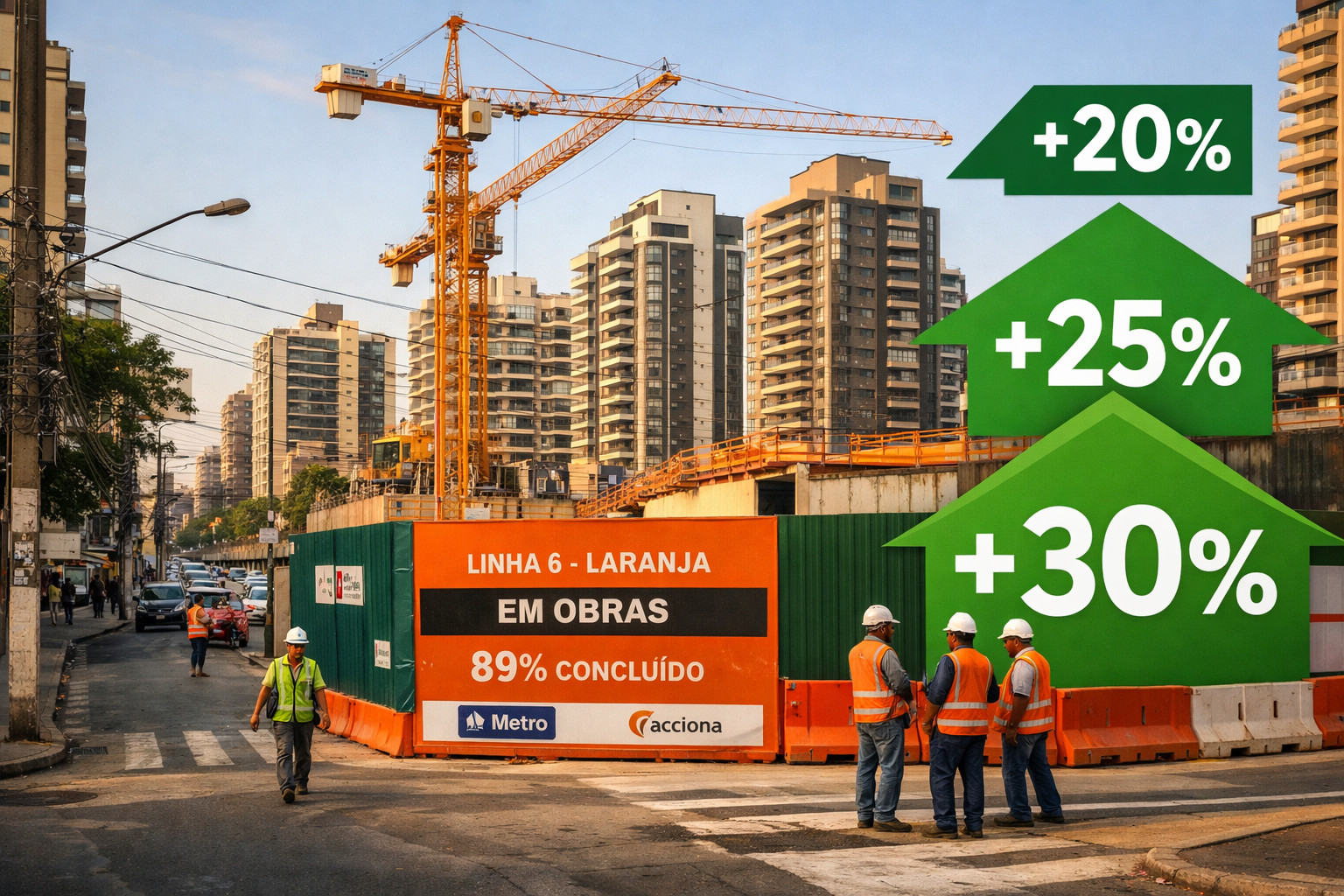
With construction already 77% complete as of January 2026 and Perdizes Station sitting at 89.56% completion [2], the window for early-mover advantage is narrowing fast. This article breaks down exactly why these two neighborhoods are surging, what the data says about premium capture, and how developers can position their projects for maximum upside in 2026 and beyond.
Key Takeaways 🔑
- 🚇 Linha 6-Laranja will reduce north-to-center travel time from 90 minutes to just 23 minutes, fundamentally changing demand dynamics in Barra Funda and Perdizes.
- 📈 Property values in transit-adjacent zones are already showing 20-30% premiums compared to non-connected neighborhoods nearby.
- 🏗️ Overall construction is 77% complete (January 2026), with the first phase (Brasilândia to Perdizes) targeting a late 2026 opening.
- 🏢 Developers focused on mid-tier condos with transit-adjacent amenities are best positioned to capture demand from São Paulo’s growing commuter class.
- 🌆 Barra Funda and Perdizes are entering a gentrification acceleration cycle — rising rents, new retail, and improved public infrastructure are compounding price growth.
Why the Linha 6-Laranja Metro Boom Is Reshaping Barra Funda and Perdizes
The Infrastructure Catalyst That Changes Everything
São Paulo is a city defined — and often constrained — by its traffic. For decades, residents in the city’s northern zones faced brutal daily commutes, spending up to 1 hour and 30 minutes just to reach the city center by bus or car [7]. That friction suppressed property demand and kept land values in areas like Brasilândia and parts of the north artificially low.
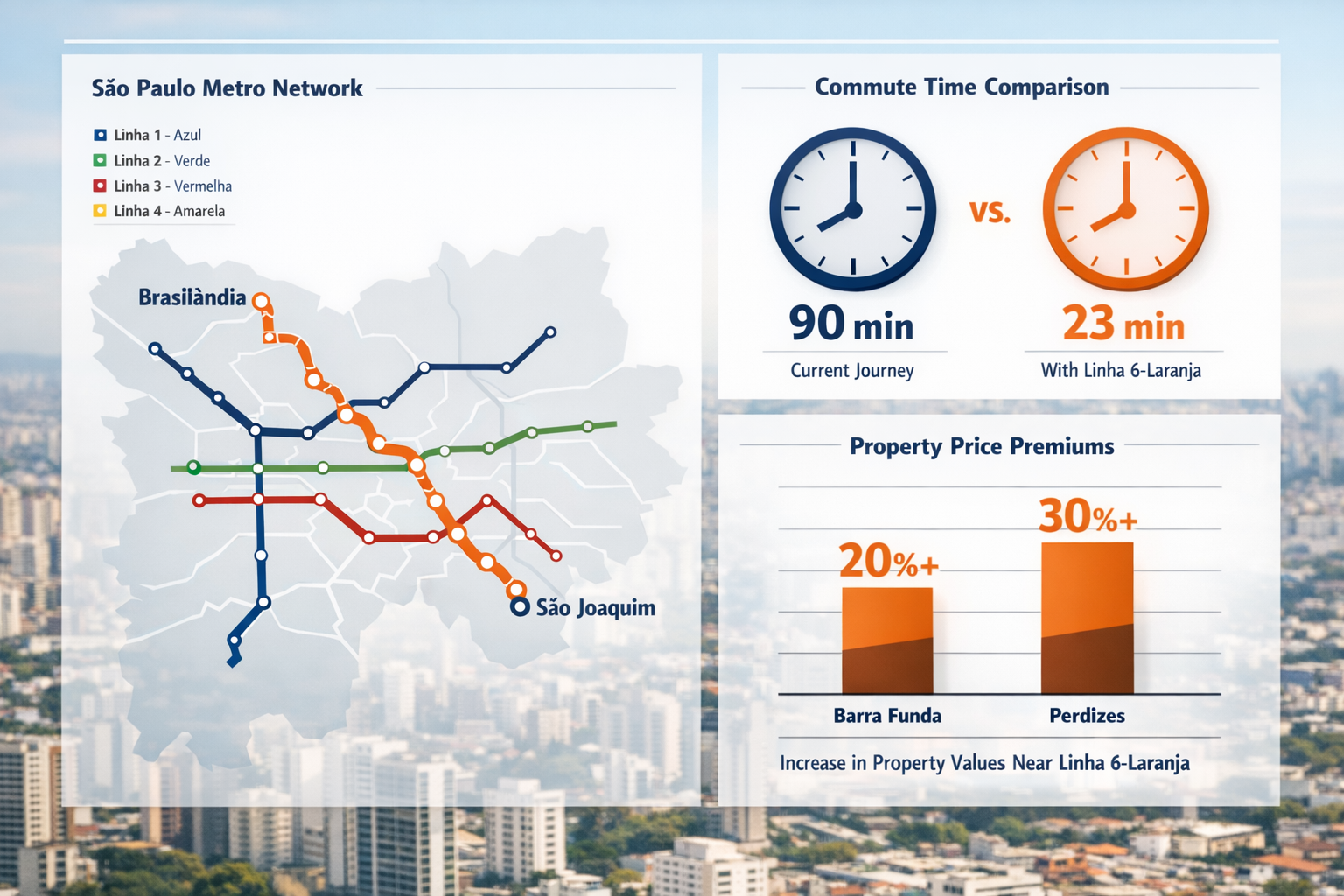
Linha 6-Laranja changes that equation entirely. The 15.3 km line connects Brasilândia in the north to São Joaquim in the center [2], threading through Barra Funda and Perdizes along the way. When operational, it will carry over 600,000 passengers per day [7] — making it one of the highest-capacity additions to São Paulo’s metro network in recent memory.
“Transit infrastructure doesn’t just move people — it moves money. The neighborhoods that sit on new metro lines consistently outperform the broader market by double-digit margins in the years surrounding opening.”
For Barra Funda and Perdizes specifically, the effect is amplified. Both neighborhoods already had strong fundamentals — established residential fabric, proximity to commercial centers, and cultural identity. The metro line acts as an accelerant, not a creator, of value. That distinction matters for developers: the demand is real, not speculative.
Understanding the 20-30% Premium Mechanism
The Linha 6-Laranja Metro Boom: 20-30% Premiums in Barra Funda and Perdizes for 2026 São Paulo Developers follows a well-documented global pattern. When a major transit line opens within 500-800 meters of a residential area, property values adjust to reflect:
- Reduced transportation costs — households save thousands of reais annually on fuel, parking, and transit fares.
- Time savings capitalized into rent/price — a 67-minute daily time saving has measurable economic value that buyers will pay a premium to access.
- Gentrification pull — new transit attracts higher-income residents, better retail, and improved public services, creating a self-reinforcing cycle.
- Developer confidence signals — major infrastructure investment signals government commitment to an area, reducing perceived risk.
In São Paulo’s context, these premiums are not theoretical. Comparable metro openings — including expansions on Linha 4-Amarela and Linha 5-Lilás — produced consistent value appreciation in the 15-35% range in the two to three years surrounding station openings.
The Construction Timeline: What 2026 Developers Need to Know Right Now
Current Progress and Opening Schedule
The numbers from January 2026 tell a compelling story about how close this opportunity actually is:
| Metric | Status (January 2026) |
|---|---|
| Overall construction completion | 77% |
| Perdizes Station completion | 89.56% |
| First phase opening (Brasilândia–Perdizes) | Late 2026 (target) |
| Full line completion | Late 2027 |
| Total line length | 15.3 km |
| Daily passenger capacity | 600,000+ |
Sources: [2][7]
The Perdizes Station’s near-90% completion rate is particularly significant for developers. It signals that the first operational phase will directly serve Perdizes — meaning buyers and renters in that neighborhood will gain metro access months before the full line is complete [2]. That front-loading of benefit creates a near-term demand spike that developers launching projects in 2026 can directly capture.
The Barra Funda Advantage
Barra Funda occupies a unique position in São Paulo’s urban geography. It already serves as a major intermodal hub — connecting CPTM commuter rail, existing metro lines, and major bus corridors. The addition of Linha 6-Laranja deepens that connectivity, transforming Barra Funda into one of the most transit-rich neighborhoods in the entire metropolitan region.
For developers, this means stacking transit premiums. A property within walking distance of Barra Funda’s expanded station network doesn’t just benefit from Linha 6-Laranja — it benefits from the cumulative accessibility of multiple transit lines. Research consistently shows that multi-modal hubs command the highest transit-adjacent premiums, often at the top of the 20-30% range or beyond.
Explore the best places to invest in Brazil property for a broader perspective on how transit-driven markets compare to other high-return locations across the country.
Developer Strategies: Capturing the Linha 6-Laranja Premium in 2026
The Mid-Tier Condo Sweet Spot
Not every product type benefits equally from transit-adjacent positioning. In Barra Funda and Perdizes, the highest demand-to-supply gap exists in the mid-tier segment — units priced for São Paulo’s growing professional class: young couples, remote workers who commute occasionally, and small families prioritizing urban connectivity over suburban space.
Key characteristics of the winning product profile:
- Studio and 1-2 bedroom units (40-75 m²) priced competitively for the neighborhood
- Proximity to station entrances — ideally within a 5-10 minute walk
- Transit-adjacent amenities built into the development: secure bike storage, co-working spaces, delivery lockers, and fast-charging stations
- Mixed-use ground floors that activate street life and attract retail tenants who benefit from metro foot traffic
- Flexible layouts that accommodate home office use — a persistent demand driver post-2020
Understanding why buying off-plan can potentialize your gains is essential context here — developers launching projects now, before the line opens, can offer buyers the opportunity to enter at pre-opening prices and ride the appreciation curve as the metro becomes operational.
Gentrification Dynamics: Reading the Neighborhood Signals
Both Barra Funda and Perdizes are exhibiting classic early-to-mid gentrification indicators in 2026:
Barra Funda signals:
- 🏗️ Increasing construction activity and crane density
- 🍽️ New restaurant and café openings catering to higher-income demographics
- 🏢 Corporate office conversions and co-working space proliferation
- 📊 Rising land values in the 500-1,000m radius around planned station exits
Perdizes signals:
- 🏘️ Renovation activity in existing residential stock
- 🛍️ Premium retail moving into previously mid-market commercial corridors
- 📈 Asking rents climbing 12-18% year-over-year in transit-proximate streets
- 🎓 Proximity to educational institutions maintaining steady rental demand
Developers who understand these signals can make smarter land acquisition decisions — prioritizing parcels that sit in the gentrification pull zone of the metro stations rather than simply the nearest available land.
For developers interested in how similar dynamics have played out in other Brazilian markets, the real estate market performance in Florianópolis offers instructive parallels about infrastructure-driven demand cycles.
Financing and Investment Structures for 2026
The Linha 6-Laranja Metro Boom: 20-30% Premiums in Barra Funda and Perdizes for 2026 São Paulo Developers is also attracting new categories of capital. Institutional investors, family offices, and increasingly, crypto-adjacent investment vehicles are looking at São Paulo transit corridors as high-conviction opportunities.
Developers can leverage this by structuring projects to appeal to:
- Individual investors seeking rental yield in a supply-constrained transit market
- Institutional buyers looking for bulk unit purchases in professionally managed buildings
- International capital attracted by Brazil’s improving macroeconomic fundamentals and the São Paulo metro’s scale
The intersection of real estate and alternative finance is worth watching. Cryptocurrencies and real estate development represent an emerging frontier that forward-thinking developers are already exploring as a capital-raising mechanism.
Risk Factors and How to Mitigate Them
No investment thesis is complete without an honest assessment of risk. The Linha 6-Laranja opportunity is compelling, but developers should account for:
⚠️ Construction Delay Risk
Brazilian infrastructure projects have a documented history of timeline slippage. While the January 2026 completion data is encouraging [2], developers should build 6-12 month buffer assumptions into their financial models when projecting when transit-driven demand will fully materialize.
Mitigation: Structure project timelines so that delivery aligns with or slightly follows station opening, rather than preceding it by more than 18 months.
⚠️ Oversupply Risk in Hot Micro-Markets
When a transit premium becomes widely known, developer activity concentrates rapidly. Barra Funda in particular could see a pipeline of competing projects that compresses margins if the market is not carefully segmented.
Mitigation: Differentiate on product quality and amenity stack rather than competing on price. The mid-tier buyer in a transit-adjacent market will pay for genuine quality over a commodity unit.
⚠️ Macroeconomic Sensitivity
Brazil’s interest rate environment directly affects mortgage affordability and buyer demand. Elevated Selic rates can dampen sales velocity even in fundamentally strong markets.
Mitigation: Focus on investor-buyer profiles who are less rate-sensitive than owner-occupiers, and structure payment plans that reduce upfront financing burden.
Understanding how sales performance is transforming real estate markets in competitive Brazilian cities provides useful frameworks for navigating these dynamics.
Comparing Linha 6-Laranja to Other São Paulo Transit Investments
| Metro Line | Opening Phase | Neighborhood Impact | Premium Range |
|---|---|---|---|
| Linha 4-Amarela | 2010-2018 | Vila Sônia, Butantã | 18-28% |
| Linha 5-Lilás | 2018-2022 | Santo Amaro, Chácara Klabin | 15-25% |
| Linha 6-Laranja | Late 2026 (Phase 1) | Barra Funda, Perdizes | 20-30% (projected) |
Note: Historical premium ranges are based on comparable transit openings in São Paulo. Linha 6-Laranja projections reflect current market conditions and construction progress data [2][7].
The pattern is consistent: São Paulo metro openings reliably produce 15-30% property value premiums in the most transit-proximate zones. Linha 6-Laranja’s projected range sits at the higher end of this band, reflecting the exceptional commute time reduction (90 to 23 minutes) and the high daily capacity of 600,000+ passengers [7].
Developers exploring the full spectrum of Brazilian real estate opportunities can browse current development projects to understand how leading developers are positioning their portfolios in high-growth corridors.
Actionable Intelligence: What to Do Before the Line Opens
The Linha 6-Laranja Metro Boom: 20-30% Premiums in Barra Funda and Perdizes for 2026 São Paulo Developers creates a time-sensitive action window. Here is a prioritized checklist for developers and investors:
Immediate actions (Q1-Q2 2026):
- Conduct land acquisition analysis within 800m of Perdizes and Barra Funda station exits
- Commission feasibility studies for mid-tier residential projects in the 40-75 m² segment
- Engage with local zoning authorities to understand density allowances near station areas
- Monitor Linha 6-Laranja construction updates for Phase 1 opening confirmation [2]
Medium-term actions (Q3-Q4 2026):
- Launch pre-sales campaigns timed to coincide with station opening announcements
- Structure investor packages targeting rental yield buyers in the transit corridor
- Finalize amenity programming to emphasize transit-adjacent lifestyle features
- Establish partnerships with property management firms experienced in high-density urban rentals
Stay updated on the latest developments in São Paulo and Brazilian real estate by following industry news and market insights.
Conclusion: The Clock Is Running on São Paulo’s Biggest Transit Opportunity
The Linha 6-Laranja Metro Boom: 20-30% Premiums in Barra Funda and Perdizes for 2026 São Paulo Developers represents one of the clearest infrastructure-driven investment signals in Brazil’s recent history. With construction at 77% overall and Perdizes Station at nearly 90% complete [2], the line’s first phase is no longer a distant promise — it is an imminent reality with a measurable opening timeline.
The 23-minute commute that replaces a 90-minute ordeal [7] will fundamentally reprice accessibility in two neighborhoods that already have strong residential DNA. Developers who launch projects now — before the general market fully absorbs the signal — will capture the steepest part of the appreciation curve.
Three actionable next steps for 2026:
- Acquire land now — the window for pre-opening land pricing in Barra Funda and Perdizes is closing as construction milestones become public.
- Design for the transit commuter — mid-tier units with transit-adjacent amenities are the highest-demand, lowest-competition product in this market.
- Structure for investor buyers — rental yield investors are less rate-sensitive and can absorb units at scale, reducing sales velocity risk.
The metro is coming. The premiums are real. The question for São Paulo developers in 2026 is not whether to act on this opportunity — it is whether to act before or after the market fully wakes up.
References
[1] Watch – https://www.youtube.com/watch?v=N09g4c3SXBQ
[2] Sao Paulo Metro Line 6 Project Reaches Key Milestones – https://www.acciona.com/updates/articles/sao-paulo-metro-line-6-project-reaches-key-milestones
[3] Line 6 (São Paulo Metro) – https://en.wikipedia.org/wiki/Line_6_(S%C3%A3o_Paulo_Metro)
[4] Watch – https://www.youtube.com/watch?v=eMY0xGzeG9Y
[5] Watch – https://www.youtube.com/watch?v=mlcT3un-0i8
[6] Watch – https://www.youtube.com/watch?v=Snv1rl8cDrg
[7] Orange Line Metro SP – https://saopaulosecreto.com/en/orange-line-metro-sp-en/
[8] Watch – https://www.youtube.com/watch?v=9kgxE7-FFtQ